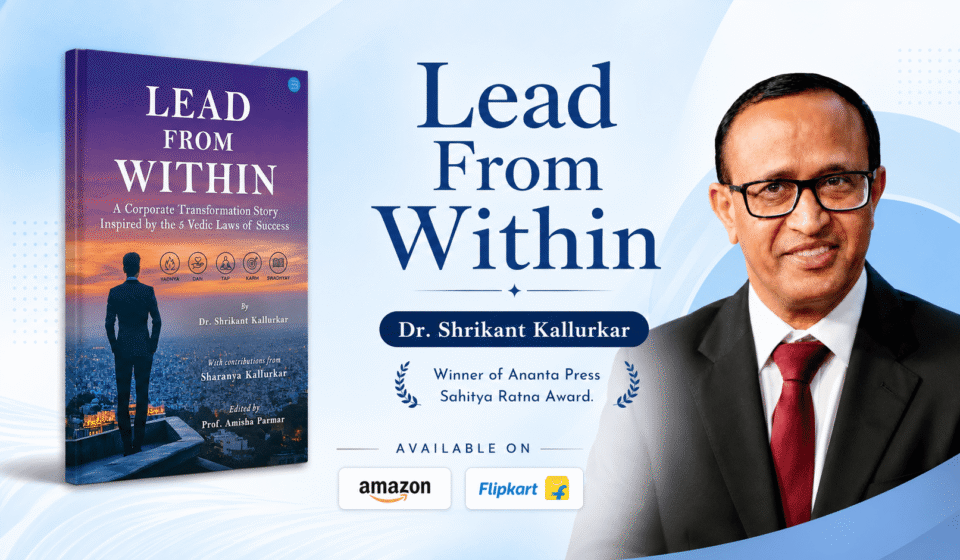

Lead From Within: A Corporate Transformation Story by 5 Vedic Laws of Success is built around an ambitious challenge: how can ideas rooted in Vedic wisdom speak meaningfully to a contemporary professional dealing with deadlines, workplace politics, exhaustion, insecurity, performance expectations, and the pressure to remain relevant? Dr. Shrikant Kallurkar approaches this challenge not by asking the reader to leave the modern workplace behind, but by bringing ancient frameworks directly into it. The book’s most distinctive achievement is this act of translation. It takes concepts that might otherwise appear philosophical or distant and shows how they can become a practical language for self-regulation, ethical action, discipline, contribution, reflection, and leadership.
The book’s protagonist, Michael Smith, is important because he is not introduced as someone who lacks intelligence or employable skill. He is a capable Cyber Security Engineer. He works hard and produces strong technical results. His difficulty is more subtle: the person behind the performance has become depleted. He works late, neglects his health, lacks confidence in meetings, feels overlooked, and sees others advancing while he remains professionally stagnant. In this condition, the book recognizes a truth that many organizations only notice after performance has already deteriorated: professional difficulty is often multidimensional. A person can be technically competent and still be functioning poorly because energy, emotional balance, confidence, judgment, or purpose have weakened.
The Panchakosha framework gives this multidimensional view a structure. Annamaya Kosha directs attention toward the body and physical vitality. In a workplace culture that sometimes treats sleep, recovery, food, and health as secondary to output, this is a significant starting point. The book’s message is clear: the body is not simply the vehicle that transports the professional to work; it is part of the system through which concentration, endurance, emotional control, and judgment become possible. By beginning with physical foundation, the book resists the tendency to solve every problem with motivation.
Pranamaya Kosha brings breath and energy into the discussion. This may initially sound less conventional in a corporate context, yet it becomes highly relevant when connected to pressure and emotional regulation. A person under stress often reacts before thinking. Breath becomes short, the body becomes tense, and the mind moves rapidly toward fear or defensiveness. By presenting conscious breathing as part of self-leadership, the book makes a traditional idea concrete. The pause between stimulus and response is not presented merely as an inspirational concept; it is connected to a physical process that can be noticed and trained.
Manomaya Kosha addresses the mind: thoughts, fears, assumptions, interpretations, and habitual patterns. This part of the model is especially powerful for professionals because so much workplace behaviour is shaped by private narratives. “My idea will not be valued.” “I should stay quiet.” “Others are better positioned than I am.” “If I make a mistake, I will lose credibility.” Such thoughts can alter behaviour long before anyone else sees the internal struggle. Smith’s hesitation and shrinking presence become understandable through this lens. The book encourages readers to examine not only what is happening around them but also the interpretations through which they experience it.
Vijnanamaya Kosha takes the discussion beyond thought into discernment, values, and wisdom. Modern professional life often rewards speed, but speed without discernment can produce poor decisions. A technically possible action may not be the right action. A politically convenient response may not be the ethical one. A short-term gain may damage trust. By placing wisdom within the model of professional performance, Lead From Within makes ethics and judgment central rather than optional. This is especially relevant for managers, engineers, educators, entrepreneurs, and professionals whose decisions can affect others.
Anandamaya Kosha completes the inner framework with purpose, fulfilment, and joy. This is perhaps the most neglected element in conventional career advice. Professionals are often encouraged to set goals but less frequently asked what kind of life those goals are intended to create. The book does not imply that every working day must feel joyful. Instead, it places meaningfulness within the architecture of sustainable excellence. Without some connection to purpose, ambition can become mechanical, and achievement can fail to produce fulfilment.
The Five Vedic Laws of Success then move the reader from inner understanding to outward practice. Yadnya, expressed as contribution, offers an alternative to a purely transactional view of work. The principle does not deny the importance of recognition, compensation, or advancement. Rather, it asks whether the professional identity is built only around what one receives or also around the quality of what one contributes. This is a subtle but important shift because contribution is one of the few aspects of professional life that remains within the individual’s control even when recognition is uncertain.
Dana is interpreted as giving and kindness: appreciation, respect, time, patience, and support. This makes the concept highly relevant to organizational culture. Many workplaces speak about collaboration while rewarding individual competition. Dana introduces the idea that generosity can be a professional strength. Giving credit, listening carefully, helping a colleague, or responding with patience can strengthen trust and influence. The law therefore expands the meaning of leadership beyond command and decision-making into the quality of everyday interactions.
Tapa becomes discipline and stability. In modern productivity culture, discipline is often imagined as relentless effort. Lead From Within gives it a more balanced meaning: consistency, restraint, and steadiness under pressure. This interpretation is valuable because professional maturity is often visible not in how someone behaves when conditions are easy, but in how they remain composed when conditions are difficult. Discipline becomes the ability to maintain constructive behaviour even when emotion encourages a less useful response.
Karma, presented as right action, may be the most important bridge between philosophy and professional ethics. The book distinguishes action from mere activity. Being busy is not the same as acting responsibly. Right action requires courage, integrity, ownership, and an understanding of consequences. This distinction can challenge professionals who measure their value primarily by workload. The question becomes not “How much did I do?” but “Was what I did necessary, responsible, and aligned with my values and purpose?”
Swadhyaya, self-reflection, completes the cycle. Without reflection, experience does not automatically become learning. A professional can repeat the same patterns for years while accumulating experience but not wisdom. Self-observation allows the reader to notice triggers, strengths, habits, assumptions, and recurring mistakes. In Smith’s case, transformation becomes possible when he stops seeing every problem as something happening outside him and begins to examine his own participation in his stagnation. This is not self-blame; it is self-responsibility, and that distinction is central to the book’s philosophy.
What makes Lead From Within especially useful is the relationship between the two frameworks. The Five Koshas are not simply another list placed beside the Five Vedic Laws. They perform different functions. The Koshas help the reader understand the inner condition from which behaviour arises. The Vedic Laws guide the outward expression of a more stable inner condition. The formula presented in the book – Five Koshas for inner stability, Five Vedic Laws for outer excellence – gives readers a memorable way to hold the entire argument together.
The story format prevents this structure from becoming overly academic. Smith’s professional frustration, his painful loss of recognition, and the moment when he is told that he is shrinking make the ideas emotionally understandable. Readers can see why a framework is needed before they encounter it. The narrative also reduces the distance between Vedic terminology and everyday experience. Instead of asking readers to accept philosophical concepts first, the book presents a recognizable problem and then offers a language for understanding it.
Dr. Kallurkar’s long experience in engineering education, academic leadership, research, mentoring, entrepreneurship, and institutional development is relevant here. His work reflects sustained engagement with professionals, students, scholars, and organizations. The development of Vedic Success Systems appears to grow from that practical background. The objective is not to preserve ancient ideas in isolation but to test their relevance against modern questions: stress, leadership, decision-making, career direction, wellbeing, and ethical responsibility.
For readers interested in Indian Knowledge Systems, the book offers a contemporary application rather than a purely historical discussion. For readers unfamiliar with Vedic thought, it offers an accessible entry point because the concepts are connected to recognizable professional experiences. For corporate readers, it expands the idea of performance. For educators, it provides a framework for holistic development. For managers and leaders, it suggests that organizational influence begins with personal regulation and ethical clarity.
Lead From Within is unique because it refuses the false choice between ancient wisdom and modern professional life. It treats them as two bodies of insight that can inform each other. The book argues, in effect, that a twenty-first-century workplace problem may still require a timeless human answer: understand your body, regulate your energy, observe your mind, strengthen your discernment, reconnect with purpose, contribute generously, act with discipline, choose what is right, and keep reflecting. That combination gives the book both cultural depth and practical relevance.
Amazon link: https://www.amazon.in/Lead-Within-Corporate-Transformation-Inspired/dp/9378256465/ref=tmm_pap_swatch_0