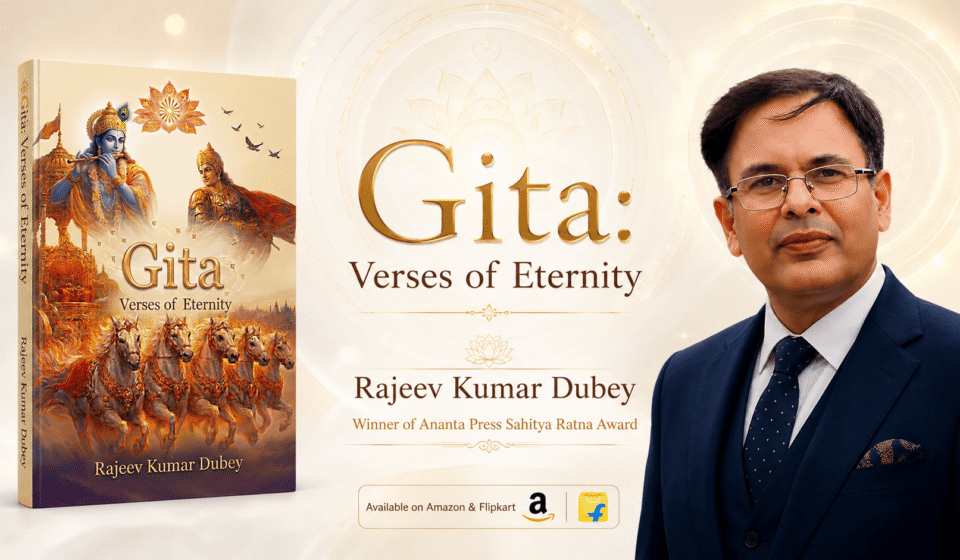

Gita: Verses of Eternity by Rajeev Kumar Dubey is distinctive because it approaches one of India’s most influential philosophical texts through the language of poetry. That choice matters. The Bhagavad Gita has always carried both intellectual depth and lyrical force, yet for many contemporary readers its Sanskrit verses, layers of interpretation, and traditional commentaries can create a sense of distance. Dubey’s work responds to that distance not by reducing the Gita to a list of lessons, but by returning to verse as a means of connection. The result is a literary project that places accessibility and poetic feeling at the centre of spiritual reflection.
The most interesting quality of the book is the relationship it builds between form and purpose. Poetry is uniquely suited to ideas that are at once philosophical and emotional. Concepts such as duty, detachment, self-knowledge, discipline, purpose, and spiritual balance can be explained in prose, but poetry allows them to be felt. A poem does not always insist on a single interpretation; it can create space around an idea. It can slow the reader down. It can leave behind an image, rhythm, or phrase that continues working in the mind after the page has been turned. For a book inspired by the Gita, this contemplative quality is especially valuable.
Dubey’s aim is clearly reader-oriented. The work is intended for first-time readers of the Gita, seekers from different backgrounds, professionals dealing with ethical choices, young people searching for meaning, and anyone drawn to reflective literature. This wide audience reveals an important principle behind the book: wisdom becomes culturally alive when it can be encountered rather than merely inherited. A classic can be revered so deeply that people become hesitant to approach it. Gita: Verses of Eternity attempts to remove some of that hesitation. It tells the reader, in effect, that the conversation is still open.
That idea of an open conversation is one of the book’s strongest literary and philosophical features. The setting of the original Gita is ancient, but the psychological condition it addresses is timeless: a human being confronted by a situation in which emotion, duty, identity, and consequence collide. That crisis is not limited to epic history. Modern life repeatedly places individuals in situations where they must choose between comfort and responsibility, impulse and principle, fear and action. By translating the spirit of these dilemmas into accessible poetry, Dubey allows the battlefield to become a metaphor for the reader’s own difficult decisions.
The book also benefits from resisting the mistaken assumption that spiritual life is separate from active life. Its stated orientation emphasises engagement rather than escape. This gives the poetry practical relevance. Spirituality here is not simply a private mood or a retreat from responsibility; it is a way of understanding how to participate in the world. That distinction is crucial for contemporary readers who may be managing careers, family life, leadership, education, or public responsibilities. The deeper question is not how to avoid complexity, but how to meet complexity without losing moral direction or inner balance.
From a literary perspective, the project has a pleasing circularity: a text born in verse inspires a new poetic response centuries later. Yet this is not merely imitation. The modern poet writes for readers shaped by different habits of language and attention. That makes accessibility an artistic challenge. A successful adaptation of spiritual ideas must avoid two extremes: becoming so simplified that the philosophy loses depth, or becoming so ornate that the reader once again feels excluded. The concept behind Gita: Verses of Eternity seeks a middle path by using poetry to preserve dignity and reflection while remaining emotionally approachable.
Rajeev Kumar Dubey’s personal profile makes the work particularly intriguing. Professionally, he is a Professor of Anaesthesiology at the Institute of Medical Sciences, Banaras Hindu University, and his academic background includes anaesthesiology, critical care, and hospital administration. At the same time, he is a poet who has long followed Indian culture, literature, and history, with particular interests in the Gita, spirituality, meditation, and yoga. His poems have appeared in literary journals, have been presented on literary and poetic platforms, and have been broadcast by All India Radio. This dual life gives the book a distinctive sensibility.
Medicine and poetry may appear to belong to different worlds, but they share a concern with human experience. Medicine encounters the body under pressure; poetry encounters language under pressure. Critical care places professionals close to uncertainty, mortality, responsibility, and hope. Poetry offers a way to contemplate precisely such conditions without turning them into statistics. In Dubey’s case, his scientific and medical training coexists with a sustained interest in spiritual and cultural traditions. The book can therefore be read as the work of someone accustomed both to disciplined knowledge and to reflective inwardness.
His stated poetic concerns—truth, social harmony, universal brotherhood, and human values—also align naturally with the inclusive spirit of this volume. The Gita has been interpreted through many philosophical schools, but its continued relevance often comes from its ability to provoke self-examination. A reader does not have to agree with every metaphysical interpretation to ask meaningful questions about intention, action, ego, duty, and self-mastery. By presenting these themes through poetry, Dubey creates a space in which the reader can reflect before deciding what the ideas mean personally.
This is also why the book has potential appeal to younger readers. Many young people encounter inherited wisdom in fragmented ways: quotations on social media, motivational references, or brief summaries detached from context. Gita: Verses of Eternity offers a more sustained encounter while remaining approachable. Poetry can become a bridge between the brevity of modern reading habits and the depth of classical thought. It invites readers to pause without demanding that they begin with academic commentary.
The uniqueness of the book rests not in claiming ownership over the Gita’s wisdom but in creating a contemporary literary route toward it. This is an important distinction. Great source texts endure partly because each generation finds new forms through which to hear them. Translation, commentary, performance, storytelling, scholarship, and poetry all participate in that process. Dubey contributes to this living tradition by emphasising poetic accessibility.
Readers who appreciate reflective poetry will find the premise especially appealing because the book treats philosophical insight as something to be experienced aesthetically. Readers interested in Indian thought may value the work as an introductory or companion volume. Professionals may recognise ethical tensions mirrored in their own lives. Seekers may appreciate its meditative orientation. And readers already familiar with the Gita can encounter familiar themes through the fresh lens of a contemporary poet.
Ultimately, Gita: Verses of Eternity stands out because it understands that accessibility is not the enemy of depth. When done thoughtfully, making an idea approachable can be an act of respect: it gives more people the opportunity to engage seriously with it. Rajeev Kumar Dubey’s poetic project invites readers to approach ancient wisdom without fear of inadequacy, to listen for what remains relevant, and to allow the old dialogue between uncertainty and understanding to continue in their own lives.
Amazon purchase link: https://amzn.in/d/0e2udQ4o