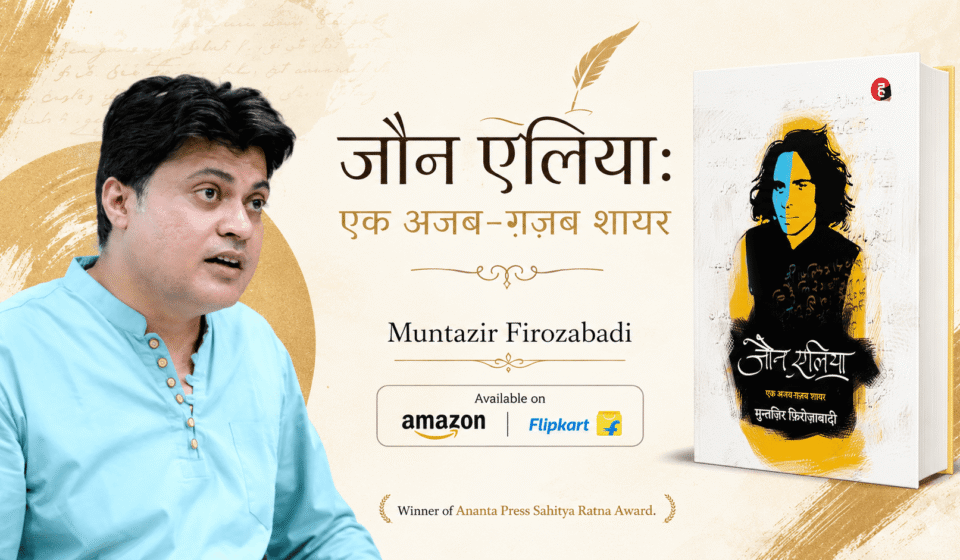

Book: Jaun Elia: Ek Ajab Ghazab Shayar | Author: Muntazir Firozabadi (Anant Bhardwaj) | Category: Poetry
Jaun Elia: Ek Ajab Ghazab Shayar can be read as a book about one poet, but its larger achievement is that it opens a conversation about the changing life of Urdu poetry itself. Muntazir Firozabadi places Jaun Elia at a fascinating crossroads: behind him stand the immense traditions associated with Mir, Momin, Ghalib, Faiz, Khumar and others; before him stands a contemporary generation that encounters poetry on phones, stages, video clips, literary portals, and social media. Jaun’s extraordinary popularity across these worlds makes him more than an individual poet. He becomes a bridge, and this book is most compelling when it helps the reader see how that bridge works.
The author’s description of newer poets increasingly gravitating toward Jaun’s stylistic orbit points to an important literary reality. Influence is not merely a matter of copying vocabulary or cadence. A major poet changes what later writers believe poetry is allowed to do. Jaun expanded the emotional permission available to the ghazal-reading public: he could sound irritated, sarcastic, self-destructive, argumentative, philosophical, romantic, and almost conversational without surrendering poetic intensity. In his work, elegance could coexist with abrasion. For younger poets, that mixture can feel liberating because it offers an alternative to polished sentimentality.
This is where the book’s multi-form structure becomes important. By including ghazals, nazms, qata’at, and material connected to ‘Jauniyat,’ Firozabadi does not confine Jaun to one familiar poetic posture. Readers are encouraged to experience range. The ghazal may reveal the compression and paradox for which Jaun is celebrated; the nazm can permit broader movement of thought; qata’at offer another kind of sharpness; and the personality-focused passages provide human and cultural context. Together, these forms suggest that Jaun’s appeal is not reducible to a single mood, even though melancholy and rebellion remain central to his public image.
One of the book’s greatest strengths is its awareness that reading Jaun is an accumulative experience. The supplied introduction memorably suggests that the more one reads him, the more he opens up, until a kind of addiction or thirst develops. This metaphor is useful because Jaun’s poetry often works through recurrence. Similar anxieties return in different forms: the failure of love, dissatisfaction with the self, mistrust of certainty, estrangement from society, intellectual pride, metaphysical unease, and the strange comedy of being conscious. A single famous sher may charm a reader, but repeated reading reveals a much larger architecture of temperament.
The title, Ek Ajab Ghazab Shayar, is well chosen because ‘strange’ and ‘extraordinary’ capture the difficulty of categorizing Jaun. He was deeply learned, but he could cultivate the tone of someone impatient with solemnity. He could be emotionally extravagant while intellectually dissecting that very emotion. He could sound intensely personal and yet touch experiences shared by a wide audience. Such contradictions are not flaws to be solved; they are the source of his magnetism. Firozabadi’s book appears to understand that the most faithful portrait of Jaun is one that preserves contradiction rather than smoothing it out.
The historical dimension adds another layer. Jaun was born in Amroha and eventually made Karachi his home. That trajectory connects him to the history of Partition, migration, and the divided-yet-shared cultural world of Hindi-Urdu letters. Readers in India and Pakistan continue to claim him with affection, demonstrating how literary language can ignore political borders more successfully than institutions often do. A book written in India about a poet whose later life unfolded in Pakistan is therefore itself part of an ongoing cross-border literary conversation.
Muntazir Firozabadi is particularly well suited to this mediating role because his work occupies the Hindi-Urdu interface. His participation in literary festivals, mushairas, digital platforms, radio projects, podcasts, and literary discussions indicates familiarity with both traditional and contemporary modes of cultural transmission. His association with Rekhta situates him within one of the most visible modern ecosystems devoted to Urdu literature. Meanwhile, his work on other poets suggests an archival instinct: he is interested in keeping literary personalities alive for new generations, not merely celebrating them nostalgically.
The book also has pedagogical value. A reader who has heard Jaun’s name but lacks a systematic entry point can use this volume to develop a more informed relationship with his work. Because it combines poetic material and personality-oriented context, the reader does not need to begin with an academic biography or a technical study of poetics. The book can function as an accessible first encounter, after which readers may seek Jaun’s complete collections, recordings, interviews, or more specialized criticism. Good introductory books do not replace deeper reading; they create the desire for it. This one is positioned to do exactly that.
At the same time, seasoned admirers may appreciate the attention to ‘Jauniyat.’ Long-time readers often know that Jaun’s public persona has become part of his reception history. Stories about his temperament, performance style, beliefs, friendships, disappointments, and uncompromising speech circulate almost like oral literature. Bringing some of these facets into a book recognizes that modern literary reputation is shaped not only by printed texts but also by remembered presence. Jaun’s delivery, gestures, pauses, and dramatic self-presentation have affected how his verses are heard. A purely textual account would therefore feel incomplete.
The concept of rebellion is handled best when understood broadly. Jaun’s rebelliousness is not only political or social; it is also rhetorical and existential. He resists emotional clichés. He challenges the dignity with which poets are expected to suffer. He sometimes turns the poetic self into an object of ridicule. He can expose the absurdity inside romantic despair even while experiencing that despair intensely. This ability to break the expected emotional script is one reason his poetry feels contemporary. Firozabadi’s characterization of his rule-breaking instinct helps readers notice this deeper form of rebellion.
Another distinctive aspect is the way philosophy enters the discussion without turning the book into abstract commentary. Jaun’s poetry frequently gives the impression of a mind unable to stop thinking, even when thinking worsens the wound. This is an important part of his uniqueness. Many love poets dramatize feeling; Jaun often dramatizes the argument inside feeling. Desire interrogates itself. Loss becomes a philosophical problem. The self watches itself suffering and then mocks the spectacle. A collection that places this dimension alongside the emotional and biographical one can help readers understand why his writing rewards rereading.
In the current literary environment, where poetry is often consumed as instantly shareable content, Jaun’s popularity can create both opportunity and distortion. The opportunity is obvious: millions of readers who might otherwise ignore Urdu poetry are drawn toward it. The distortion occurs when complexity gets flattened into captions. Jaun Elia: Ek Ajab Ghazab Shayar works against that flattening by gathering multiple modes of encounter in one volume. It asks readers to remain with the poet for longer than the duration of a scroll.
The book is therefore valuable not only because Jaun Elia is important, but because the manner of presenting him matters. Firozabadi’s project connects admiration to context, popularity to literary inheritance, and personality to poetic form. That synthesis makes the book useful across generations. Older readers may recognize the lineage of Urdu poetry within it; younger readers may recognize the rebellious voice that first drew them to Jaun. Both can meet in the same pages.
As a result, Jaun Elia: Ek Ajab Ghazab Shayar stands out as a cultural bridge disguised as a poet-centered volume. It shows how a twentieth-century Urdu poet continues to shape twenty-first-century taste, how literary memory travels across India and Pakistan, and how a distinctive personality can keep a poetic tradition alive in new formats. For anyone interested in the continuity and reinvention of Hindi-Urdu literary culture, this book offers a lively, affectionate, and thought-provoking point of entry.
Amazon purchase link: https://amzn.in/d/09j2BZ3r