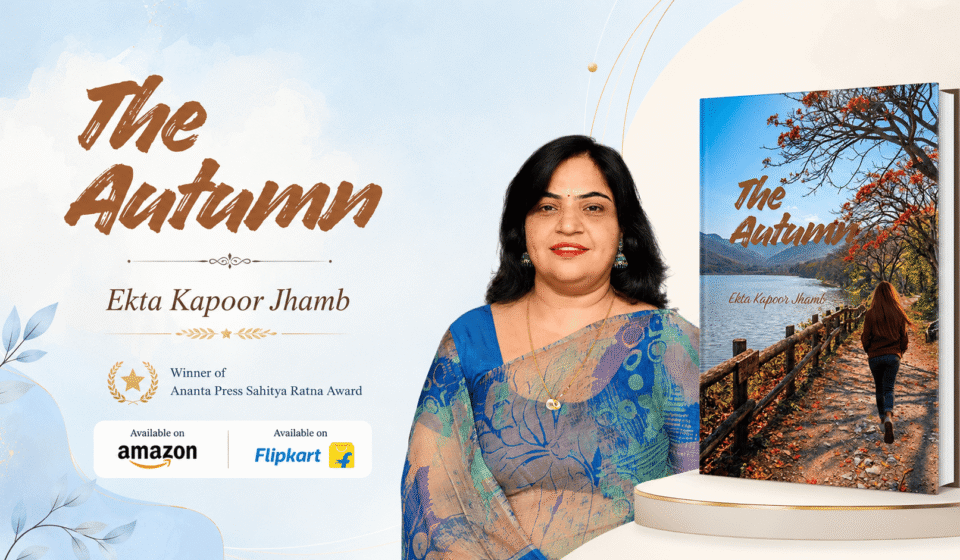

At the center of The Autumn is a woman whose intelligence is not simply an attractive character trait; it is part of the emotional problem the novel is designed to explore. Aaradhya is meticulous, highly intelligent, and accustomed to taking life seriously. She enters love with Kabir, a man described as her match, and that equality gives the relationship an immediate spark. Yet Ekta Kapoor Jhamb’s novel is most interesting when read not as a straightforward romance but as a story about what happens to a woman’s sense of self when the future she has carefully imagined begins to resist her plans. In that sense, The Autumn is a novel of self-recovery disguised, beautifully, as a love story.
Aaradhya’s characterization appeals because competence is not treated as immunity. Popular fiction sometimes makes intelligent women emotionally invincible, as if confidence in one area of life should automatically translate into certainty everywhere else. Jhamb’s premise takes the opposite route. A meticulous mind can become even more vulnerable in situations that cannot be optimized. Love, grief, family expectations, and social pressure do not follow a clean formula. When Aaradhya and Kabir struggle to remain in orbit, the issue is not a lack of intelligence. Their difficulty exposes the limits of intelligence as a tool for controlling emotional life.
The image of orbit is central to the book’s appeal. Two people may be drawn to each other by admiration, memory, history, and emotional gravity, yet proximity does not guarantee stability. Orbits depend on motion; they are never truly still. By describing Aaradhya and Kabir as people who struggle to stay in orbit, the novel suggests a relationship that is alive but under pressure. For Aaradhya, this instability forces a confrontation with a difficult question: if a relationship changes, does that mean she has failed, or can change become the beginning of a more honest understanding of herself? The distinction matters because many women are socialized to take disproportionate responsibility for maintaining emotional harmony.
The author materials deepen this reading by describing the hardships around the relationship as family expectations, personal loss, and pressure to conform. These are not random complications. Each one tests a different layer of identity. Family expectations ask who Aaradhya is in relation to others. Personal loss asks what remains when something valued disappears. Pressure to conform asks whether belonging is worth the cost of self-suppression. Taken together, these forces create a credible emotional environment for a character who must gradually move from fixing circumstances to understanding herself.
This is where the idea of “unraveling” becomes especially powerful. The provided description says that even when life tries to shrink Aaradhya, she keeps unraveling herself – questioning old beliefs, healing, and choosing who she wants to become. Unraveling can sound destructive, but in the context of the novel it carries a second meaning: loosening knots that have been pulled too tight. Aaradhya’s progress does not necessarily require her to become an entirely different person. It may require her to separate inherited beliefs from chosen values, fear from loyalty, and effort from self-erasure. That is a psychologically rich foundation for contemporary women’s fiction.
The Autumn is also strengthened by the fact that Aaradhya’s journey is not isolated from place. Ekta Kapoor Jhamb has made Indore – the city that became her home after marriage – the emotional and geographical setting of her fiction. That local connection matters because personal transformation is never completely private. Cities contain families, institutions, social circles, workplaces, memories, and expectations. A woman deciding who she wants to become is not doing so in a vacuum. She is making that choice while moving through familiar roads and relationships that may still reflect earlier versions of her. A rooted setting therefore increases the emotional credibility of the book’s central struggle.
Jhamb’s career as an educationist also helps explain the clarity of the themes she chooses. Her professional work has involved teaching English, encouraging discussion, developing curriculum, mentoring teachers, and helping students trust their own voices. The Autumn’s focus on self-definition feels consistent with that worldview. Aaradhya’s challenge is, in a sense, also a challenge of voice: can she identify what she truly thinks and wants when competing expectations are loud around her? Fiction becomes especially effective when the thematic question grows naturally from character, and here the relationship between voice, choice, and recovery appears integral to the protagonist’s arc.
Aaradhya is additionally interesting because strength is not simplified into toughness. The author’s stated pattern across her fiction is to write women who choose to stand. In The Intruder, that stance was directed against a devastating external wrong; in The Autumn, it becomes an internal and relational act. Standing can mean remaining present with pain, refusing to disappear inside another person’s needs, or allowing an old certainty to change. This broader definition of strength makes Aaradhya more relatable than a heroine who simply defeats every obstacle. She can be intelligent, wounded, loving, uncertain, and strong at the same time.
Kabir’s role within this character-centered reading is important precisely because he is not described as inferior to Aaradhya. He is her match and the architect of many of her favorite memories. If the central relationship were obviously unequal in intellect or feeling, Aaradhya’s decision-making would be much easier. Instead, the attraction makes sense. The memories make sense. The wish to preserve the relationship makes sense. That is what gives the conflict emotional weight. Readers are not being asked to wonder why she cares; they are invited to understand why caring may not be enough to freeze a relationship in its happiest form.
The title The Autumn beautifully supports Aaradhya’s internal movement. Autumn is often misunderstood as simply a season of endings, yet it is also a season of revelation. Trees become visually striking while they are letting go. Landscapes change color before becoming spare. In symbolic terms, autumn can represent the moment when a person stops pretending that everything must remain green forever. Aaradhya’s journey toward healing and self-choice fits this image. She is not necessarily becoming less loving; she is becoming more capable of accepting that change does not invalidate what came before.
For readers, especially women who have lived through the tension between personal choice and familial or social expectation, this dimension can be deeply resonant. The book’s value lies in acknowledging how exhausting it can be to carry the belief that every important relationship must be saved through personal effort. The “fixer” identity is often praised because it looks like loyalty, maturity, or care. The Autumn asks readers to examine the hidden cost. What happens when fixing becomes the only permitted response? What happens when a woman cannot admit that she is tired, changing, or no longer willing to inhabit an old version of herself?
The novel therefore occupies an appealing space between romance and reflective women’s fiction. It contains the emotional magnetism of a relationship between two matched individuals, but its deeper movement is toward self-knowledge. Aaradhya’s story can be read as an argument for a more compassionate definition of resilience. Resilience is not always returning to exactly what existed before. Sometimes it is the ability to reorganize one’s life after loss, reconsider old beliefs, and choose differently without denying the sincerity of earlier choices.
The Autumn stands out because it allows its heroine to be both a lover and a person in transformation. Ekta Kapoor Jhamb does not reduce Aaradhya to a romantic role; the provided description makes her recovery and evolving selfhood central to the novel’s purpose. Readers looking for fiction about emotionally intelligent women, contemporary Indian relationships, and the complicated boundary between persistence and self-preservation are likely to find much to consider here. Aaradhya’s autumn is not merely a decline from summer. It is the season in which she learns that becoming herself may require letting certain ideas fall away.
Amazon purchase link: https://www.amazon.in/dp/B0H2WGRVX3