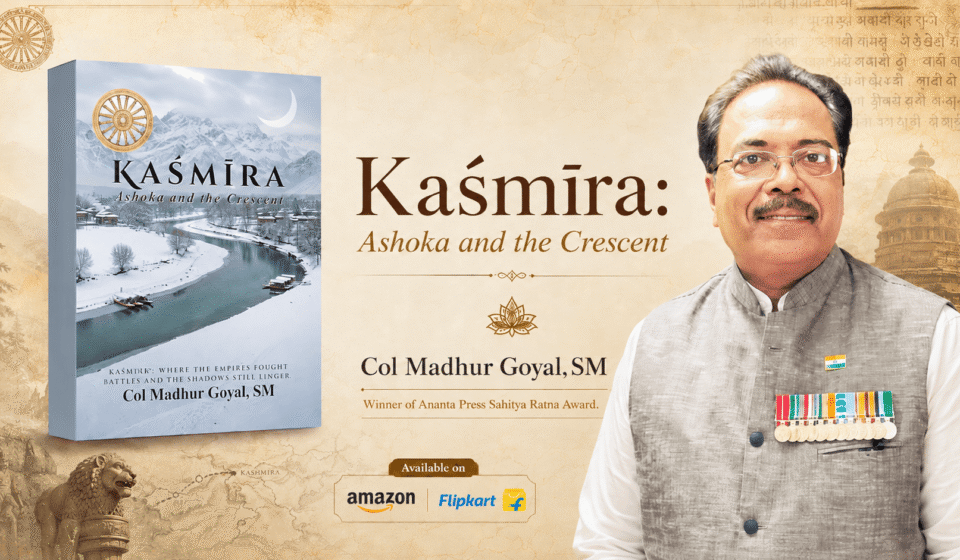

Book: Kaśmīra: Ashoka and the Crescent | Author: Col Madhur Goyal, SM
Many books about Kashmir begin with conflict. Kaśmīra: Ashoka and the Crescent chooses a more revealing starting point: it begins with the land and then moves into the beliefs, kingdoms and cultural currents that gave the valley its historical personality. This makes Col Madhur Goyal, SM’s work especially interesting for readers who want to understand Kashmir not only as a strategic problem but as a civilisation whose beauty, spirituality and geography have repeatedly shaped its political destiny.
The book’s decision to begin with mountains, rivers and physical geography is more than an introductory flourish. In Kashmir, landscape has always influenced history. The valley’s snowbound peaks create both protection and isolation. Rivers sustain communities and routes of movement. Mountain passes open pathways for traders, armies, pilgrims and ideas, yet they can also close suddenly under weather and war. In the modern period, the same terrain becomes central to military planning, border disputes and high-altitude deployments. By treating geography as an active force, Kaśmīra establishes an important principle early: in this region, the map is never merely a map. It is part of the story.
This geographical foundation allows the book to move naturally into the valley’s ancient and religious history. Buddhism, Hinduism, Sikhism, Islam and Sufism appear as major traditions in the long evolution of Kashmir. Such a structure is valuable because it avoids flattening the valley into a single religious identity or a single political era. Instead, Kashmir emerges as a layered space where belief systems, political powers and cultural practices have overlapped, replaced one another, influenced one another and left enduring memories behind.
The book’s emphasis on Sufism is particularly significant within this framework. Sufi traditions have often been associated with mystical devotion, poetry, spiritual interiority and forms of cultural exchange. In a work concerned with conflict, this spiritual dimension provides necessary contrast. It reminds the reader that Kashmir has also been a landscape of shrines, prayer, philosophical reflection and sacred imagination. Snowbound peaks and glacial battlefields stand beside places where generations have searched for meaning. This juxtaposition between faith and fire gives the book much of its emotional character.
The title, Kaśmīra: Ashoka and the Crescent, deepens this civilisational approach. “Ashoka” is not merely a name from the ancient past; within the book’s symbolic framework it comes to represent India’s vision of unity and a historical idea of integration. “The Crescent” evokes Pakistan’s ideological and religious identity and its claim regarding self-determination. As the narrative moves forward, the “Dragon” represents China’s strategic calculus. These symbols are effective because they transform abstract geopolitical actors into memorable conceptual images. They also show how the valley is repeatedly interpreted by external powers through different ideas of history, sovereignty and strategic interest.
One of the book’s central achievements is to show how these historical layers survive beneath modern political events. Maharaja Hari Singh’s dilemmas at the moment of Partition, the violence surrounding the division of the subcontinent and the conflict beginning in 1947 are not presented as the origin of all Kashmiri history. Rather, they are a dramatic new phase in a much older story. The wars of 1965 and 1971, the rise of militancy in 1989, the exodus of Kashmiri Pandits, the Kargil War and later developments are therefore read against a background of older identities and memories.
This makes the book’s treatment of the Kashmiri Pandit exodus especially important within its broader theme of civilisational continuity. Displacement is not merely a demographic statistic; it is a rupture in the relationship between community, memory and place. When people are forced to leave landscapes that contain their temples, neighbourhoods, family histories and inherited cultural worlds, the loss becomes more than physical. A book that wants to explore Kashmir’s soul must necessarily confront the pain of such ruptures. At the same time, the book’s stated attention to diverse Kashmiri voices prevents the valley from being reduced to a single community’s experience. Kashmir’s tragedy is partly the coexistence of multiple legitimate memories of suffering, fear and aspiration.
The military chapters extend this relationship between land and human experience. Siachen, described as the “Frozen Battlefield,” represents perhaps the most extreme example of geography becoming destiny. Soldiers there confront not only an adversary but temperatures, altitude, ice and avalanche. The frozen landscape that appears breathtaking from afar becomes physically punishing when inhabited as a military post. Col Goyal’s own Army career gives this part of the subject unusual immediacy. His service included Siachen and multiple tenures connected with Kashmir, and he received the Sena Medal for Gallantry after an anti-terrorist operation in Budgam. His background therefore makes the book’s movement from beauty to battlefield feel personal rather than purely academic.
The same pattern appears in Aksai Chin. The region is described as silent and barren, yet its strategic significance is immense. Through the 1962 war with China and contemporary strategic concerns such as the China-Pakistan Economic Corridor, the book shows how remote terrain can become central to national policy. What appears empty on the ground may be dense with military meaning. Here again, geography and geopolitics become inseparable.
What I found most compelling about the book’s concept is its refusal to let any single period monopolise Kashmir’s identity. The valley existed before modern nationalism, and its cultural memory is larger than any one border dispute. Yet the book also does not romanticise the past as though spiritual traditions automatically prevented conflict. Faith, empire and politics have all left marks on the region. The result is a more mature portrait: Kashmir as a place of beauty and devotion, but also conquest, displacement, rivalry and trauma.
For readers who are tired of simplified political arguments, this layered approach is valuable. Kaśmīra does not ask us to forget contemporary disputes; it asks us to locate them within a much longer historical continuum. It reminds us that political boundaries are drawn across landscapes already filled with memory. It also shows that identities are rarely created in a single moment. They emerge through centuries of religious practice, cultural exchange, political rule, migration, warfare and storytelling.
The book’s final question – whether a land of faith and fire can find peace beyond the shadows of history – therefore feels earned rather than ornamental. Faith and fire are not simply poetic opposites. They describe two enduring realities of Kashmir: the search for transcendence and the persistence of conflict. Peace, in this framing, would require more than an absence of gunfire. It would require a way of acknowledging layered histories and competing memories without allowing them to become permanent weapons against the future.
This is where the book’s broader human value becomes clear. Its subject is Kashmir, but its themes are universal. Many regions around the world live under the pressure of inherited conflict, contested borders, displaced communities and sacred histories. Kaśmīra shows how difficult it is to separate identity from territory when both have been shaped by centuries of memory. It also suggests why durable peace cannot be built through strategy alone; it must somehow make room for human belonging.
Kaśmīra: Ashoka and the Crescent stands out because it approaches Kashmir as more than a dispute to be solved. It treats the valley as a civilisation to be understood. That change of emphasis is significant. Readers may come to the book for history or geopolitics, but they are likely to leave thinking about mountains, shrines, migrations, soldiers, families and the many ways a place can live inside the people who call it home. In a public conversation often dominated by certainty, this book’s greatest invitation is to look longer, think historically and recognise the depth beneath the headlines.
Amazon: https://amzn.in/d/2VeZbFr