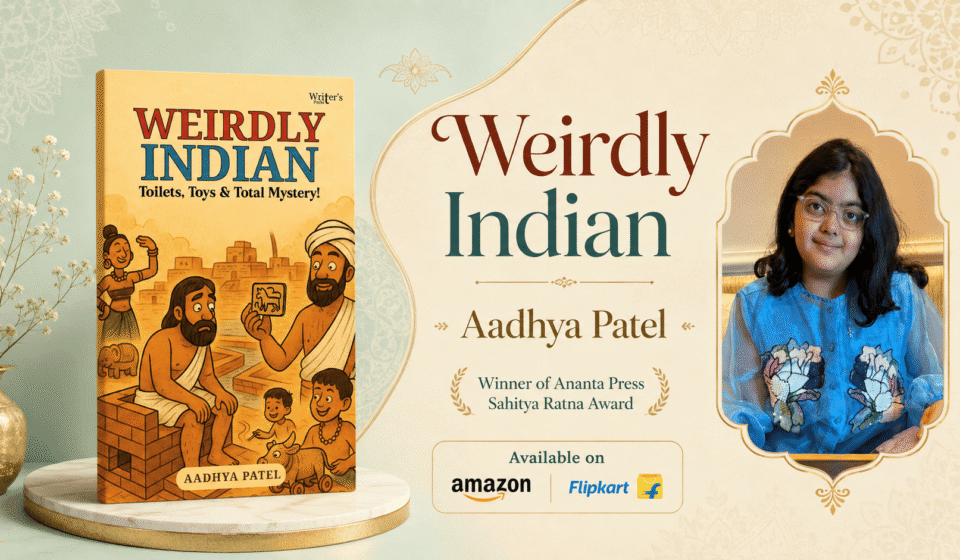

What happens when a young writer looks at an ancient civilization and refuses to ask only the questions that textbooks usually ask? Weirdly Indian – Toilets, Toys & Total Mystery! is the answer. Aadhya Patel’s book is not simply a retelling of the Indus Valley Civilization for younger readers. It is a reorientation of the subject. It shifts attention away from what children are often told they must remember and toward what they genuinely want to know. That child’s-eye perspective is what gives the book its freshness.
A conventional history chapter might begin with the dates of the civilization, the location of Harappa and Mohenjo-daro, and a summary of urban planning. Patel’s approach is more intimate. She asks readers to imagine the people behind the ruins. Did children have toys? What did homes look like? How did people manage toilets and drains? What did they eat? What kinds of objects did they wear, make, exchange, and leave behind? The civilization becomes understandable because it is approached through human routines. For children, this is an especially effective bridge between the present and the distant past.
The title is a clever statement of intent. “Toilets” immediately overturns the expectation that history must be grand and solemn. “Toys” introduces play, childhood, and familiarity. “Total Mystery” opens the door to investigation. Together, the three ideas capture the book’s larger argument: the past is found in ordinary things, the people who lived long ago were human in recognisable ways, and many of their secrets are still unsolved. The title is playful, but it is also surprisingly accurate as a summary of the book’s method.
A major quality of Weirdly Indian is its ability to make scale understandable. The Indus Valley Civilization flourished thousands of years ago, which can feel almost unimaginable to a child. Patel narrows that intimidating distance by focusing on concrete objects. A drain can be pictured. A seal can be examined. A toy can be compared with a modern toy. A brick can be held in the imagination. Once the reader has entered the world through these objects, larger ideas—city organisation, trade, technology, agriculture, and archaeology—become easier to grasp.
This object-centred approach also gives the book an unusual emotional texture. A broken toy does not merely provide information about material culture; it suggests a child. Jewellery suggests taste and identity. Cooking and farming tools suggest meals and labour. Toilets and drainage systems suggest privacy, planning, health, and the unglamorous work required to make a city function. These details make ancient people feel less remote. They are not anonymous figures frozen behind museum glass. They are families, workers, craftspeople, traders, and children whose everyday choices left traces.
The book is also strengthened by its willingness to include uncertainty. This may be one of the most important choices Patel makes. Children’s non-fiction sometimes gives the impression that experts possess one final answer for every historical question. Weirdly Indian is more truthful. The Indus script remains unread. The political structure of the cities is not fully known. The reasons for decline remain debated. Rather than hiding these uncertainties, the book puts them at the centre of the experience.
For a young reader, this changes the meaning of history. It is no longer a finished answer sheet. It is a field in which discoveries can still alter interpretations. A mysterious seal is interesting not because the book will immediately reveal its exact translation, but because nobody can confidently translate it. That unresolved quality allows children to feel intellectually involved. They can wonder what the symbols might have meant, why certain objects existed, and what combination of environmental, social, or economic changes may have contributed to decline.
The rediscovery of the civilization is especially effective in this context. The story of Harappan bricks being used by railway workers before their significance was recognised dramatizes how easily evidence can be overlooked. It also gives children a concrete sense of archaeology’s importance. Ancient history is not preserved automatically. It has to be noticed, protected, studied, compared, and interpreted. This is an excellent lesson in the fragility of cultural heritage.
Patel’s voice contributes significantly to the reading experience. Because she is herself a young author, the tone does not sound like an adult trying hard to imitate a child. It comes across as an authentic mixture of amazement, humour, and persistence. The book can be excited by a drainage system without apologising for that excitement. It can admit that toilets are funny while also showing why they are evidence of sophisticated urban planning. It can ask an apparently simple question and then discover that the answer is historically complicated. That pattern mirrors genuine curiosity.
The illustrations and question-driven structure reinforce this accessibility. Visual storytelling matters greatly in children’s historical non-fiction because it helps convert archaeological abstraction into imagined life. When facts are accompanied by drawings, humorous observations, and direct questions, the reader is more likely to stay active. Rather than reading passively from beginning to end, children can stop, notice, infer, and discuss. The book therefore has clear value not only for independent reading but also for parents and teachers who want to start conversations.
Another important quality is the book’s resistance to the “great ruler” model of history. There may be no clearly identifiable king at the centre of this story, and Patel does not force one into it. Instead, the achievement belongs to a civilization: planners, builders, craft workers, traders, farmers, families, and generations of unknown people. This is educationally useful because it broadens a child’s understanding of what makes a society historically significant. Civilizations are not only remembered because of famous individuals. They are also remembered because of systems, skills, technologies, communities, and ways of organising life.
The book’s Indian perspective gives the subject an additional resonance. Young Indian readers are often introduced to ancient history through curricular summaries that can feel distant despite describing their own region’s past. Weirdly Indian makes that heritage conversational. It suggests that Indian history is not something sealed away for exams. It can be explored with humour, disagreement, amazement, and personal questions. A child is allowed to feel that this past belongs to their intellectual world.
That sense of ownership is strengthened by Aadhya Patel’s own story as a young writer. Her background reflects a broad curiosity across reading, public speaking, performance, music, and other activities, but the most relevant aspect for this book is her belief that learning should begin with questions. The author’s motto, “Awards are nice. Curiosity is better,” expresses the spirit of the work more accurately than any marketing phrase could. The book’s achievement is not simply that it conveys historical information; it models curiosity as a habit.
This is why Weirdly Indian feels different from many books that are merely “educational.” It does not disguise a lesson with jokes. Instead, the jokes, mysteries, objects, and questions are the learning process. A child is invited to see that a city’s drain can reveal engineering, a toy can reveal family life, a seal can reveal both trade and uncertainty, and an old brick can reveal how history itself may be lost or rediscovered.
The result is a book with both immediate appeal and lasting value. Younger readers may first be drawn by the title and the unusual details. They are likely to finish with a more complex idea of history: one that includes evidence, interpretation, ordinary people, technological ingenuity, and unresolved questions. That is a meaningful accomplishment.
Weirdly Indian – Toilets, Toys & Total Mystery! is therefore more than a child-friendly introduction to the Indus Valley Civilization. It is a reminder that the best way to bring the past close is not always to make it simpler. Sometimes the better approach is to make it stranger, more specific, more human, and more open to questions. Patel does exactly that, and young readers benefit from it.
Amazon Purchase Link: https://amzn.in/d/0aBM1ljI