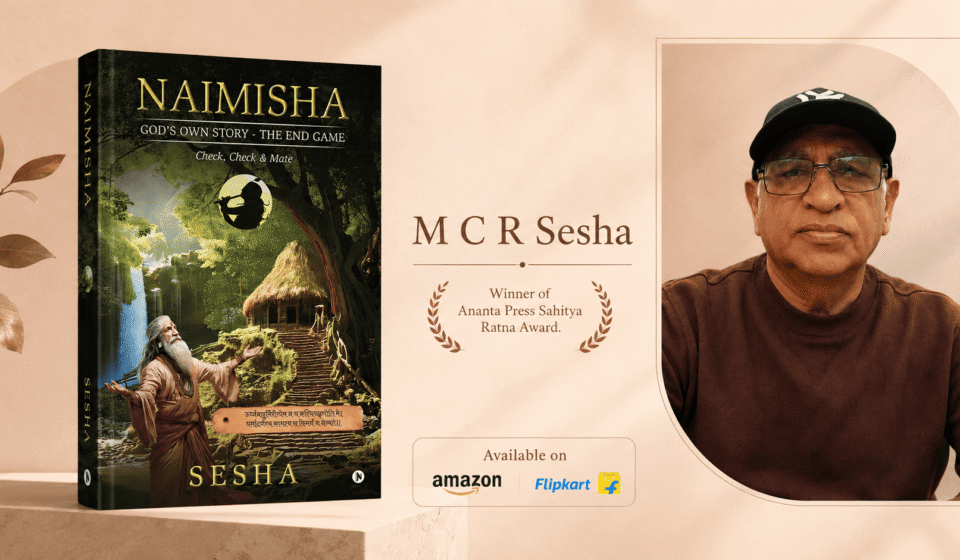

There are many ways to revisit the Mahabharata. One can retell its best-known episodes, modernise its characters, focus on a neglected figure, question the morality of its heroes, or use the epic as a framework for an entirely new story. Naimisha – God’s Own Story – The End Game – Check, Check & Mate takes a particularly ambitious route because it arrives as the final part of a trilogy. M C R Sesha is not approaching the epic as a collection of isolated legends. He has built a sustained narrative across three books and, in this concluding volume, turns toward the moment when everything must be accounted for. The Kurukshetra War, the Ashwamedha campaigns, Krishna’s journey, and the endings of the original characters Animish and Asareer come together in a narrative whose defining mood is closure.
That idea of closure gives the book its strongest identity. Historical and mythological fiction often has an unusual problem: readers already know the broad outcome. Kurukshetra will happen. Great warriors will fall. The political order will change. Krishna’s story will eventually reach its end. Suspense therefore cannot depend only on the question, “What happens next?” It must depend on a more interesting question: “How will this author understand what happens?” Sesha’s third volume appears to recognise that challenge. The interest is not simply in reproducing the epic’s chronology, but in interpreting the emotional and philosophical meaning of its final movements.
This is where the book’s subtitle, Check, Check & Mate, becomes more than a catchy phrase. Chess is a game in which pressure can build long before the decisive move. A king may still stand while the position around him has become impossible. In a similar way, the Mahabharata’s catastrophic war is the result of a long accumulation of choices. Grievances, vows, humiliations, loyalties, ambitions, political calculations, and ideas of honour slowly narrow the available paths. By the time the armies assemble, the “end game” has already been prepared by earlier moves. A final volume built around this metaphor encourages the reader to see destiny not as a sudden supernatural intervention but as something created through repeated human decisions.
The Kurukshetra material naturally supplies the book with scale. Few battle narratives in world literature carry such an enormous burden of moral interpretation. The war is both necessary and horrifying, heroic and tragic, decisive and spiritually unsettling. A good retelling cannot reduce it to spectacle. What gives Sesha’s project promise is the stated emphasis on philosophical undertones. That suggests an understanding that the real drama lies not only in combat but in the tension between action and conscience. Who is obligated to fight? When does duty become violence? Can a righteous cause remain righteous after the means required to achieve it become morally complicated? What does victory look like when one’s own family and civilisation have been devastated? These questions are part of why the Mahabharata has remained inexhaustible, and a historical-fiction treatment that allows them breathing space can feel more substantial than a simple adventure narrative.
The decision to continue into the Ashwamedha wars is equally important. It prevents the book from treating Kurukshetra as a convenient cinematic ending. The aftermath is where the cost of the war becomes visible. The surviving order must justify itself. Kingship must move from battlefield claim to political reality. The world does not become peaceful simply because one side has prevailed. By including these later campaigns, the novel can explore the uneasy relationship between victory and governance. Such material also reinforces the chess metaphor: checkmate may conclude one game, but history immediately sets up another board.
The fictional characters Animish and Asareer provide a different kind of narrative energy. In a story populated by figures whose destinies are already culturally familiar, original characters can create genuine uncertainty. The reader does not carry inherited expectations about how their lives must end. Their presence allows the trilogy to retain the freedom of fiction within the structure of epic tradition. More importantly, their different life journeys create an opportunity for contrast. One character’s ending may suggest fulfilment, another’s may suggest sacrifice, ambiguity, renunciation, regret, or transformation. The book description deliberately notes that their journeys conclude “in different ways” and leave readers with provocative thoughts. That is the kind of ending that suits a philosophically inclined trilogy: one that resolves the plot without flattening the moral questions.
Krishna, of course, complicates every attempt at simple judgment. He is at once a divine presence, counsellor, strategist, friend, political actor, and philosophical teacher. Any novel that offers “closure” to Krishna has to work on several levels. His actions can be viewed through devotion, ethics, statecraft, metaphysics, or human relationship. The finality of his arc also marks the passing of a larger epoch. In that sense, the book’s end game is not merely the end of a war or even the end of a trilogy. It is the end of a world. Such endings carry a particular emotional force because they combine fulfilment with loss. Something has been completed, but completion itself means that a familiar moral and cultural landscape can no longer continue unchanged.
Another quality that may appeal to readers is the author’s perspective as someone who entered literary writing after retirement. M C R Sesha’s professional life was spent in banking, where he rose from direct officer entry to top management, after academic distinction that included gold medals from Andhra University. It would be simplistic to claim that a banking career directly explains a literary style, yet the life experience behind the trilogy is relevant. A long career in institutions, decision-making, hierarchy, responsibility, and consequences can sharpen one’s interest in how systems and individuals influence each other. That is precisely one of the Mahabharata’s enduring concerns. Its tragedies are personal, but they are also institutional: family structures fail, political structures fail, codes of honour collide, and the decisions of leaders affect entire populations.
The author’s later turn toward reading, travel, family life, and writing also gives the trilogy the feel of a considered passion project rather than a hurried literary experiment. Completing three connected books is itself an act of persistence. The third book therefore has a double sense of culmination: it concludes the fictional-historical world and also completes the author’s own planned trilogy. That makes the final volume especially interesting for readers who value long-form storytelling. A trilogy can create patterns, echoes, and consequences that a standalone novel cannot. Characters who appeared earlier can be re-evaluated in light of later events; themes introduced quietly can become central; apparent victories can reveal hidden costs.
Naimisha – God’s Own Story – The End Game – Check, Check & Mate stands out because it treats the final phase of the Mahabharata as both event and meditation. Its battlefield scope is substantial, but the more memorable promise lies in what the battles mean. The familiar epic figures are offered closure, while original characters create fresh emotional possibilities. Kurukshetra is not isolated from what follows, and Ashwamedha is not dismissed as a footnote. Krishna is not only part of the action but part of the philosophical horizon. Together, these choices make the novel suitable for readers who want historical fiction with cultural depth and moral complexity.
The best epic fiction does not ask the reader merely to admire the past. It asks the reader to use the past as a mirror. Questions of ambition, loyalty, power, justice, compromise, and responsibility remain recognisable because human nature has not become simpler. A book that revisits the Mahabharata’s final movements can therefore feel ancient and contemporary at once. Sesha’s concluding volume appears to understand that paradox. Its characters may move toward checkmate, but the reader is left to consider whether life ever offers such perfect finality. That tension between resolution and continuing thought is what gives the book its distinctive appeal.
Amazon Purchase Link: https://amzn.in/d/0giaBcBM