
Why local context makes emergency guidance more useful, memorable, and realistic
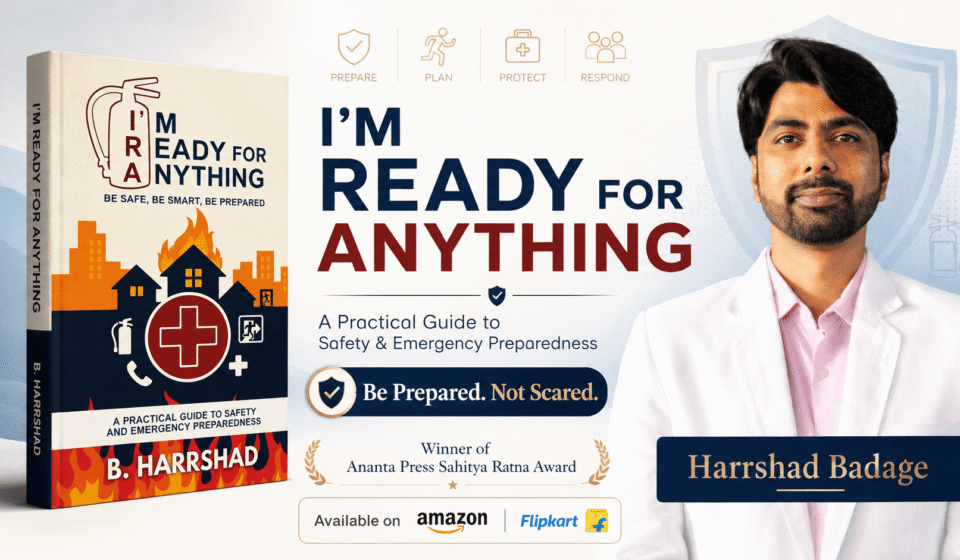
A safety handbook succeeds only when readers can see their own lives inside it. That is the central achievement of I’m Ready for Anything (IRA) by Harrshad Badage. The book is built around the practical realities of Indian homes, roads, workplaces, communities, and digital life. Rather than beginning with distant survival scenarios, it begins with emergencies that feel familiar: LPG leaks in kitchens, monsoon flooding, road accidents, building fires, earthquakes, blackouts, workplace incidents, cyber scams, stampedes, and periods of civil unrest. This local grounding is more than a marketing distinction. It changes the usefulness of the advice because the situations, limitations, habits, and decisions described are closer to what an Indian reader may genuinely face.
Many preparedness books inherit the language and assumptions of the countries in which they are written. Their examples may involve blizzards, wilderness isolation, large private properties, or emergency systems that function differently from those in India. Such books can still contain useful principles, but readers often have to translate them mentally before applying them. IRA reduces that distance. It asks what preparedness looks like when people live in apartments, use LPG cylinders or piped gas, navigate crowded roads, experience seasonal flooding, rely on mobile payments, work in offices or factories, and live in communities where neighbors and family networks may become part of the emergency response. That practical localization is one of the book’s strongest and most distinctive qualities.
The author profile explains why this gap became important to Badage. Across years of safety training, participants repeatedly asked for study material that could help them retain what they had learned after a session ended. Yet the available survival literature often seemed disconnected from the incidents people were actually asking about. Badage had worked across fire safety, first aid, emergency response, workplace safety, defensive driving, and disaster preparedness, and he had trained thousands of people in educational institutions, hospitals, industries, residential communities, and corporate environments. The book appears to grow directly out of those recurring questions: What do ordinary people need to know? What do they forget? What should a family prepare in advance? What can someone realistically do in the first few minutes?
That practical origin gives IRA a different tone from a textbook. The information is presented through conversational explanation, relatable stories, real-life Indian case studies, practical checklists, first-aid techniques, and emergency planning strategies. This format matters because safety knowledge has an unusual requirement: it must survive stress. A concept that is understood only in theory may disappear from memory when alarms are sounding, people are shouting, the power is out, or someone is injured. Clear instructions, familiar examples, and repeatable checklists are more likely to be remembered. The book’s teaching style therefore supports its purpose. It is not enough to inform; the guidance has to remain usable when a reader is under pressure.
The Indian focus also encourages readers to think about preparedness in a more realistic social context. In many emergencies, the first people available are not specialized responders but relatives, coworkers, security staff, neighbors, commuters, teachers, or bystanders. That makes basic knowledge widely valuable. A person who can recognize danger, alert others, avoid making a situation worse, provide appropriate first aid, or communicate accurate information can contribute meaningfully even before professional help arrives. IRA’s broader vision seems to be that resilience improves when more people possess simple, shared knowledge instead of assuming that safety is somebody else’s department.
One of the book’s most appealing ideas is that preparedness should not be separated from ordinary life. A family already plans school schedules, travel, finances, celebrations, and medical appointments; it can also plan emergency contacts and meeting points. A workplace already conducts meetings and maintains equipment; it can also strengthen evacuation awareness and first-aid readiness. A school already teaches life skills; it can include basic safety behaviors. This approach lowers the psychological barrier to preparedness. Instead of presenting readiness as a major project requiring specialized gear, the book makes it feel like a set of sensible habits that can be built gradually.
The inclusion of cyber scams is especially notable because it expands the traditional meaning of “emergency preparedness.” Safety today includes both physical and digital vulnerability. A fraudulent call or message can create financial and emotional damage just as surely as a physical incident can create bodily risk. By placing cyber awareness beside fires, floods, accidents, and blackouts, the book acknowledges how modern Indian life actually operates. People move between physical and digital environments constantly, and good preparedness requires attention in both. This makes the book feel contemporary rather than restricted to conventional disaster-management topics.
The author also emphasizes confidence over fear, which is an important choice for a book covering so many hazards. A catalogue of disasters could easily become overwhelming. IRA instead frames preparation as empowerment. The question is not how many terrible things might happen, but how much better a person can respond after learning a few essential actions. That perspective is psychologically healthier and educationally stronger. Fear can produce avoidance; confidence encourages practice. Readers are more likely to review a checklist, prepare supplies, learn first aid, or discuss a family plan when they feel that these actions increase control rather than confirm danger.
The book’s uniqueness also lies in the bridge it creates between professional safety training and general readership. Badage’s background began in soft-skills training before he moved into fire safety and emergency education. That earlier experience may help explain the accessible style described in the book material. Safety trainers often know the content but not always how to communicate it to non-specialists. A writer who has spent years teaching communication as well as emergency response brings a useful combination: technical awareness and an understanding of how people learn. The result is a guide intended not to impress readers with complexity but to make important ideas understandable enough to act upon.
For Indian families, this localization could make the book particularly useful as a reference kept at home. For students and young adults, it can offer life skills that are rarely taught systematically. For employees and managers, it can reinforce the idea that workplace safety depends on behavior as much as compliance. For teachers and community leaders, it can provide a framework for conversations about preparedness. And for readers who have never thought seriously about emergency planning, it can function as an accessible introduction without demanding prior knowledge.
I’m Ready for Anything stands out because it meets readers where they are. It recognizes that the most valuable safety lesson is not necessarily the most dramatic one; it is the one that can be remembered and used in the place where the reader actually lives. Its India-first approach, practical teaching style, wide range of everyday risks, and emphasis on calm action create a book with immediate social relevance. It does not ask readers to imagine themselves as extreme adventurers. It asks them to become more prepared parents, children, colleagues, commuters, neighbors, and citizens.
That is why the book feels less like a conventional survival guide and more like a modern life-skills manual. Its goal is not to turn ordinary people into rescue professionals. It is to help them recognize risk earlier, make smarter first decisions, and support others until expert assistance is available. In a country as diverse, densely populated, fast-moving, and hazard-exposed as India, that is a meaningful contribution. IRA makes preparedness local, understandable, and achievable – and that is precisely what gives it its value.
Amazon Purchase Link: https://amzn.in/d/01LeypC9