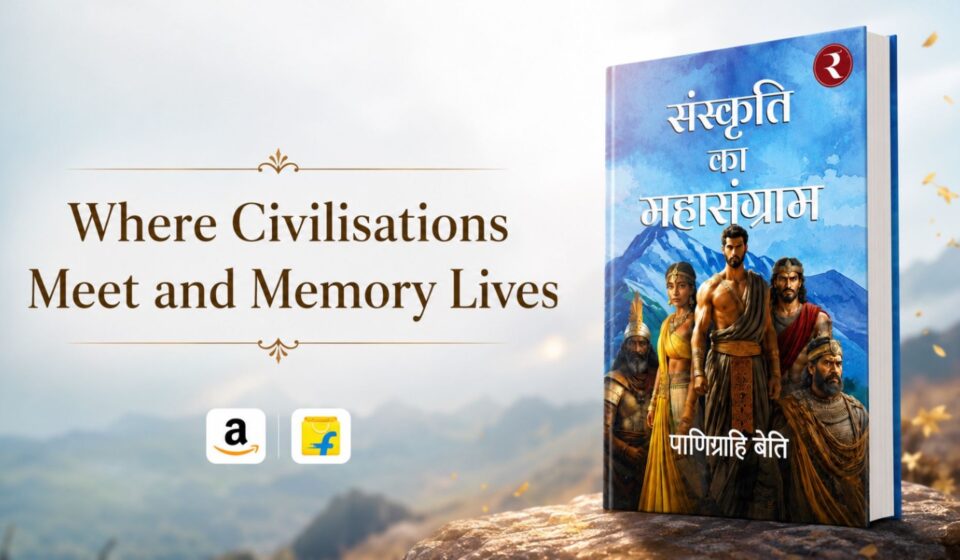

Historical fiction occupies a peculiar and demanding position in literature. It must be true to the known record without being enslaved to it; it must animate the past without anachronising it; it must give voice to people who can no longer speak for themselves while still telling a story worth reading for its own sake. Panigrahi Bethi’s Sanskriti Ka Mahasangram, translated in Hindi by Asha Seth, succeeds on every one of these counts. It is not merely a fine historical novel. It is an act of imaginative restoration that returns to the Indus Valley Civilisation something it has long been denied in popular culture: full and complex humanity.
The novel is set against the backdrop of one of history’s most significant and still imperfectly understood encounters — the meeting, and eventual merging, of the Harappan world with the incoming Aryan tradition. This is terrain that has attracted considerable scholarly attention but relatively little serious literary treatment. Panigrahi Bethi fills that gap with confidence, care, and a narrative intelligence that transforms potentially dry historical material into something vivid, emotionally compelling, and genuinely moving.
The Archaeology of Character
What distinguishes Sanskriti Ka Mahasangram from lesser works of historical fiction is the quality of its characterisation. It would have been easy — and commercially tempting — to populate this story with familiar archetypes: the noble savage, the enlightened conqueror, the doomed idealist. Panigrahi Bethi refuses all of these shortcuts. Every significant character in the novel possesses the kind of interior life that resists reduction to type.
Consider Baguhara, the ruler of Harappa. He is not a tragic king awaiting his inevitable fall; he is a leader navigating a crisis with the tools available to him — wisdom, precedent, and a deep knowledge of his people. His limitations are visible, but they are human limitations: the difficulty of relinquishing certainty when certainty has served you well, the tendency to mistake the familiar for the inevitable. His greatness and his vulnerability are inseparable, and it is this integration that makes him so compelling.
Or consider the relationship between Ashwin and Varun, the philosophical counterpoint that runs through the novel like a second melody beneath the main theme. Their debates — about the nature of authority, the relationship between mobility and settlement, the question of what a civilisation owes to those who built it — are some of the finest intellectual writing in recent Indian fiction. They are not debates that the novel resolves; they are debates it opens up, trusting the reader to continue them in their own mind.
Harappa: A World Fully Realised
The Harappan world rendered in this novel is one of the most fully realised fictional environments in recent memory. The grid streets, the public granaries, the sophisticated drainage systems, the absence of the monumental royal vanity projects that characterised other ancient civilisations — all of these details are present and felt rather than merely noted. The city of Harappa in this novel has a texture, a smell, a quality of light. It is a place you want to walk through slowly, alert to every detail.
What is particularly impressive is the way Panigrahi Bethi renders the Harappan philosophy of collective wellbeing — their apparent preference for civic infrastructure over royal monuments, for wide streets and clean water over military fortifications — not as policy positions but as lived values. The citizens of Harappa in this novel are not inhabitants of a sociological thesis; they are people for whom certain ideas about the good life have become second nature. Their commitment to order and cleanliness and civic responsibility is not ideological; it is simply how things are done, how things have always been done, how things should be done. When that world begins to strain under pressure from without and within, the sense of loss is genuine and specific rather than merely symbolic.
The Art of Even-Handedness
One of the most striking aspects of Sanskriti Ka Mahasangram is its unwillingness to assign moral victory to either side. The novel contains no heroes and villains in the conventional sense. The Aryan characters are not portrayed as invaders or despoilers; the Harappan characters are not portrayed as passive victims awaiting rescue or destruction. Both worlds contain admirable qualities and troubling limitations. Both carry within themselves the seeds of their own futures.
This even-handedness is not a failure of moral imagination; it is the highest expression of it. To resist the temptation to flatten a complex historical encounter into a simple moral fable requires genuine intellectual courage. Panigrahi Bethi possesses that courage, and it elevates what might otherwise have been competent historical entertainment into something that merits the description of literature.
Relevance in a Divided World
It would be possible to read Sanskriti Ka Mahasangram purely as historical fiction — as an absorbing narrative about a world long vanished — and to come away deeply satisfied. But the novel also rewards reading as a parable about the present: about the encounters between different cultures that are happening every day, all over the world, and about what those encounters can be at their best and worst.
The world of the novel is one in which different peoples are forced to reckon with each other: to decide whether the encounter between different ways of living will be experienced as threat or opportunity, as loss or enrichment, as the end of one story or the beginning of another. These are not questions that history has resolved. They are questions that every generation must answer for itself. Sanskriti Ka Mahasangram does not provide those answers, but it provides something more valuable: the model of a narrative that takes the questions seriously and trusts its readers to do the same.
Conclusion
Sanskriti Ka Mahasangram is a landmark work of Indian historical fiction. It restores to the Harappan Civilisation the dignity and complexity it deserves; it gives voice to characters who refuse to be reduced to archetypes; it stages a complex cultural encounter with intelligence, fairness, and genuine literary craft. Panigrahi Bethi has written one of the most significant works of Indian historical fiction in recent years. Asha Seth’s translation ensures that Hindi readers can experience it in all its depth and power.
It is a novel that will endure. Read it now, and read it again.
Rating: ★★★★★ (5/5)
Available in paperback and e-book on Amazon (https://www.amazon.in/dp/9349988852), Flipkart, and at all major online retailers worldwide. Both English and Hindi editions available globally.