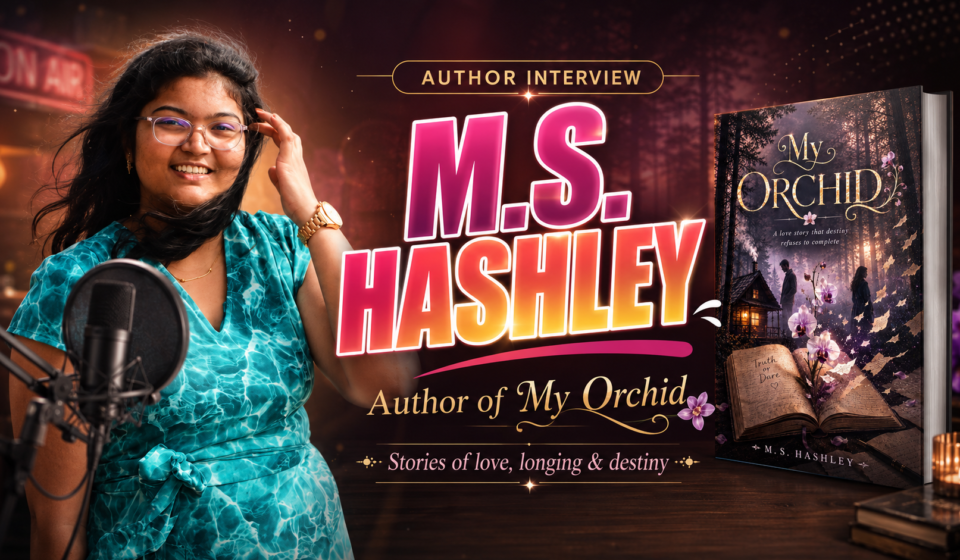

Shreya Raina– What was the original idea or emotional experience that inspired you to write My Orchid?
M.S. Hashley – We live in a fast-paced society where everything feels urgent. I wanted to slow things down and take a pause instead of rushing through life. That’s why Hardhik chooses to rent a secluded cabin, away from the constant noise and distractions.
In an era where messages can be edited, deleted, or rewritten before they’re sent, I wanted two strangers to grow close to each other without the influence of technology. A handwritten diary is the perfect medium because it captures thoughts exactly as they are without any filters
Shreya Raina– Why did you choose the title My Orchid, and what does the orchid symbolise in Hardhik and Hrishika’s relationship?
M.S. Hashley– When I was choosing a title, I wanted something that reflected not only Hrishika’s presence in Hardhik’s life but also the essence of their relationship. An orchid, with its beauty and rarity, felt like the perfect symbol for the kind of love they share.
Throughout the story, Hardhik and Hrishika share a rare and genuine kind of love that many people long to experience. Ultimately, My Orchid is not just the title of the book. It is Hardhik’s way of describing someone whose inner beauty changed the way he perceived life and love.
Shreya Raina– The novel contains two interconnected love stories—Hardhik and Orchid’s romance and Ro and Lavanya’s unfinished relationship. Which of these stories came to you first?
M.S. Hashley – To be frank, neither. Ro and Hardhik’s relationship came to me first. I wanted to portray the warm, easy-going bond between an uncle and his nephew, and how one person can quietly transform another’s life.
Even though Rohan belongs to an older generation, I believe love is timeless. I wanted Hardhik to slow down, learn about love from someone who had truly experienced it, and question everything he thought he knew about relationships.
That’s where Ro and Lavanya’s story became the foundation of the novel. Their selfless, inspiring, and unconditional love laid the emotional groundwork for Hardhik and Orchid’s journey. In many ways, Hardhik doesn’t just fall in love with Orchid. He first learns what love truly means through Ro and Lavanya.
Shreya Raina– Ro is an uncle, guardian, best friend and father figure to Hardhik. How did you develop such a layered bond between these two characters?
M.S. Hashley – I’ve always believed that some of the most meaningful relationships in our lives aren’t always defined by blood or titles. They are defined by the role people choose to play in our lives. I wanted Ro to be that one person for Hardhik. He isn’t just an uncle; he’s a guardian, a mentor, a best friend, and at times, even the father figure Hardhik needs.
Ro doesn’t lecture Hardhik or tell him what to do. Instead, he guides him through his own experiences and allows Hardhik to find his own answers. I wanted their relationship to feel effortless, filled with light-hearted moments, teasing, and genuine affection, while also carrying emotional depth when it mattered.
Shreya Raina– Hardhik initially struggles to distinguish between love, attachment, ego and emotional dependency. What did you want readers to learn from his transformation?
M.S. Hashley – Hardhik’s journey is one of self-discovery. Like many of us, he initially confuses love with attachment, ego, and emotional dependency. But there is a very fine line between love and whatever else. Attraction, attachment, and emotional dependency can give you butterflies and make you believe you’re in love. But I believe love goes far beyond all of this. Would you still choose that person at their lowest? Would you still want to grow old with them, even when youth and beauty have faded?
I wanted readers to realize that not every intense emotion is love. I want them to ask themselves the same questions that Ro asked Hardhik in the initial chapters: Are you really in love with them? Or are you convincing yourself that you are in love? Maybe you just love the idea of having them around.
If My Orchid encourages readers to pause and honestly question their own feelings, then I believe Hardhik’s transformation has achieved its purpose.
Shreya Raina– Why did you choose a handwritten diary, puzzles and clues as the primary means through which Hardhik and Orchid fall in love?
M.S. Hashley– In today’s world, social media has made it incredibly easy to create a version of ourselves that isn’t always real. We can carefully choose our words, delete messages with a backspace, and hide our true emotions. Sometimes, people fall for appearances or carefully crafted conversations rather than the person behind them.
I wanted to explore a different possibility. What if you fell in love with someone purely because of who they are on the inside? When we communicate without filters, we understand each other more deeply. We slow down, listen, and connect in a way that’s becoming increasingly rare in today’s fast-paced world.
That’s why I chose a handwritten diary.
But a diary entry alone might have felt too straightforward, so I introduced puzzles, clues, and truth-or-dare entries. They added curiosity and playfulness while allowing Hardhik and Orchid to gradually discover each other, one page at a time.
Shreya Raina– Both Hardhik and Orchid become writers after painful friendship breakups. Do you believe emotional pain often becomes a source of creativity?
M.S. Hashley – Not necessarily, but sometimes it can be. Pain makes us pause, reflect, and search for meaning. In that process, we often discover parts of ourselves we never knew existed. For Hardhik and Orchid, writing became a way to understand their emotions rather than escape them.
Shreya Raina– Orchid says that pages have the patience to listen when people do not. How closely does this idea reflect your personal relationship with writing?
M.S. Hashley – There are times when your thoughts become so loud and heavy that you fall completely silent. Not because everything is okay, but because you’re too overwhelmed to put them into words. And when you finally do, people often dismiss them as overthinking or drama, even when those thoughts are quietly consuming you. Unlike people, pages don’t interrupt, judge, or leave. They simply listen. That’s a belief I share with Orchid.
Shreya Raina– Lavanya is visually impaired but is portrayed as independent, ambitious and professionally successful. What research or experiences helped you create her character?
M.S. Hashley – From a young age, I volunteered at L.V. Prasad Eye Institute, Hyderabad, where I recorded audiobooks. I also had an opportunity to give dubbing in an audio film called I’m possible as 11-year-old kid. At LVPEI, I came across several visually impaired people who are incredibly independent, confident and inspiring. Those experiences stayed with me over the years and eventually inspired Lavanya’s character.
Shreya Raina– Ro allows people to believe that he betrayed Lavanya in business, even though he left to protect her happiness and reputation. Do you consider his decision selfless, misguided or a combination of both?
M.S. Hashley – I think it was a combination of both. Ro’s intentions were completely selfless. He was willing to sacrifice his name and happiness for what he believed was a better future for Lavanya. But at the same time, he thought about what was better for her instead of asking what she would have wanted.
I wanted readers to see that even good people can make flawed decisions out of love. Sometimes, our greatest sacrifices become our biggest mistakes. Not because our intentions are wrong, but because we forgot to let the other person choose.
Shreya Raina– The novel repeatedly shows characters sacrificing their happiness for someone else. Where do you believe healthy love ends and harmful self-sacrifice begins?
M.S. Hashley – I believe love naturally involves sacrifice. When you truly care about someone, you’ll often put their happiness before your own. But healthy love should never cost you your happiness, self-respect and peace of mind.
The moment you’re constantly hurting, compromising your values, or losing who you are just to keep someone else happy, it stops being love and becomes self-destruction. Love should help you grow, not erase you.
Shreya Raina– Orchid fears romantic relationships because of the emotional damage caused by losing her best friend, Maria. Why was it important to explore friendship breakups with the same seriousness as romantic heartbreak?
M.S. Hashley – Most of us acknowledge the pain of losing a romantic partner, but we often dismiss the pain of losing a close friend. I’ve even heard people say that a friendship breakup isn’t real heartbreak, and I think that’s a very unfair thing to say. Perhaps they have simply been lucky to have never experienced one.
For many of us, our friends are our safe space, and sometimes even our soulmates in a non-romantic sense. Losing someone like that can be just as devastating as losing a romantic partner.
I don’t think anyone has the right to decide what another person should or shouldn’t grieve. Pain is personal, and heartbreak isn’t reserved only for romantic relationships.
Through Orchid, I wanted to give that kind of heartbreak the recognition and empathy it deserves.
Shreya Raina– Hardhik and Orchid fall in love before they properly know each other’s names or appearances. What does their relationship suggest about emotional intimacy in the age of social media?
M.S. Hashley – In an age where we’re constantly connected, I think we’re slowly losing the art of truly knowing someone. We often know a person’s photos, profile, and online persona before we know their heart.
Through Hardhik and Orchid, I wanted to explore the opposite. Their relationship suggests that emotional intimacy isn’t built by seeing someone every day. It is built by understanding their thoughts, values, fears, and vulnerabilities. When appearances are taken away, you’re left with the person they truly are.
I wanted readers to ask themselves a simple question: If you removed physical appearance, would you still choose the same person? After all, what are we, if not our souls? To me, that’s where emotional intimacy begins.
Shreya Raina– Orchid’s parents provide her with comfort and opportunity, yet she still feels emotionally neglected. What did you hope to communicate through the difference she identifies between having parents and having a “mom and dad”?
M.S. Hashley – As parents, we naturally feel responsible for our children’s education, comfort, and future. But sometimes, in fulfilling those responsibilities, we unintentionally forget to simply be there for them.
I think every child needs a parent who is also a friend. Not every memory is about what you provide for us. Sometimes, all that a child needs is emotional presence—to cheer for them during a tournament, attend a school performance, or celebrate a small achievement with genuine excitement. Those moments may seem ordinary, but they’re the ones children carry with them for years. Sometimes, simply showing up speaks louder than the money or bills you pay. Responsibilities may make you a parent, but emotional presence is what makes you a mom or a dad. That’s the difference I wanted to portray through Orchid’s relationship with her parents.
Shreya Raina– The discovery that Orchid is Lavanya’s daughter connects the younger generation’s romance with the older generation’s unfinished love. How early in the writing process did you plan this revelation?
Shreya Raina – To be honest, I didn’t plan it until Hardhik and Orchid met in person. It was then that I felt that the story needed one twist. So, the idea of connecting the two generations through Orchid being Lavanya’s daughter came to me.
Looking back, it felt like everything naturally fell into place. Ro and Lavanya’s story had already become the emotional foundation of the novel, so intertwining it with Hardhik and Orchid’s journey gave both stories a deeper meaning.
Shreya Raina– Orchid encourages Hardhik to bring Ro back instead of treating him as competition. What qualities did you want her response to reveal about her understanding of love?
M.S. Hashley – I wanted Orchid to show that true love isn’t about being someone’s only priority. It’s about respecting the relationships that already exist in their life. If you truly love someone, you don’t make them choose between you and the people they care about.
I also believe that when you truly love someone, their family becomes your family. There shouldn’t be your relatives and my relatives. It should become our family. Love isn’t about replacing the people in someone’s life; it’s about embracing them. Love should expand a person’s world, not shrink it.
Shreya Raina– Hrishika reveals her real name only during her final moments. Why did you choose that particular point for Hardhik and the reader to learn her identity?
M.S. Hashley – I wanted readers to know her as Orchid before they knew her as Hrishika. Throughout the novel, Hardhik falls in love with her personality, values, and soul. By the time he learns her real name, he has already fallen in love with who she is.
Orchid never revealed her real name earlier because, in the beginning, she wanted to share it only when she completely trusted and loved Hardhik. As time passed, she realized that “Orchid” had become something special between them. It wasn’t just a nickname; it had become an identity that belonged only to the two of them. She wanted Hardhik to call her by the unique name only they both knew, rather than the one everyone else used.
But in her final moments, she felt he deserved to know every part of her from her own lips. Revealing her real name was her way of loving him completely and leaving no part of herself hidden.
Shreya Raina– The ending is emotionally intense and tragic. Did you ever consider allowing Hardhik and Orchid to marry, or was their separation always essential to the story?
M.S. Hashley – I actually did consider giving them a happy ending. As a writer, you naturally become attached to your characters, and there was a part of me that wanted Hardhik and Orchid to end up together.
But the more I understood the story, the more I felt that their separation gave My Orchid its true meaning. I wanted readers to finish the book with a sense of gratitude rather than regret—to appreciate that some love stories are beautiful not because they last forever, but because they leave us as better people than they found us.
There was another reason too. If Orchid had survived, she would have been happy with Hardhik, but she would still have carried the void left by losing her best friend, Maria. Hardhik eventually found a way to fill his own void through Ro. I felt Orchid deserved that same peace. In a way, the ending reunites her with the person she missed the most.
Shreya Raina– The book questions the comforting idea that people may be together in another universe. What does the novel ultimately say about appreciating the relationships we experience in this life?
M.S. Hashley – We often say, “Maybe in another universe, we’re still together.” It’s comforting to believe we’ll get another chance somewhere else, but that hope shouldn’t stop us from appreciating the relationships we have today.
I once came across an Instagram reel that asked, “Why is it always another universe and not this one?” It made me wonder why are we so busy imagining a different universe that we forget to notice what we already have in this one? Maybe in other universe, someone is hoping that they have something that you do in this one.
Instead of hoping for another universe to make things right, I hope readers choose to cherish the people who are with them here and now. Because this life is the only one we know we have.
Shreya Raina– After readers finish My Orchid, what is the one feeling, question or message you hope remains with them?
M.S. Hashley – First, I hope readers walk away realizing that life is uncertain, but love doesn’t have to wait. Cherish your people while they’re still here. Don’t wait for another universe, another lifetime, or another chance to appreciate the people who make this life beautiful. Tell them what they mean to you while you still can.
But at the same time, it’s equally important not to fall in love blindly. We live in a world where one person climbs the Empire State Building to propose to the love of their life, while another scams the very person they marry. Love has the power to bring out both the best and the worst in people. Be aware, trust your instincts, and choose someone whose actions match their words.
Finally, I hope readers close the book and think about the people they love. I hope they slow down and spend a little more time with the people who matter to them amidst all the chaos of life. Not because it’s their duty, but because they’re their priority.
I’d like to end with the beautiful message displayed on the banner unfurled atop the Empire State Building during that proposal:
“When the power of love beats the love of power, the world knows peace.”