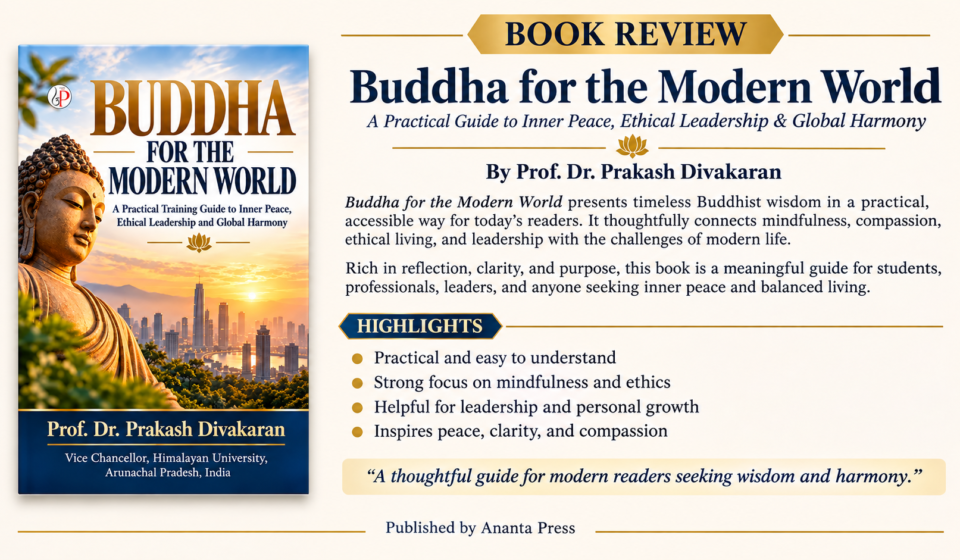
Buddha for the Modern World: Rediscovering Ancient Wisdom for Inner Peace, Ethical Leadership, and Global Harmony

Author: Prof. Dr. Prakash Divakaran
Publisher: Ananta Press
Publication Year: 2026
ISBN: 978-93-7821-199-7
Genre: Spirituality | Philosophy | Mindfulness | Personal Development | Leadership
Book Title: Buddha for the Modern World: A Practical Training Guide to Inner Peace, Ethical Leadership and Global Harmony
Ancient Wisdom for a World Searching for Peace
In an era defined by technological advancement, relentless competition, emotional exhaustion, and increasing social divisions, the search for inner peace has become more important than ever. People are connected through digital platforms yet frequently struggle with loneliness, anxiety, uncertainty, and a lack of meaningful direction. Amid these challenges, the teachings of Gautama Buddha offer a powerful reminder that genuine happiness cannot be found through external achievements alone.
Buddha for the Modern World: A Practical Training Guide to Inner Peace, Ethical Leadership and Global Harmony by Prof. Dr. Prakash Divakaran is a thoughtful exploration of how ancient Buddhist principles can guide individuals toward a more balanced, compassionate, and purposeful existence.
Rather than presenting Buddhism solely as a religious philosophy or historical tradition, the author approaches it as a practical framework for understanding human behavior, improving relationships, developing ethical leadership, and encouraging peaceful coexistence.
Spanning 38 chapters, the book provides an extensive journey through Buddhist philosophy and its contemporary applications. Its greatest strength lies in connecting spiritual understanding with everyday responsibilities, allowing readers to recognize that mindfulness, compassion, and ethical decision-making are not distant ideals but qualities that can be developed through consistent practice.
Understanding the Buddha Beyond Traditional Interpretations
The book begins by addressing a fundamental question: Why do the teachings of the Buddha remain relevant in the twenty-first century?
To answer this, Prof. Dr. Divakaran examines the pressures shaping modern existence, including workplace demands, digital distractions, emotional instability, and conflicts arising from differing beliefs and expectations.
He introduces the Buddha’s teachings not as rigid doctrines requiring unquestioning acceptance but as principles that readers can investigate through personal experience.
The chapters exploring Siddhartha Gautama’s life and historical surroundings establish an important philosophical foundation. From his sheltered upbringing to his encounters with suffering, renunciation, spiritual exploration, and eventual awakening, the Buddha’s journey becomes a meaningful illustration of humanity’s search for understanding.
Particularly compelling is the author’s treatment of the Middle Way, which rejects both excessive indulgence and extreme self-denial.
For contemporary readers, this principle has unmistakable relevance. Many individuals alternate between exhausting themselves through excessive ambition and withdrawing when responsibilities become overwhelming. The Middle Way offers an alternative based on moderation, discipline, self-awareness, and sustainable effort.
The author also distinguishes historical evidence from traditional narratives and legends, encouraging readers to approach Buddhist history with respect and intellectual curiosity.
This balanced treatment makes the book accessible to readers interested in spirituality as well as those seeking philosophical understanding without necessarily identifying with a particular religious tradition.
The Four Noble Truths: A Framework for Understanding Human Suffering
One of the most intellectually engaging sections explores the Four Noble Truths, the foundation of Buddhist teaching.
Instead of limiting their interpretation to spiritual suffering, the author connects them with contemporary problem-solving.
The First Noble Truth acknowledges the existence of suffering and dissatisfaction. The Second investigates their causes, particularly craving, attachment, and misunderstanding. The Third recognizes the possibility of freedom from suffering, while the Fourth presents a disciplined path toward that freedom.
Prof. Dr. Divakaran interprets these teachings through a practical sequence: identify the problem, examine its causes, recognize the possibility of improvement, and develop an appropriate course of action.
This interpretation is especially useful because it transforms philosophical ideas into a framework that readers can apply to professional disagreements, personal disappointment, emotional distress, and difficult decisions.
Another valuable discussion concerns dukkha, commonly translated as suffering but encompassing a broader sense of dissatisfaction and instability.
The author explains how suffering can emerge not only from painful experiences but also from our reactions, expectations, and resistance to change.
The distinction between an unavoidable painful event and the additional distress created by our response encourages readers to examine their emotional habits more carefully.
Importantly, the book does not suggest that genuine hardship should simply be ignored. Instead, it emphasizes awareness, appropriate action, and compassionate understanding.
The Noble Eightfold Path as a Guide to Everyday Life
The Noble Eightfold Path receives detailed treatment across several chapters, making it one of the book’s central educational strengths.
Right View, Right Intention, Right Speech, Right Action, Right Livelihood, Right Effort, Right Mindfulness, and Right Concentration are presented as interconnected dimensions of personal and ethical development.
The author demonstrates that these principles extend far beyond meditation or religious observance.
Right Speech, for example, becomes particularly relevant in workplaces where ineffective communication, misunderstanding, criticism, and impulsive reactions can damage trust.
Speaking truthfully, respectfully, and constructively is presented as an essential foundation for healthier relationships.
Similarly, Right Livelihood encourages readers to consider the ethical implications of their professional responsibilities.
The book asks readers to reflect on whether their work contributes positively to society, respects human dignity, and aligns with personal values.
Right Effort emphasizes consistent improvement rather than unrealistic perfection, while Right Mindfulness and Right Concentration explore the importance of training attention in an increasingly distracted world.
What makes this discussion effective is its practical orientation. The reader is not merely introduced to eight philosophical concepts but encouraged to recognize how they influence thoughts, speech, actions, employment, and relationships.
Mindfulness and Meditation: Turning Knowledge into Experience
A distinguishing quality of Buddha for the Modern World is its strong emphasis on experiential learning.
The author repeatedly reinforces that understanding an idea intellectually is different from applying it consistently.
Dedicated chapters examine meditation, emotional awareness, anger, resentment, attachment, impermanence, and the nature of the ego.
These discussions encourage readers to recognize habitual reactions and develop healthier responses.
The book introduces simple meditation exercises, including breath awareness and short periods of focused observation. It also recommends maintaining a notebook to record experiences, monitor emotional patterns, and evaluate personal progress.
Such exercises are particularly valuable for beginners who may find traditional meditation practices intimidating.
Instead of demanding immediate transformation, the author encourages gradual development through manageable routines.
A practical example appears early in the book, where readers are guided to establish a daily practice period, observe their starting levels of stress and concentration, and review their progress periodically.
This structured approach makes mindfulness more approachable and encourages readers to treat personal development as an ongoing learning process.
The discussions surrounding anger and resentment are equally relevant. By examining the relationship between emotional triggers, thoughts, and reactions, the book encourages greater patience and self-control.
However, its approach remains realistic: meditation is presented as a supportive educational practice rather than a replacement for professional psychological or medical assistance when such care is necessary.
Ethical Leadership: Where Spirituality Meets Responsibility
Perhaps the book’s most distinctive contribution is its integration of Buddhist philosophy with contemporary leadership and organizational management.
Many publications on Buddhist teachings focus predominantly on individual peace. Prof. Dr. Divakaran goes further by exploring how mindfulness and compassion can influence institutions, professional conduct, and collective decision-making.
Chapters on mindful leadership, ethical decision-making, compassionate teams, conflict resolution, and responsible business practices demonstrate this broader perspective.
The author challenges the assumption that effective leadership depends exclusively on authority, productivity, or financial success.
Instead, he encourages leaders to develop self-awareness, fairness, accountability, empathy, and responsible judgment.
A mindful leader, as the book suggests, must learn to listen carefully, recognize personal biases, respond thoughtfully during conflict, and consider the consequences of decisions for others.
This becomes particularly meaningful in professional environments where competition and performance pressure can overshadow employee well-being.
The book also examines compassionate teamwork and constructive conflict resolution, emphasizing that genuine cooperation requires trust, respectful communication, and shared responsibility.
The inclusion of practical assessments, reflection activities, and structured exercises gives these chapters additional value for educators, managers, administrators, and organizational leaders.
The author’s professional experience in academic leadership and industry helps explain the strong organizational perspective throughout the text.
His treatment of leadership demonstrates that spiritual intelligence and professional responsibility need not exist separately; they can reinforce each other when translated into thoughtful action.
Compassion, Interdependence, and Global Harmony
Beyond individual growth and professional development, the book explores the wider implications of Buddhist wisdom for society.
Its discussions of compassion, loving-kindness, sympathetic joy, equanimity, karma, and interdependence encourage readers to consider how their choices affect other people and the environment.
The concept of interdependence is particularly significant in a world facing environmental challenges, political tensions, economic inequality, and cultural misunderstandings.
The author highlights the importance of recognizing that human lives, communities, organizations, and natural systems are deeply interconnected.
This perspective encourages an understanding of responsibility that extends beyond personal interests.
The later chapters address sustainability, social responsibility, cross-cultural understanding, digital behavior, and the creation of a culture of peace.
These subjects broaden the relevance of Buddhist philosophy without reducing it to a collection of motivational statements.
The discussion of peace in the digital age is especially timely. Modern communication technologies have transformed how people exchange information, form opinions, and engage in disagreements.
Mindfulness offers an opportunity to examine these habits and develop greater awareness before reacting or communicating.
The book’s emphasis on global harmony ultimately rests on a straightforward principle: collective peace becomes more attainable when individuals cultivate awareness, compassion, ethical conduct, and respect for differences.
Writing Style, Structure, and Practical Value
One of the book’s notable strengths is its systematic organization.
Across 38 chapters, Prof. Dr. Divakaran develops concepts progressively, beginning with foundational Buddhist philosophy before moving into personal development, organizational leadership, and wider social responsibility.
The writing generally favors explanation and practical application over complex philosophical terminology.
Tables, checklists, exercises, reflection questions, and suggested routines help readers engage actively with the material.
This makes the book useful not only for continuous reading but also as a reference for specific challenges.
A reader dealing with anger might focus on emotional regulation, while an educator could explore responsible mindfulness training. A manager might find particular value in the chapters addressing ethical leadership or conflict resolution.
The final chapter, devoted to a practical action plan, brings the book’s major themes together by encouraging readers to connect inner peace, ethical behavior, and leadership through observable daily habits.
The repeated use of structured exercises is both a strength and a stylistic characteristic. Readers seeking a purely narrative or contemplative work may occasionally find the instructional format more formal than expected.
Likewise, those looking for extensive scholarly debate about Buddhist scriptures may find the practical emphasis more prominent than detailed textual analysis.
Nevertheless, these characteristics are consistent with the book’s stated purpose as a training guide.
Its accessibility and focus on application make it especially appropriate for readers who want to move beyond learning spiritual concepts toward incorporating them into their lives.
Final Verdict: A Meaningful Guide to Conscious Living
Buddha for the Modern World succeeds in presenting Buddhist wisdom as a practical resource for contemporary life.
Its central achievement is the connection it establishes between inner awareness, ethical responsibility, compassionate leadership, and social harmony.
Prof. Dr. Prakash Divakaran reminds readers that meaningful personal growth does not depend on dramatic spiritual experiences. It emerges through repeated choices: responding rather than reacting, listening rather than judging, acting ethically despite pressure, and recognizing the dignity of others.
The book will particularly appeal to students, educators, working professionals, institutional leaders, mindfulness learners, and readers interested in applied philosophy.
It is also a valuable starting point for those who wish to explore the Buddha’s teachings without approaching them exclusively through religious practice.
Ultimately, this book encourages readers to see peace not as an abstract destination but as an ongoing discipline reflected in everyday behavior.
In a world that frequently celebrates speed, achievement, and external recognition, Buddha for the Modern World offers a different measure of progress: greater clarity of mind, greater integrity of action, and greater compassion toward humanity.
A thoughtful, accessible, and practice-oriented exploration of ancient wisdom, this book deserves consideration from anyone seeking a more mindful, ethical, and meaningful way of living.