
A visual and imaginative appreciation of an alphabet adventure
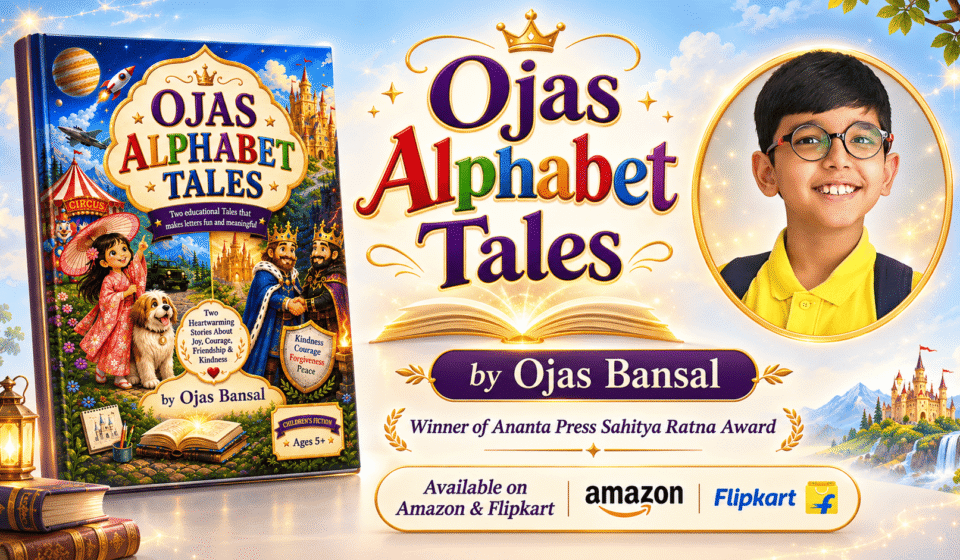
Consider the contrast that appears on the cover of Ojas Alphabet Tales. On one side, a rocket rises toward a night sky filled with stars and planets. On the other, a fairy-tale castle catches the light of a magical landscape. Below them are a circus tent, friendly characters, royal figures, and the welcoming image of a book opening into its own glow. The effect is deliberately exuberant. Rather than asking a child to choose between outer space and enchantment, the artwork places both within the same imaginative universe. It is a fitting visual introduction to a book whose stated purpose is to make the alphabet adventurous, engaging, and meaningful.
The pleasure of this idea lies in its refusal to treat alphabet learning as a narrow subject. A letter is a tiny form on a page, but the language built from letters can describe nearly anything: a moonlit castle, a brave decision, a family conversation, an unfamiliar word, or the happiest moment of a friendship. The premise of Ojas Bansal’s 34-page illustrated book is to connect those small forms with stories, cheerful characters, vocabulary activities, and quizzes. In that sense, its subject is larger than the ABCs. It is about discovering what words make possible. The fantasy and science-fiction classification is therefore not merely a decorative label; it speaks to the book’s central imaginative energy.
There is a particular challenge in writing for beginning readers: the world of the story must feel wide, even when the book itself is short. Young children bring enormous powers of invention to even a simple image, but they also need clarity. A castle may suggest mystery, yet a scene still requires an understandable emotional center. A space adventure may promise excitement, yet an unfamiliar concept must be introduced in language a child can follow. A well-conceived illustrated alphabet book can work within those boundaries by letting its images establish atmosphere while the text concentrates on accessible action, conversation, or feeling. The materials provided for Ojas Alphabet Tales point toward that kind of partnership between words and pictures.
The cover is especially interesting for the way it treats familiar storytelling traditions as neighbors rather than rivals. The circus hints at play and spectacle. The spacecraft suggests exploration and invention. The crowned characters evoke classic fairy tales and questions of conflict or reconciliation. The child and dog suggest affection and companionship. These observations concern the cover’s imagery; they do not establish the actual events of the interior stories. Nevertheless, as an invitation to browse, the design has real narrative character. It prepares readers to expect variety and to accept the possibility that learning may take them somewhere surprising.
Illustration can play several roles in early literacy, and this book’s illustrated format makes those roles worth considering. A picture can help a beginner identify an object before encountering its written name. It can give clues about a character’s mood, supply context for a new word, or invite the reader to describe what is happening. It can also inspire a child who is not yet confident in independent reading to participate anyway. Pointing, predicting, comparing, and inventing are all legitimate forms of engagement. The best children’s books do not regard these acts as distractions from reading; they recognize them as part of how readers find their way into a story.
An alphabet-based framework adds a second imaginative layer. Letters provide order, while stories provide freedom. The order helps a young reader recognize progress. The freedom stops that progress from becoming mechanical. In principle, a child may move from one letter to the next with the comforting sense of a pattern, while still discovering a fresh setting, idea, or emotion. The supplied summary describes each letter as connected with storytelling, though it does not include a complete letter-by-letter breakdown. What can be appreciated without inventing those details is the structural promise: a recognizable educational sequence made less predictable through narrative invention.
The vocabulary challenges and interactive quizzes introduce yet another kind of play. A story allows children to inhabit a situation, while a challenge asks them to look closely at its language. The two activities can complement each other particularly well when the questions respect the reader’s imagination. A prompt about a new word may lead to a silly sentence or a drawing. A question about a character’s choice may lead to a different ending. A quiz may become an opportunity for a child to explain an idea in their own voice. That is the beauty of a flexible activity: it can support learning without demanding that every child encounter the material in exactly the same way.
Behind all this color sits a surprisingly traditional reason for reading stories. The book’s stated themes include courage, kindness, friendship, family, and curiosity. Those are among the enduring subjects of children’s literature, not because they are simple, but because children are constantly beginning to understand them. A child may know the word kindness long before understanding how difficult it can be to act kindly. A child may enjoy a brave character while still wondering what it feels like to be afraid. Fantasy makes space for such questions. It allows an ordinary emotion to appear in an extraordinary setting, where a young reader can examine it from a comfortable distance.
The authorship brings a fresh layer to the project. According to the supplied profile, Ojas Bansal has published fifteen books at eight years of age and enjoys exploring languages, cultures, drawing, and coloring. Those interests are consistent with a storytelling project that celebrates many kinds of imaginative territory. They also remind adult readers that children’s imaginative work need not be treated merely as an exercise. When a child writes, their questions about the world can become the beginning of a real book. The point is not that youth automatically makes every story exceptional; it is that youthful creativity deserves to be read with attention and evaluated on its own terms.
The book’s ambitious cover also sets a high expectation. Abundant imagery can excite a reader, but what ultimately matters is the experience inside. The synopsis does not provide the complete pages of Ojas Alphabet Tales, so it would be unfair either to praise unseen plot turns or to fault unexamined pacing. A reader interested in purchasing it may reasonably examine sample pages to understand the balance of narrative, vocabulary, and questions. In an illustrated educational book, that balance can make the difference between a book that is enjoyed once and one that invites children to return. The present review is best read as an assessment of the concept, positioning, and available presentation.
Even with that distinction, the project has a persuasive identity. It does not try to make learning attractive by disguising letters completely. Instead, it gives letters a place in a larger imaginative world, where they can share attention with stories and feelings. For a young reader who loves fantasy, that can make an important difference. A lesson presented as a route toward a castle or a journey beyond the stars may inspire the kind of voluntary attention that no worksheet can command. The educational purpose remains, but wonder leads the way.
At its best, children’s fantasy enlarges the reader’s sense of possibility. A small image can make a room feel like a kingdom; a short sentence can make a child curious about an unfamiliar planet; a new word can become the seed of a story told aloud at dinner. Ojas Alphabet Tales is built around that possibility. Its bright cover, compact illustrated format, and story-centered approach promise an alphabet experience that is theatrical rather than routine. The most compelling reason to explore it is not simply the hope that a child will remember more letters. It is the possibility that those letters will begin to feel like tools for making their own imaginary worlds.
Buy the book on Amazon: https://www.amazon.in/Ojas-Alphabet-Tales-Bansal/dp/B0HLXNHBXV/