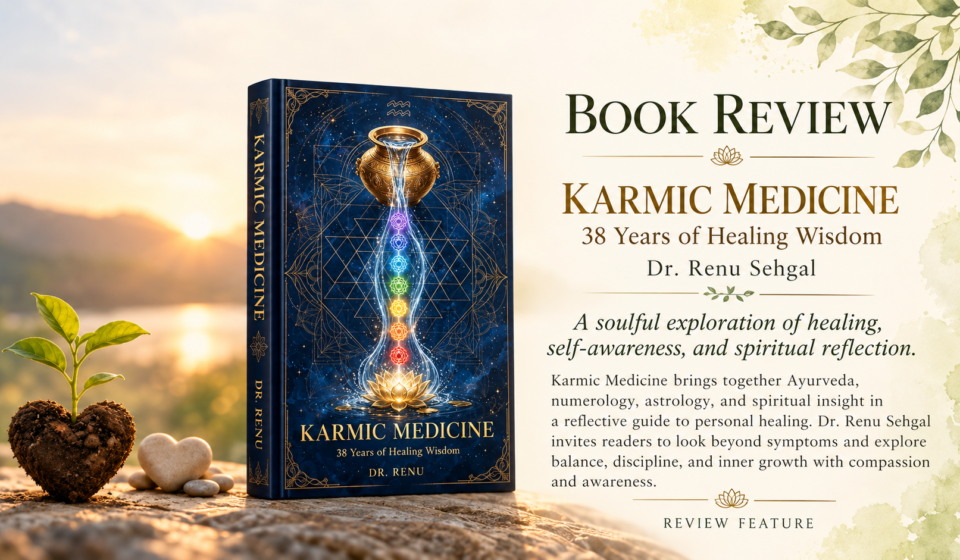
Karmic Medicine by Dr. Renu Sehgal: An Exploration of Healing, Karma, and the Wisdom of Self-Discovery

Exploring 38 years of healing experience through Ayurveda, numerology, astrology, spiritual awareness, and the philosophy of conscious living.
Book Title: Karmic Medicine
Author: Dr. Renu Sehgal
Publisher: Ananta Press
Publication Year: 2026
ISBN: 978-93-7821-119-5
Genre: Spirituality, Alternative Healing, Ayurveda, Astrology & Personal Growth
Understanding Healing Beyond the Physical Body
Healing is often understood as the process of recovering from physical illness, overcoming discomfort, or restoring the body’s natural balance. However, spiritual traditions have long encouraged people to explore another dimension of human experience: the relationship between thoughts, emotions, actions, beliefs, and personal well-being.
Karmic Medicine by Dr. Renu Sehgal explores this spiritual perspective through an unusual combination of Ayurveda, numerology, astrology, karmic philosophy, and traditional practices.
Drawing upon 38 years of experience as a spiritual healer, psychic surgeon, and medical astro-numerologist, Dr. Sehgal presents her understanding of how human experiences may be interpreted through symbolic relationships between numbers, planets, emotions, and the body.
The book is not structured as a conventional medical guide. Instead, it introduces a spiritual framework intended to encourage self-awareness, personal responsibility, and reflection.
Its central idea is that understanding ourselves requires more than examining our immediate circumstances. Within the author’s spiritual philosophy, our repeated behaviours, emotional experiences, beliefs, and karmic patterns may offer another way to reflect upon the challenges we encounter.
This perspective makes Karmic Medicine a distinctive contribution to contemporary spiritual writing, particularly for readers interested in traditional Indian wisdom and alternative approaches to personal growth.
A Lifetime of Experience Behind the Book
One of the most notable aspects of Karmic Medicine is the personal experience that informs its content.
In the preface, Dr. Sehgal describes her decades of working with people seeking guidance for physical and emotional difficulties. Her understanding of healing has developed through practices involving spiritual interpretation, numerology, astrology, energy work, and prayer.
Rather than separating these traditions into independent subjects, she attempts to bring them together into a unified philosophy.
The book reflects her belief that suffering can encourage reflection and that personal difficulties may inspire individuals to reconsider their habits, priorities, and relationships.
Her writing frequently returns to compassion, discipline, responsibility, and service.
These values help give the book a more personal dimension than a purely technical manual of astrological calculations.
While readers may differ in their acceptance of its spiritual claims, the author’s dedication to explaining her chosen framework is evident throughout the manuscript.
The Connection Between Ayurveda and Numerology
The opening chapters establish the foundations of what Dr. Sehgal describes as Ayurvedic numerology.
Ayurveda traditionally discusses three doshas: Vata, Pitta, and Kapha. In the framework presented in this book, these concepts are connected with specific numbers, planets, elements, and personal tendencies.
The author introduces the Driver Number, calculated from the day of birth, and the Conductor Number, derived from the complete date of birth.
These numbers become essential components of her interpretation of individual spiritual patterns.
Other digits appearing in the date of birth are described as supporting numbers, while absent digits are interpreted as areas that may deserve conscious attention.
This approach is particularly interesting because the book attempts to develop a consistent symbolic system rather than presenting disconnected spiritual observations.
Readers interested in numerology will encounter explanations of how the author assigns meaning to numerical patterns and relates them to traditional Ayurvedic concepts.
The book also encourages readers to examine their lifestyle, emotional responses, and personal discipline.
However, the proposed connections between birth numbers, doshas, and particular illnesses should be understood as spiritual interpretations, not medically validated methods of identifying disease.
The Hidden Language of Numbers
One of the more engaging sections of Karmic Medicine explores what the author calls hidden numbers.
The chapters on repeated numbers, missing numbers, and the Back-Seater Number offer an elaborate system for interpreting birth dates.
Within this framework, repeated numbers are associated with intensified personality tendencies, while missing numbers symbolically represent lessons or qualities requiring development.
The Back-Seater Number is presented as another influence that may not be immediately obvious through the more familiar Driver and Conductor calculations.
What makes these chapters engaging is their emphasis on self-examination.
The author invites readers to consider questions about emotional needs, repeated habits, personal strengths, and areas of imbalance.
For example, discussions of discipline, communication, patience, generosity, and emotional expression can encourage meaningful reflection even among readers who approach numerology primarily as a symbolic tradition.
The calculations and examples also make these chapters useful as reference material for enthusiasts.
Rather than reading the entire book in one sitting, readers may prefer returning to particular sections while exploring different numerological concepts.
The 27 Nakshatras and Their Spiritual Significance
Another substantial section examines the 27 Nakshatras of Indian astrology.
Each Nakshatra is presented through its planetary association, symbolic relationship with particular body areas, spiritual themes, and suggested practices.
Dr. Sehgal combines these descriptions with references to mantras, colours, foods, charitable activities, and personal conduct.
For readers already familiar with Vedic astrology, this section provides an organised presentation of the author’s spiritual interpretations.
For beginners, it offers an introduction to the symbolic importance traditionally associated with Nakshatras.
The book treats each Nakshatra as part of a larger system of spiritual reflection.
This expands its subject beyond basic horoscope interpretation and connects astrology with broader questions about personal responsibility.
Nevertheless, claims that Nakshatras can establish disease susceptibility or determine effective medical treatment are not scientifically established. These descriptions are best considered part of the book’s belief-based framework.
The Celestial Pharmacy: A Distinctive Spiritual Concept
Perhaps the most unusual aspect of Karmic Medicine is the concept of the Celestial Pharmacy.
In this section, Dr. Sehgal develops a system of symbolic correspondences involving planets, gemstones, Rudraksha, crystals, colours, mantras, and charitable practices.
The discussion becomes more detailed in the chapter titled “The 81-Combination Celestial Pharmacy.”
Here, the author considers different planetary number combinations and proposes corresponding spiritual practices.
This is one of the book’s most information-rich sections.
The tables and combinations demonstrate the effort involved in organising the material into a reference framework.
Readers interested in traditional astrological remedies may appreciate how the various elements are brought together.
An especially important recurring concept is seva, or selfless service.
The author frequently places charitable action alongside prayer, reflection, and ritual practices.
This emphasis adds an ethical dimension to the material. It suggests that spirituality should involve how individuals treat others, not merely what rituals they perform.
The proposed remedies remain traditional or spiritual practices rather than clinically demonstrated treatments, but the broader encouragement towards kindness and responsible action gives this section considerable reflective value.
Timing, Planetary Transits, and Karmic Patterns
The chapters on the Celestial Clock and the Triple-Timing Method develop another aspect of the author’s framework.
They explore the relationship between planetary periods, transits, and numerical patterns.
Terms such as Mahadasha, Antardasha, and birth-grid combinations are used to explain how the author interprets different stages of life.
The Triple-Timing Method combines a numerical grid, planetary periods, and transits in an attempt to identify spiritually significant periods.
These chapters reveal the book’s more technical character.
They contain calculations, structured interpretations, and examples that may appeal particularly to readers with a strong interest in astrology.
At the same time, this is