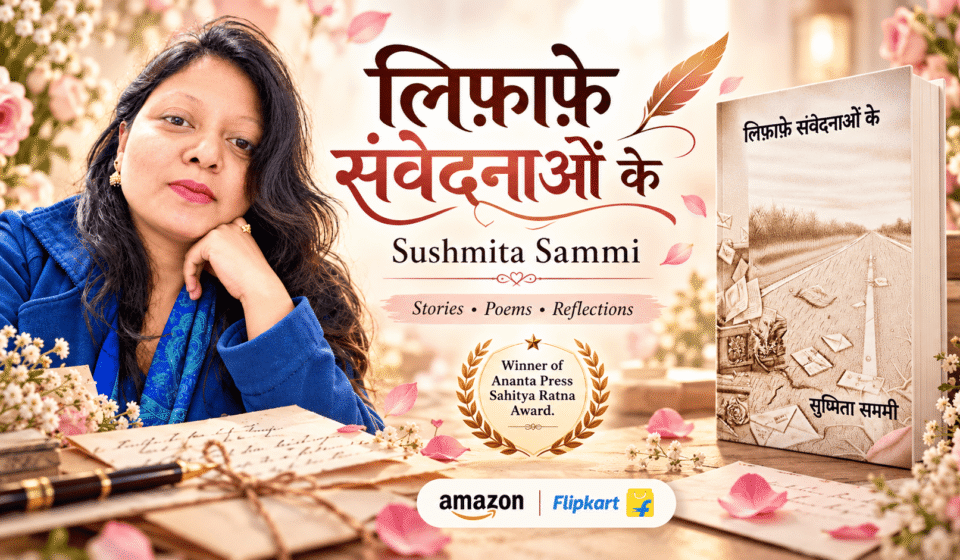

Book: लिफ़ाफ़े संवेदनाओं के — किस्से, कविताएँ और ख़याल | Author: Sushmita Sammi
What should a writer do when an experience does not fit neatly into one genre? A sorrow may be too fleeting for a conventional story, yet too tangled for a short poem. A moment of affection may need narrative context before it becomes meaningful. A spiritual question may resist both plot and rhyme, preferring the openness of reflection. लिफ़ाफ़े संवेदनाओं के: किस्से, कविताएँ और ख़याल by Sushmita Sammi begins with an appealing answer: let the form follow the emotion. Described as a Hindi collection of stories, poetry, and thoughts, the book is interesting not simply for the feelings it examines but for the flexibility of its literary shape. At a time when books are often marketed through rigid categories, its willingness to inhabit the space between forms gives it an immediately recognisable creative character.
Why the form matters
Literary form is not only a container for a subject; it changes the kind of attention that a subject receives. A story can show how misunderstanding accumulates through action and consequence. A poem can pause within one emotional instant and allow its associations to unfold. Reflective prose can speak directly to an uncertainty without pretending to resolve it. Because Sammi’s chosen subjects include love, separation, silence, memory, and healing, each form potentially illuminates a different side of the same interior landscape. The collection’s structure is therefore meaningful rather than merely eclectic. Its variety creates opportunities for movement: from observation to feeling, from the particular to the universal, and from a remembered incident to the questions that incident leaves behind.
This cross-form method also provides an alternative to the familiar expectation that a poetry book must be read as a sequence of separate, self-contained lyrical performances. The presence of stories invites readers to consider emotional circumstance, while the reflections may act as spaces in which a response continues beyond an ending. Together, the three modes can encourage a richer reading habit. One does not only ask what happened, or what a line means, but why an experience might need different voices at different moments. That question is central to the appeal of hybrid collections. They can honour emotional inconsistency without turning it into formal confusion, provided the writer maintains a strong thematic centre. In this book’s stated conception, human sensitivity provides that centre.
The place of Hindi in an emotionally intimate book
Hindi is not a neutral vehicle here. The book’s original title is itself a small study in emotional tone. Lifafe suggests the physical act of enclosing and preserving. Samvednaon suggests not a single mood but an entire field of feeling and responsiveness. Kisse, kavitayein, and khayal bring three related but distinct ways of speaking into proximity. The result is a title that feels personal without becoming obscure. Readers familiar with Hindi expressions of remembrance and longing may hear in it the cadence of conversations, letters, and everyday confidences. Readers approaching contemporary Hindi literature may find in its premise a reminder that the language can accommodate a modern, varied emotional voice without sacrificing warmth or immediacy.
The supplied description calls the writing simple and touching. That description points toward an important aesthetic ambition. Clear language can make poetry hospitable to readers who do not regularly read verse, while reflective prose can introduce literary hesitation and nuance into a familiar conversation. The risk in any accessible emotional writing is that broad statements may replace particular observation. The opportunity, however, is equally significant: an ordinary image or phrase can become powerful when its emotional context is carefully understood. Since the complete texts are not provided, a close assessment of imagery, rhythm, or diction must remain open. What can be appreciated from the available information is the collection’s commitment to communicative clarity rather than exclusivity.
Small pieces, large afterlives
A mixed collection can be unusually friendly to repeated reading. The first encounter with a poem may be shaped by one mood; a second encounter, weeks later, may bring out a different association. A short narrative can be reconsidered after personal experience makes its conflict newly familiar. An observation that once seemed uncomplicated can gain weight over time. This does not require the pieces to be obscure. In fact, the possibility of revisiting an accessible work is one of the strengths of reflective literature. Its significance often changes with the reader rather than with the words on the page. A book concerned with memory and human connection seems particularly suited to that kind of evolving relationship.
Such a reading pattern also changes what counts as an effective ending. In a conventional plot-driven novel, resolution may be a major source of satisfaction. In a poem or reflection, openness can be more appropriate. The reader may close a page with an unanswered question, a feeling of recognition, or a newly available word for an old discomfort. The described combination in Lifafe Samvednaon Ke makes room for these quieter outcomes. Its value can be measured less by the number of dramatic turns it promises than by the opportunities it offers for attention. It is a book whose concept encourages lingering rather than rushing, especially when the reader discovers that a modest phrase reflects something difficult to articulate.
A writer who moves beyond one medium
The author’s profile helps explain why a fluid approach to form might come naturally to her. Sushmita Sammi is presented as a writer working across poetry, emotional prose, spiritual reflection, letters, and screenwriting, with a creative identity in film-related work as Swarnima Sagar. The details are relevant because the movement between media trains different kinds of attention. A screenwriter asks what a character can reveal through action or silence. A poet asks what can be held within a concentrated verbal image. A reflective essayist asks how an experience can be examined without exhausting its meaning. This broad practice need not produce identical qualities in every project, but it does provide a context for the genre-crossing ambition of this particular book.
Her statement that every pain has a voice also helps clarify the project. The challenge is not to make every emotion sound alike simply because each is deeply felt. It is to discover the appropriate distance, length, and perspective for each one. A writer handling remembered love may need one level of intimacy; a meditation on courage after difficulty may require another. A story about human relationships could benefit from characters who disagree, while a poem about loneliness might need only the presence of absence. The collection’s announced breadth makes these distinctions possible. Its most promising artistic principle is that vulnerability can be explored through several lenses rather than confined to a single declaration of feeling.
For whom does this approach work?
Readers who dislike being kept within one emotional register may appreciate the change of pace between forms. So may those returning to reading after a long interruption, or those who want literary material that can fit into short intervals without becoming trivial. The collection’s themes also offer different entry points. Someone may come for the poetry of love and stay for questions of memory. Another may be drawn by reflective thoughts and discover an interest in brief stories. A third reader may treat the book as an invitation to begin writing personal recollections. None of these responses requires advanced literary training; the emotional situations at the centre of the project are widely recognisable.
There is a useful distinction between an easy reading experience and an emotionally lightweight one. Good accessible writing does not need to simplify the complexity of life. Instead, it provides a route into that complexity through language readers can inhabit. This book’s title and description promise precisely that route, using ordinary objects and familiar feelings to organise a potentially varied set of texts. The sense of welcome is part of its reader appeal. For a literary collection, accessibility should not be treated as a secondary virtue. It is often what allows a work to pass from an individual reader into a shared conversation among friends, generations, or members of a family.
A coherent experiment in literary openness
The uniqueness of लिफ़ाफ़े संवेदनाओं के lies in its refusal to choose between narrative, lyric, and contemplation when its subject demands all three. The envelope metaphor gives these different forms an imaginative relationship: each piece can be considered a message, even when the message is addressed inward. This is a persuasive organizing idea. It helps the project avoid being described merely as a miscellaneous compilation and gives the reader a reason to think of its parts as belonging together. Because the available material is descriptive rather than a full manuscript, its success at the sentence and poem level cannot be judged directly. But its creative design, literary accessibility, and emotion-led ambition are clear. For readers who enjoy Hindi literature that crosses formal borders while keeping the human heart in view, this collection offers a thoughtful and inviting point of entry.AMAZON PURCHASE LINK: https://www.amazon.in/dp/8199672064