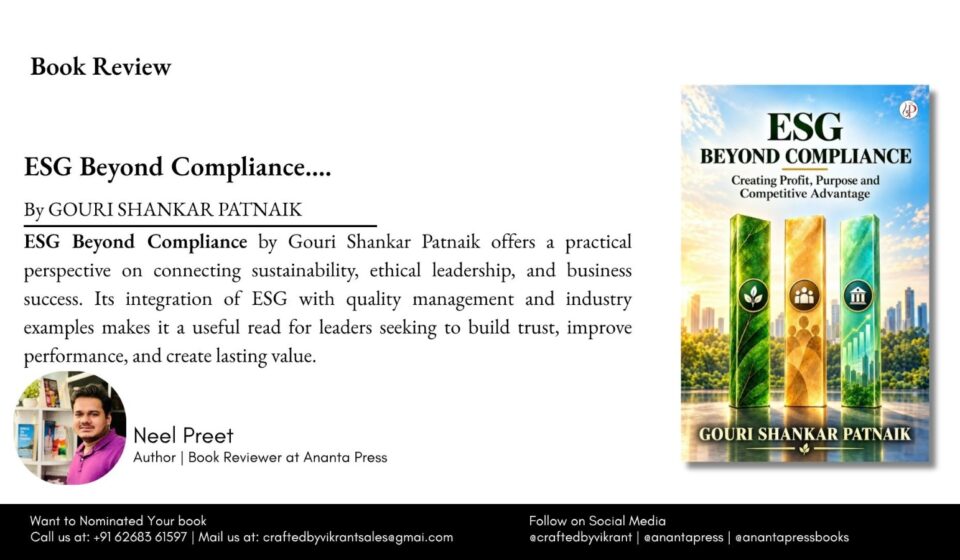
ESG Beyond Compliance: A Practical Guide to Responsible Business and Lasting Value by GOURI SHANKAR PATNAIK

Business success is often measured through revenue, growth, productivity, and market share. Yet these indicators alone cannot explain whether an organization deserves public trust or is prepared for the future. Environmental pressures, employee expectations, ethical responsibilities, and accountability increasingly shape how businesses are judged. In ESG Beyond Compliance: Creating Profit, Purpose and Competitive Advantage, Gouri Shankar Patnaik examines these connections through a practical management perspective. His central argument is clear: environmental, social, and governance principles become valuable when they influence everyday decisions. The book invites readers to see responsible business practices as part of how organizations operate, improve, and create lasting value.
Patnaik brings four decades of professional experience in quality, technology, operations, and organizational development to this discussion. That background gives the book its distinctive orientation. He approaches sustainability through processes, leadership responsibilities, resource use, and continuous improvement. His professional journey, including his involvement with the revival of the Pulp and Paper Research Institute, helps explain his interest in organizational renewal and stakeholder cooperation. These experiences establish the perspective behind the book: sustainable progress depends on disciplined systems and people working toward a shared purpose. Readers familiar with manufacturing or quality management will recognize this emphasis, while newcomers receive an accessible introduction to its relevance.
The book’s strongest idea is that compliance and commitment produce different organizational behaviours. A company may complete disclosures, publish policies, and satisfy reporting requirements while making few meaningful changes to its operations. Patnaik asks what happens after those formal obligations have been met. Are resources being used more responsibly? Are employees safer? Do leaders accept accountability? Are stated commitments reflected in measurable performance? These questions give the discussion practical direction. They encourage readers to examine whether ESG has become part of management or remains confined to documentation. This distinction provides a useful thread connecting the book’s treatment of strategy, governance, operations, and leadership.
Another strength is its explanation of the relationship between profit and purpose. Patnaik presents responsible practices as potential contributors to business performance through efficiency, risk reduction, stronger relationships, and innovation. Energy conservation can lower operating costs, waste reduction can improve material utilization, and transparent governance can strengthen confidence. The value of this discussion lies in making sustainability relevant to familiar management concerns. Rather than leaving readers with broad aspirations, the book identifies pathways through which responsible decisions may support organizational performance. Its argument is especially useful for professionals who must explain sustainability initiatives in terms that operational and financial decision makers can understand.
The environmental sections maintain this practical focus. Energy efficiency, water stewardship, emissions, circularity, and resource optimization are discussed as connected aspects of operational responsibility. The manufacturing perspective gives these themes a clear setting: businesses consume materials and energy, generate waste, and make decisions that affect surrounding ecosystems. Improving those decisions requires attention to processes and performance over time. The book helps readers understand why environmental responsibility cannot be assigned entirely to a separate department. Procurement, production, maintenance, technology, and management all influence outcomes. This organizational view makes the environmental discussion more useful than a treatment limited to general statements about conservation.
Patnaik’s attention to the social dimension gives the book a necessary human foundation. Employee wellbeing, workplace safety, inclusion, community relationships, and stakeholder engagement receive consideration alongside operational performance. The discussion recognizes that businesses depend on people whose contribution cannot be captured fully through productivity figures. Working conditions, respect, opportunities, and trust affect how employees experience an organization and how willingly they contribute to it. The idea that social capital supports business value is persuasive because it connects responsibility with the relationships that sustain daily operations. It also broadens the reader’s understanding of sustainability beyond environmental targets and resource consumption.
The treatment of governance is particularly effective in explaining how organizational intentions become credible. Patnaik connects ethics, transparency, responsible leadership, and accountability with stakeholder trust. Governance emerges as a pattern of decisions and behaviours that people can observe. Policies matter, but their credibility depends on how leaders respond when circumstances become difficult. The book’s questions about fairness, organizational values, and the wider consequences of decisions encourage reflection without making the subject unnecessarily abstract. Readers are reminded that trust grows through consistency: honest communication, fulfilled commitments, clear responsibility, and willingness to address problems. These are practical expectations with direct relevance across industries.
One of the book’s most distinctive contributions is its integration of ESG with quality management. Patnaik explores connections with Total Quality Management, Lean, Six Sigma, continuous improvement, and management system standards. This approach offers an understandable starting point for organizations that already use structured methods to improve performance. Identifying waste, investigating causes, defining responsibilities, measuring outcomes, and implementing corrective action are familiar activities for quality professionals. The book shows how those habits can also support sustainability objectives. This connection gives ESG a workable organizational foundation and demonstrates why professionals outside dedicated sustainability roles can make meaningful contributions to responsible business performance.
The emphasis on measurement further strengthens that connection. Patnaik distinguishes between reporting activity and improving results, directing attention toward relevant indicators, reliable information, and accountability. A target has limited value if nobody owns it, if the underlying data is weak, or if performance receives little management attention. The book therefore encourages readers to connect ESG measures with business objectives and improvement processes. This is a useful corrective to the assumption that producing more information necessarily means making more progress. For managers, the practical lesson is straightforward: measurement should support decisions, reveal gaps, and help teams understand whether their actions are producing the intended outcomes.
Examples involving Unilever, Microsoft, ITC, and the Tata Group provide recognizable contexts for the discussion. Their inclusion helps illustrate how sustainability, innovation, leadership, and stakeholder relationships can intersect within business strategy. These examples are most useful as starting points for understanding approaches that readers might examine in their own settings. Organizations differ in resources, markets, risks, and operational priorities, so application still requires judgment. The book’s broader management principles remain relevant across those differences. Its value lies in prompting readers to ask how responsible practices could fit their circumstances, rather than treating sustainability as a single programme that every company must reproduce identically.
Leadership receives sustained attention throughout the book, and appropriately so. ESG commitments depend on people who allocate resources, establish priorities, review performance, and shape organizational culture. Patnaik recognizes responsibilities at several levels, including senior leadership, quality professionals, middle management, and operational teams. This makes the discussion more complete than an approach focused exclusively on boardroom declarations. Employees learn what matters through decisions they see repeated, especially when competing demands arise. The book encourages leaders to demonstrate consistency between stated values and actual choices. That expectation gives its discussion of purpose a practical test: whether responsibility remains visible in ordinary management behaviour.
The chapters addressing reporting frameworks and harmonization add useful breadth. Readers encounter major approaches such as GRI, SASB, ISSB, TCFD, CDP, and India’s BRSR within a wider discussion of organizational accountability. For someone entering the subject, this helps explain why ESG reporting can appear complex and why consistency matters. The book also considers future developments involving artificial intelligence, climate challenges, digital monitoring, and leadership capabilities. These sections extend its central argument into emerging operational questions. They encourage readers to consider how information, technology, and human judgment can work together in organizations seeking more reliable oversight and better informed sustainability decisions.
The writing is accessible and organized around clear themes, explanatory sections, and summaries. This structure suits readers who want an introduction they can relate to practical responsibilities. The breadth of coverage also means that some topics receive an overview rather than a detailed technical examination. Specialists looking for extensive calculations, implementation templates, or close analysis of individual reporting requirements may need additional resources. Several central messages recur across chapters, particularly the connections between trust, responsibility, and long-term performance. Readers seeking tighter progression may notice this repetition, although it reinforces the book’s teaching purpose and makes individual chapters easier to approach independently.
Overall, ESG Beyond Compliance offers a useful bridge between sustainability principles and familiar management practices. Its strongest contribution is the connection it builds among quality, operational discipline, ethical leadership, employee welfare, and environmental responsibility. Patnaik gives business leaders, manufacturing professionals, quality managers, and students a coherent way to think about these subjects together. The book is most rewarding when read as an invitation to examine organizational habits and improve them. By asking readers to connect commitments with decisions and measurable outcomes, it provides a practical perspective on how businesses can pursue profitability while strengthening the relationships and systems on which lasting success depends.