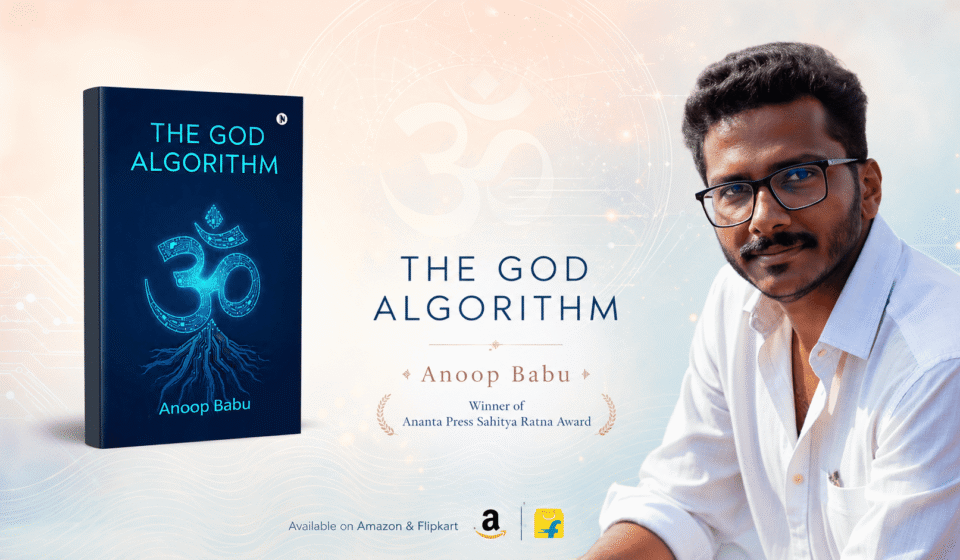

THE GOD ALGORITHM | Anoop Babu | Fiction (General)
The most compelling imaginative act in The God Algorithm is not the creation of a powerful artificial intelligence. Contemporary fiction has already offered many intelligent machines, predictive systems, digital tyrants, and technological saviours. Anoop Babu’s more original decision is to reintroduce the great moral and intellectual temperaments of history as students. By translating the saint, scientist, poet, warrior, rebel, ascetic, and non-violent resistor into the social world of a modern college, the novel makes philosophy young again. Ideas that might otherwise feel monumental, remote, or finished become uncertain, argumentative, emotionally exposed, and urgently alive.
This transformation matters because college is one of the few spaces where a person can still change direction without having to pretend that the earlier direction never existed. Students arrive with inherited identities but quickly encounter competing accounts of truth. A political conviction can be challenged by friendship. A scientific certainty can be disturbed by an ethical dilemma. A spiritual belief can be tested by injustice. A romantic attachment can complicate abstract principles. The campus at Mar Athanasius College of Arts therefore functions as a laboratory of conscience. It allows the novel to ask not simply what famous philosophies once taught, but how those philosophies would behave under twenty-first-century pressure.
The book’s ensemble premise suggests a narrative built on contrast. The saint may view suffering through compassion and transcendence, while the rebel sees structures that must be broken. The scientist may seek evidence and causal explanation, while the poet senses meanings that cannot be quantified. The warrior may insist that delay itself can become a moral failure, while the advocate of non-violence warns that righteous intention does not purify destructive means. The ascetic may question desire at its root, while the politically engaged student argues that withdrawal can become privilege. None of these positions is trivial. Each contains wisdom, and each can become dangerous when isolated from the others.
That is where The God Algorithm gains its dramatic and philosophical force. A “conclave of minds” is interesting only when the minds genuinely disagree. If every character merely confirms one moral lesson, the premise would collapse into allegory. The novel’s promise lies instead in the possibility that truth must be approached through conversation. The human future may depend not on selecting one tradition and silencing the rest, but on discovering how courage, reason, compassion, imagination, resistance, discipline, and non-violence can correct one another. The campus becomes a place where no single worldview is sufficient, yet every worldview may contribute something necessary.
The contemporary crises identified by the book give these conversations real stakes. Social injustice, political division, and artificial intelligence are not separate themes. They interact. Technology can reproduce social prejudice because it learns from human data. Political actors can use digital systems to amplify division. People experiencing injustice can use technology for solidarity, documentation, and resistance, while authorities can use the same tools for surveillance and manipulation. An algorithm does not enter an innocent society. It enters a field already shaped by inequality, ambition, fear, and competing narratives. By connecting AI to social and political questions, the novel avoids the common mistake of treating technology as if it developed outside history.
The title, The God Algorithm, is particularly effective in this context. Modern societies often distrust old forms of authority while quietly granting enormous authority to systems they do not understand. Recommendations determine what people watch. Rankings shape what they value. Automated assessments influence opportunities. Predictive systems create an aura of neutrality even when their assumptions remain hidden. The algorithm can appear objective, invisible, and everywhere—a secular imitation of divine knowledge. Yet unlike a religious conception of God, an algorithm is built, trained, selected, and deployed by human beings. The title therefore carries an implied warning: when we call a system intelligent, we may stop asking whose values it serves.
The students’ role in confronting such power is symbolically appropriate. Young people will live longest with decisions being made now about AI governance, automation, privacy, education, labour, war, culture, and creativity. They are also among the first to experience technology not as an external tool but as an environment. Their friendships, reputations, studies, political identities, and aspirations are mediated through digital systems. Placing the central conflict among students prevents the story from becoming an abstract debate among experts. It makes the future personal.
Anoop Babu’s roots in Kerala add an important cultural dimension to the novel. Kerala has a strong literary culture, a history of public debate, and a social landscape in which religion, politics, education, and modernity often meet intensely. The supplied author background describes a childhood surrounded by Malayalam literature, devotional songs, and philosophical discussion, followed by a career in public-sector auditing. That mixture helps explain the book’s interest in both moral inheritance and systemic accountability. The author seems drawn to the question of how large structures—whether bureaucratic, political, spiritual, or computational—affect individual lives.
The novel also belongs to a developing category of AI-collaborative literature. According to the author’s background, Babu previously explored human-AI interaction in The Doctor’s Dilemma: AI Meets Human and continued that inquiry in The God Algorithm. This continuity is significant. The new book does not appear to use AI merely because the technology is fashionable. It emerges from an ongoing creative and ethical concern. The collaboration between human author and AI co-author mirrors the novel’s central question: can machine intelligence participate in meaning without displacing human responsibility?
From a literary perspective, this self-referential structure is one of the book’s strongest claims to uniqueness. The reader is not only told about collaboration between ancient wisdom and new intelligence; the book itself is an example of human creativity meeting an “inhuman” system. That does not settle the debate about AI authorship. On the contrary, it sharpens it. Which parts of creativity depend on lived experience? Can pattern generation produce insight? Does the author’s role become one of selection, direction, revision, and ethical accountability? The novel invites these questions simply by existing in the form it does.
The campus framework can also make difficult ideas more accessible. Philosophical fiction sometimes intimidates readers because it arrives in dense exposition. A student setting creates opportunities for dialogue, conflict, humour, rivalry, and emotional discovery. Ideas can be embodied in choices rather than delivered only as lectures. A debate about non-violence becomes powerful when a character faces provocation. A theory of detachment becomes meaningful when someone risks losing a relationship. A scientific commitment to evidence becomes complicated when data can be manipulated. The thriller dimension further ensures that decisions cannot remain hypothetical.
The book’s broadness is both its opportunity and its test. With so many symbolic personalities and urgent themes, the narrative must resist reducing characters to labels. A “poet” must be more than sensitivity; a “scientist” more than logic; a “warrior” more than aggression. Readers connect with contradictions. The scientist may be superstitious in private. The ascetic may struggle with pride. The rebel may fear intimacy. The non-violent resistor may experience anger more intensely than anyone else. The more human the students become, the more powerful the philosophical experiment becomes. The premise is strongest when archetype opens into personality rather than replacing it.
For readers, The God Algorithm offers the pleasure of recognition and rediscovery. Familiar traditions can be seen from new angles. Historical wisdom is not presented as museum material but as a living resource. At the same time, the novel does not assume that the past automatically answers the present. Artificial intelligence creates conditions that earlier thinkers could not have encountered in technical form. The challenge is therefore interpretive. What does courage mean when conflict is automated? What does truth mean when synthetic content can imitate evidence? What does non-attachment mean in an economy built on attention? What does non-violence mean when harm can be executed remotely through code?
These are excellent questions for fiction because fiction can show the cost of an answer. An essay can argue that AI requires ethical regulation. A novel can place a frightened person inside the consequences of failure. A lecture can explain political polarization. A story can show how division transforms a friendship. The God Algorithm uses the scale of speculative danger while retaining the intimacy of student life. Its movement from a handful of young people to a choice affecting humanity suggests that private moral formation and public destiny are inseparable.
The book stands out because it treats intellectual history as unfinished. Its great figures return not to repeat famous statements but to encounter a world in which their ideas must evolve through dialogue. The result is a conceptually rich piece of fiction that can appeal to readers of campus novels, philosophical narratives, speculative thrillers, Indian thought, and AI ethics. Above all, it proposes that the answer to technological power may not be another technology. It may be the difficult human practice of listening across difference, testing conviction, and choosing a direction together.
Purchase on Amazon: https://amzn.in/d/0h5eoaSK