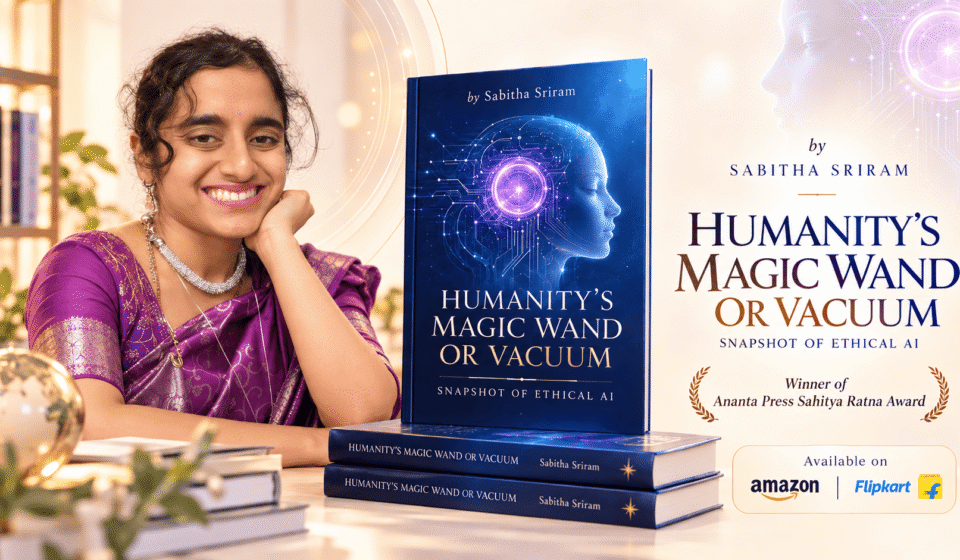

BOOK Humanity’s Magic Wand or Vacuum: Snapshot of Ethical AI AUTHOR Dr. Sabitha Sriram
The language of artificial intelligence is full of impressive capabilities, but the vocabulary of trust is often much less precise. A developer may promise accuracy, a vendor may advertise safety, and an organization may announce that a tool is responsible. None of these labels explains what happens when the system fails. Humanity’s Magic Wand or Vacuum: Snapshot of Ethical AI, by Dr. Sabitha Sriram, is especially relevant when approached from this governance perspective. Its stated concerns include hallucinations, biased outputs, managed risk, regulation, and integration into business strategy. Taken together, those concerns raise a decisive question: how does an institution move from claiming that AI is ethical to showing that its use can be justified?
There is a practical reason this question has become urgent. AI does not remain confined to research environments. Systems are embedded into workflows, attached to databases, used to draft recommendations, and placed in front of customers who may not understand their limitations. The risk profile changes whenever an experimental assistant becomes part of a consequential decision. A mistaken answer in a casual brainstorming session may be inconvenient; an invented detail in an important report may cause genuine loss. Governance begins with recognizing these differences. It requires organizations to judge a system according to the situation in which it operates, not merely the excitement associated with the underlying model.
The book’s emphasis on hallucination gives this discussion a concrete point of departure. The ability to produce convincing language can conceal uncertainty rather than resolve it. A fluent response is not proof of factual grounding, and the more confidently a system communicates, the easier it may be for users to overlook the need for verification. Responsible deployment therefore depends on procedures beyond the algorithm itself. Staff need to know when to check a generated statement, which tasks require independent evidence, and when automation should stop and a knowledgeable human should take over. These are questions about design and organizational culture as much as they are questions about model performance.
Bias presents a different but equally consequential challenge. The word is sometimes used so broadly that its practical meaning becomes blurred. In an AI setting, unfair outcomes may arise because historical records reflect past exclusions, because some groups are poorly represented, or because a model is used in a context unlike the one for which it was assessed. Detecting a statistical imbalance is only the beginning of an ethical evaluation. Institutions must ask whether the imbalance causes disadvantage, who bears the burden, how it can be corrected, and whether the system should be used for that decision at all. A useful governance conversation keeps technical measurement connected to human impact.
Sriram’s identity as both a cybersecurity consultant and an AI ethicist makes the meeting point between protective controls and moral duties particularly interesting. Cybersecurity is accustomed to the idea that threats must be anticipated before a breach occurs. Ethical AI can benefit from a similarly preventive mindset, while recognizing that social harms are not identical to cyberattacks. Privacy loss, discriminatory classifications, misleading recommendations, and overreliance can arise even when no hostile actor is present. An organization cannot secure its way out of every ethical failure. It needs risk analysis that includes normal operation, foreseeable misuse, and failures that emerge gradually as people become dependent on the tool.
The concept of governance is sometimes dismissed as an exercise in writing policies. Effective governance is more substantial. Someone must own the decision to deploy a model. Someone must establish acceptable uses, document assumptions, evaluate suppliers, approve changes, monitor outcomes, and respond when a warning appears. Employees must have the authority to flag a concern without being treated as obstacles to innovation. The public-facing side matters too: individuals affected by an AI-assisted process should have routes for questions, correction, or appeal when appropriate. These practices are examples of the operational implications of the book’s themes, not descriptions of a specific checklist reproduced from its pages.
A notable strength in the book’s underlying proposition is that business strategy and ethical safeguards need not exist in separate departments. If AI is introduced to reduce costs or accelerate decisions, management should include responsible use among the measures of success from the outset. Reliability failures can produce rework. Unfair outcomes can damage legitimacy. Poorly managed data can undermine confidence. These are not abstract issues detached from organizational value. They influence whether the benefits of adoption survive contact with customers, employees, regulators, and the broader community. Ethical planning is most useful when it shapes procurement and product design, rather than arriving as a decorative statement after launch.
Regulation adds another layer of complexity. No single rule can anticipate every technical innovation, and a policy that is too vague may be impossible to enforce. Yet the absence of clear expectations can leave vulnerable people exposed to avoidable experimentation. The balanced approach suggested by this book’s premise is to view regulation as part of responsible innovation: a means of setting boundaries, clarifying accountability, and providing remedies. A credible regulatory culture should distinguish low-risk assistance from high-impact automated judgment. It should also recognize that disclosures alone are insufficient when people have little real choice about interacting with a system.
There is also a question of evidence. AI teams often report average benchmark results, yet averages can hide failure modes that matter most to particular users. Trustworthy deployment calls for testing on relevant tasks, ongoing evaluation, documentation of known weaknesses, and attention to changes after release. An apparently excellent performance score cannot answer whether the system is comprehensible to its operators or whether a small error rate is acceptable in a sensitive setting. Thinking in this way transforms ethics from a statement of intention into a continuing obligation to investigate, learn, and revise.
For readers approaching the volume as an academic work, the phrase Snapshot of Ethical AI is an important boundary. A snapshot can organize the central dilemmas without pretending that one book settles all technical debates or regulatory questions. The value of such a work lies partly in clarifying the relationships between subjects that are too often separated: cybersecurity, fairness, strategy, organizational responsibility, and public welfare. Readers seeking a detailed implementation standard would still need current technical guidance and relevant legal advice. That is not a criticism of a book framed around an ethical overview; it is a sensible distinction between establishing principles and implementing them in a specific institution.
What makes the theme compelling is its insistence that problems be considered before they become scandals. Responsible organizations do not wait for a harmed user to prove that an overlooked risk was real. They establish oversight because uncertainty is part of modern technology. They communicate limitations because confidence should be earned. They resist the temptation to treat an external vendor’s promises as a substitute for their own accountability. These points make the book’s central argument meaningful for engineers, compliance professionals, researchers, administrators, and executives who increasingly find themselves responsible for technology they did not personally design.
Humanity’s Magic Wand or Vacuum can therefore be read as an invitation to redefine what a successful AI project looks like. Success is not simply faster output, lower cost, or a launch completed on schedule. It is a system whose purpose is defensible, whose risks are understood, whose performance is checked, and whose consequences remain answerable to human beings. Dr. Sabitha Sriram’s focus on human-centered ethics and managed risk gives a clear direction to that effort. Trust is not a feature added at the end of development. It is the result of choices made continuously, especially when those choices are inconvenient. That is the lasting governance lesson suggested by this work.
AMAZON PURCHASE LINK https://www.amazon.in/dp/9362880296