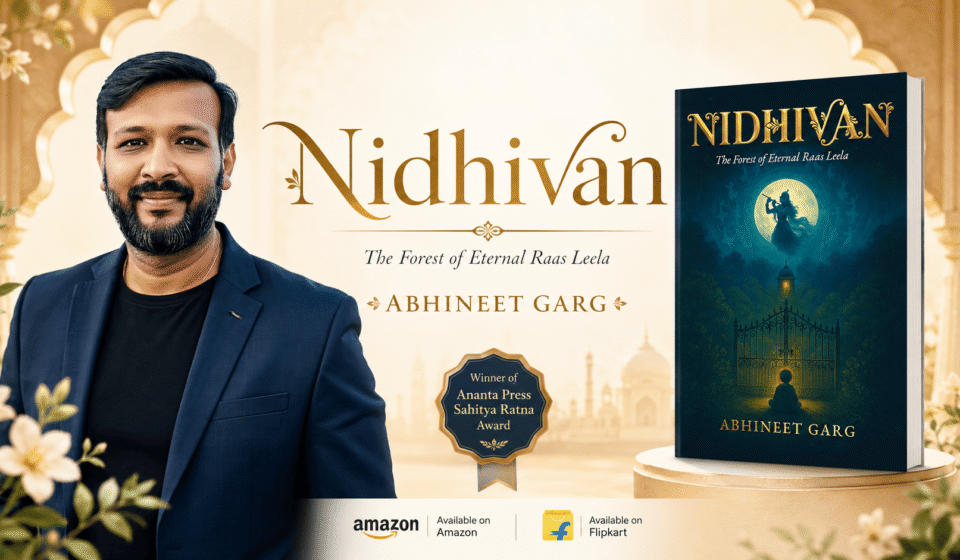

The most memorable mysteries are rarely built around a single secret. They are built around different people who encounter the same secret and emerge changed in different ways. Abhineet Garg’s Nidhivan: The Forest of Eternal Raas Leela succeeds because its narrative architecture understands this principle. Rather than following one investigator along a straightforward path, the novel presents three seekers across three timelines, then connects their unfinished journeys through a narrator who inherits the mystery decades later. This structure gives the book the depth of an archive, the momentum of a thriller, and the emotional gravity of a spiritual testimony.
At the centre of the novel is Nidhivan, the sacred grove of Vrindavan associated with the belief that Radha and Krishna continue their eternal Raas Leela after sunset. The location is already charged with devotional meaning, ritual caution, and forbidden curiosity. Garg uses this cultural foundation with restraint. The grove is not treated merely as an exotic setting for supernatural events. It functions as the central intelligence of the story, a place that reveals different truths depending on the person who approaches it. The question is not only what happens there at night. The more important question is what happens inside a human being who becomes determined to find out.
The first timeline, set in 1985, belongs to Anirudh Narayan. He is an NRI journalist whose instinct is to turn legend into investigation. His professional identity makes him an ideal opening protagonist because journalism depends on evidence, witnesses, documents, and verifiable sequences of events. Anirudh arrives with the confidence that the stories surrounding Nidhivan can be exposed as superstition, explained as ritual theatre, or shaped into a sensational publication. This initial arrogance creates tension before anything overtly mysterious occurs. The reader senses that his greatest vulnerability is not ignorance but certainty.
As Anirudh documents the rituals of Rang Mahal, the seven locks, the offerings, and the warnings associated with sunset, his investigation begins to lose its professional distance. The movement from skepticism to obsession is crucial. A weaker thriller might simply confront a rational man with a spectacular supernatural event. Garg chooses a more psychologically convincing path. Anirudh is drawn inward step by step. Each unexplained sign becomes less an answer than an invitation to continue. The seventh day becomes not just a deadline in an investigation but the point at which his identity as an observer can no longer protect him.
The second timeline, set in 1988, follows Radha, a young student. Her name itself carries devotional resonance, but the novel does not rely on symbolism alone. Radha approaches Nidhivan through emotion, longing, and personal meaning. This shift is important because it prevents the book from repeating the same investigation with a different character. Where Anirudh seeks proof, Radha seeks connection. Her openness makes her sympathetic, but it does not make her safe. The novel is perceptive about the hidden complexity of devotion. A sincere longing to witness the sacred may still contain impatience, self-centred desire, or the wish to possess an experience that should remain beyond possession.
Radha’s storyline therefore deepens the mystery rather than merely adding sentiment. She shows that Nidhivan’s power cannot be understood through a simple opposition between believer and skeptic. Belief itself can become demanding. Faith can carry grief. Surrender can be confused with emotional desperation. Through her, the forest becomes a spiritual mirror, reflecting not just what a person believes but why they believe it and what they hope the divine will give them in return.
The third timeline, set in 1990, belongs to Meera, a historian. Structurally, she arrives at the ideal point in the narrative. After the reader has witnessed the limitations of rational arrogance and devotional longing, Meera offers a third method: disciplined inquiry shaped by respect. Her work connects temple rituals, sacred geography, oral histories, and the symbolic network surrounding Vrindavan. Rang Mahal, Lalita Kund, Gopeshwar Bhagwan, Swami Haridas’s legacy, Radha temples, and the Ashta Sakhi tradition are not introduced as a list of references. They become parts of a cultural map that suggests the mystery is larger than one location.
Meera’s importance lies in her recognition that history and faith do not need to be enemies. A historian can document traditions without assuming that documentation exhausts their meaning. She can compare testimonies while admitting that some experiences resist classification. This humility brings her closest to the truth, yet the novel remains consistent in refusing to turn truth into a prize. Even the most balanced seeker must confront the possibility that knowledge has ethical boundaries. Something may be real and still not belong to the person who discovers it.
The three timelines are unified by repetition and variation. Similar signs appear, but they do not carry identical meanings. The sacred grove remains constant, yet each seeker sees a different face of it. This technique gives the novel an almost musical pattern. Anirudh’s rational confidence, Radha’s emotional yearning, and Meera’s historical discipline become three movements in a single composition. Their stories echo one another without collapsing into sameness. Each journey reveals a piece of the mystery, but each also leaves an absence.
That absence becomes the inheritance of a five-year-old boy who later grows into the narrator. Forty years after the events, he attempts to collate documents, memories, testimonies, and fragments left behind by the three seekers. This present-day frame is one of the book’s most effective choices because it transforms the narrative from a sequence of supernatural encounters into a meditation on transmission. Mysteries survive because someone remembers them. They change because memory is incomplete. They gain power because the people who inherit them are forced to imagine what the missing pieces might contain.
The narrator is not simply solving an old case. He is confronting the shape that the case has given his own life. His childhood memory of Meera’s final account becomes a seed that grows for decades. By the time he begins assembling the past, the investigation is inseparable from identity. This gives the climax emotional weight. The return to the forbidden question is not motivated by curiosity alone. It is the completion of a journey that began before the narrator was capable of choosing it.
From a craft perspective, the multi-timeline design allows Garg to control information carefully. Each era can answer one question while creating another. A document discovered in the present may alter the meaning of an event in 1985. A ritual observed by Radha may echo something Anirudh misunderstood. Meera’s scholarship may reveal that an apparently isolated detail belongs to a much older spiritual pattern. This layering keeps the mystery active without depending on arbitrary twists.
The novel’s suspense also benefits from its historical distance. The late 1980s and 1990 setting reduces the presence of instant communication, digital recording, and online verification. Investigation becomes slower, more physical, and more dependent on notebooks, witnesses, temple records, personal trust, and memory. The absence of modern technological certainty suits a story concerned with things that refuse to be captured. Even when evidence exists, it remains fragile. Paper can disappear. Testimony can be dismissed. Memory can be distorted. Sacred silence can outlast documentation.
Yet the book is not interested in nostalgia for a supposedly more mysterious age. The present-day frame makes clear that modernity has not eliminated the fundamental human hunger to know. Technology may improve the tools of investigation, but it cannot remove the spiritual and psychological motives behind the investigation. The narrator’s return to the mystery demonstrates that the unanswered question has become more powerful, not less, with time.
What makes Nidhivan distinctive is the way its structure embodies its theme. No single timeline can possess the truth. No single worldview is sufficient. Logic identifies patterns but can become arrogant. Devotion opens the heart but can become consuming. Scholarship creates context but must accept limits. Only by placing the three journeys beside one another can the reader see the larger movement from certainty to humility.
For readers who appreciate carefully layered storytelling, this is a rewarding book. The three protagonists create variety in tone and perspective, while the central mystery gives the narrative unity. The cultural setting provides authenticity and emotional resonance. The supernatural elements remain connected to spiritual tradition rather than becoming generic horror devices. The present-day narrator adds the ache of inheritance and unfinished memory.
Nidhivan: The Forest of Eternal Raas Leela is therefore not simply a novel about a forbidden forest. It is a novel about how truth changes according to the person who seeks it, and how incomplete encounters can shape lives across generations. Abhineet Garg uses three timelines not as a formal trick but as a philosophical design. Each seeker reaches the edge of understanding, and the reader is left to consider whether the final step is discovery, surrender, or silence.
PURCHASE THE BOOK