The Human Matrix: How Darsh Jain Makes Us Question Money, Nations, Belief, and the Stories We Live By

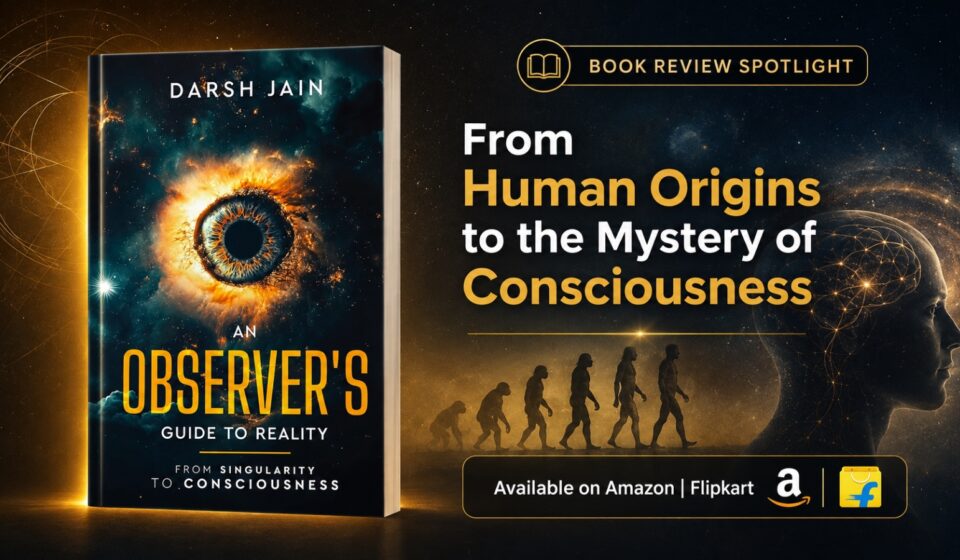
One of the most striking parts of An Observer’s Guide to Reality is the moment when the book moves from biological evolution to the world humans have built inside their minds. By then, Darsh Jain has already taken the reader through the universe, the Earth, life, primates, hominins, and Homo sapiens. Then comes a different question: if human beings are biological organisms like other animals, why do we live inside systems that no animal could understand? Why can a number in a bank account control our choices? Why can a flag move a crowd to tears? Why can a border that does not physically exist in the landscape decide who is allowed to cross it? Why can a title, law, god, company, or nation have power over millions of people? The chapter The Human Matrix makes this the centre of attention, and it is one of the strongest reasons to read the book.
Jain uses the idea of “imagined orders” to explain these systems. The phrase does not mean that money, nations, justice, or laws are meaningless. It means that they belong to a special kind of reality created through shared human belief. A tree exists whether anyone believes in it or not. Currency works only if enough people trust it. A flag is physically cloth, but a nation may see history, sacrifice, identity, pride, and belonging in it. A constitution is ink and paper at the material level, but its words can define rights and institutions because people collectively accept its authority. This distinction between physical reality and intersubjective or shared reality is presented in simple language, making a complex social idea immediately understandable.
The importance of this idea is that it changes how we look at power. Many forms of power appear solid because they have been around for so long. We may assume that institutions are natural, permanent, or inevitable. The book asks us to look again. Kingdoms, religions, markets, castes, class systems, political borders, legal codes, and social status all depend on stories people continue to tell and accept. A king is not powerful because gold physically creates authority. A king is powerful because an entire network of people behaves as though the crown stands for authority. A company exists because laws, records, employees, banks, customers, and governments recognize it. Such systems are extremely real in their effects, but their foundation is cooperation around symbols and rules.
This is also where the book connects imagination to human success. Jain does not present imagination only as daydreaming. For Homo sapiens, imagination is a survival technology. It allows us to coordinate around things that are not immediately present. A small group of animals can cooperate through direct relationships, but millions of humans can cooperate because they share ideas. People who have never met can use the same currency, follow the same traffic laws, support the same institution, or feel connected to the same nation. Shared stories let strangers trust one another enough to build cities, universities, hospitals, markets, and governments. The Human Matrix therefore does not simply attack human fictions; it shows their double nature. They can organize civilization, but they can also imprison thought.
Religion is treated in this same evolutionary and psychological frame. The book asks why human beings began seeing spirits, gods, sacred forces, or divine intention in nature. It connects belief to fear, uncertainty, grief, pattern-making, social order, and the need for explanation. A storm can be understood as atmospheric activity, but before such explanations existed, the human mind still wanted a cause that could be named. Death created an even deeper problem. The body stops moving, but love and memory continue in the survivors. Stories about souls, ancestors, heavens, rebirth, and divine worlds can give shape to that silence. Jain’s discussion can challenge religious readers, but its most valuable point is not mockery. It is the attempt to understand why belief feels so natural to a meaning-making species.
The book also shows how belief can move from comfort to control. Once a story becomes shared, people may build authority around it. Priests, rulers, institutions, and communities can connect obedience with virtue. The same belief that unites a group can define who belongs and who does not. The same identity that gives a person strength can create suspicion toward outsiders. This is why the Human Matrix is not merely historical. It speaks directly to modern life. People still divide themselves by religion, nationality, ideology, community, profession, language, and political identity. These categories can be useful, but they can also become invisible cages when we forget that humans created them.
Money may be the clearest everyday example. A currency note cannot feed us by itself. A digital balance is only a pattern stored in a system. Yet both can purchase food, land, travel, education, or labour because society agrees that they represent value. This shared trust is one of humanity’s most successful inventions. It allows complex exchange across enormous distances. At the same time, it also shows how strongly our emotional lives can be shaped by abstract systems. People can feel shame, pride, anxiety, security, superiority, or failure because of numbers that exist within an economic story. The book’s value is in making us notice these hidden relationships between symbols and feelings.
The discussion of nations works in a similar way. Rivers do not stop at political borders. Mountains do not know which country claims them. Yet human beings can feel profound attachment to a national identity. Stories of independence, sacrifice, victory, language, heroes, songs, flags, and shared memory turn geography into belonging. Jain shows how imagined borders become real through institutions, education, documents, armies, and collective emotion. Again, the point is not that nations are useless. The point is that they are created realities. Once we recognise that, we can ask more intelligent questions about what purpose they serve, when loyalty becomes harmful, and whether human beings can cooperate across the identities they inherited.
This is why the book matters for readers interested in sociology, politics, history, psychology, or culture even though it is not written as a specialist textbook in any of those fields. It gives a unifying question: what happens when a biological brain becomes capable of language and shared imagination? From that question, many familiar parts of human life begin to look different. Marriage, property, law, religion, currency, hierarchy, moral codes, status, and nationality can all be examined as systems of agreed meaning. Some help people live together. Some protect rights. Some preserve memory. Some create exploitation. Most do more than one thing at the same time.
The practical benefit for the reader is greater self-awareness. Once we learn to notice imagined orders, we can also notice how they live inside us. Which identities did we choose, and which were given to us? Which ambitions came from genuine interest, and which came from social expectations? Why do we feel successful when a system rewards us? Why do we feel insulted when a symbol we identify with is criticized? Why do we assume that a custom is natural simply because it is old? These questions do not require us to reject society. They simply help us see the difference between what exists physically and what exists because human minds keep repeating it.
An Observer’s Guide to Reality is worth reading because it makes the invisible architecture of civilization visible. After reading the Human Matrix sections, it becomes difficult to look at money, flags, offices, rituals, status, and institutions in quite the same way. The reader begins to see the layer of imagination that sits on top of matter. That can be unsettling, but it can also be liberating. If human beings created many of the systems that shape us, then human beings can also question, improve, or replace them. The book’s larger message is not that reality is fake. It is that reality has layers, and understanding which layer we are dealing with is essential. The physical universe does not need our agreement. Human society does. Knowing the difference is one of the clearest forms of intellectual freedom this book offers.
Why readers should consider this book
- It explains why money, nations, laws, symbols, and social identities can have real power despite being human constructions.
- It shows how imagination supports both cooperation and conflict.
- It gives readers a practical way to examine inherited identities and social assumptions.
Book link: https://www.amazon.in/dp/934747276X