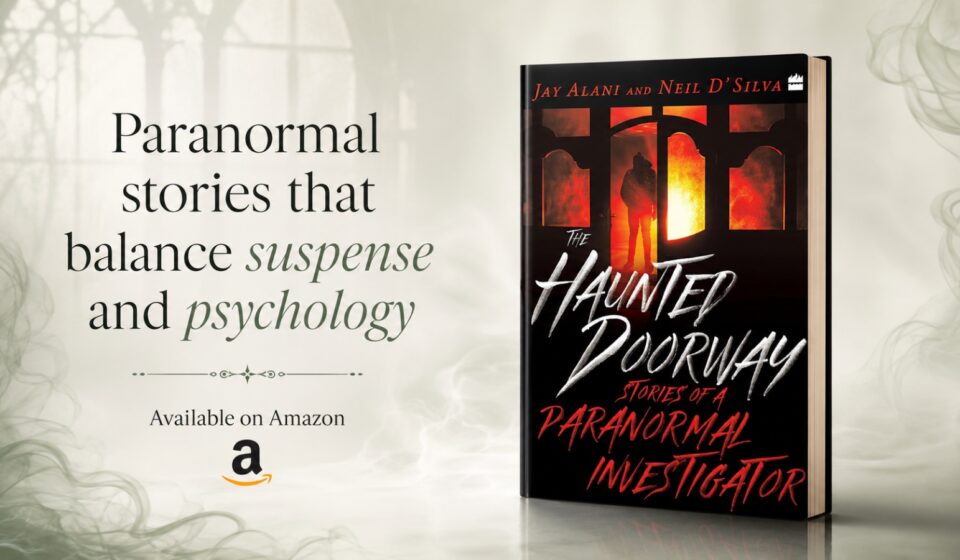
Ten Doorways into Fear: Reading Jay Alani and Neil D’Silva’s Paranormal Collection

A case-by-case structure gives this anthology speed, variety, and the addictive rhythm of a late-night investigation.
A collection built for curiosity
There is a special pleasure in a horror anthology. A novel asks the reader to enter one nightmare and remain there. Acollection offers multiple doors, each leading to a different architecture of fear. The Haunted Doorway contains ten storiesconnected by the perspective and experience of paranormal investigation. That shared frame gives the book coherence, whilethe changing cases prevent repetition. A doll, a dangerous entity, a stalking presence, an unexplained doorway, a dream figure, astrange natural image, or a culturally specific legend can each generate a separate emotional world.
The case-file rhythm
The collection’s structure resembles the rhythm of a case: a report is received, a witness describes the disturbance, theinvestigator enters an unfamiliar environment, details are tested, explanations compete, and the case moves toward resolutionor uncertainty. This pattern is naturally suspenseful because it places the reader in an active role. We are not simply being toldthat something frightening exists. We are asked to notice inconsistencies, evaluate testimony, and decide when coincidencebecomes pattern. The investigative frame also creates a satisfying beginning and ending for each story, making the book easyto read in short sessions.
Fast pacing without losing the atmosphere
Reader responses repeatedly praise the book’s pace. The stories move quickly and avoid unnecessary detours, but speeddoes not mean that atmosphere disappears. Effective short horror must establish location, emotional vulnerability, and thecentral disturbance with economy. The Haunted Doorway uses recognisable details—a domestic space, a recurring fear, a localstory, a physical object, or a family tension—to make each situation immediate. Once the reader understands what may belost, the supernatural possibility becomes more than a visual effect.
Different stories activate different fears
A varied collection recognises that readers are not frightened by the same things. Some fear possession or loss of bodilycontrol. Some fear being watched. Some fear objects that carry a history. Some fear the dead, while others fear the livingperson using a supernatural claim as a disguise. Dream states, dolls, stone eyes, unfamiliar fungi, female apparitions, allegeddemons, and haunted thresholds each draw on a separate anxiety. The book’s range allows readers to discover which imagesstay with them. One story may cause a physical shiver; another may produce sadness; another may lead to research; andanother may become disturbing only hours later.
The value of named stories
Titles such as The Demonic Doll, Dead Man’s Fingers, The Red Lady’s Ghost, Qarinah, The Wonder Witch of Dreams, TheWoman with the Stone Eyes, and The Haunted Doorway function almost like exhibits in a cabinet of curiosities. Each titleprovides an immediate image while withholding context. The reader enters with expectations shaped by horror traditions,then watches those expectations being challenged by investigative questions. This is an effective strategy because the titlepromises a supernatural object or presence, but the story can still complicate what that presence means.
The collaboration at the centre of the book
The book is credited to Jay Alani and Neil D’Silva, and its identity depends on the meeting of two kinds of expertise. Alanicontributes the perspective of a paranormal investigator who has spent years examining claims, interviewing frightenedpeople, entering charged environments, and distinguishing evidence from assumption. D’Silva contributes the craft requiredto transform investigative material into fiction with voice, suspense, and emotional shape. The combination allows the bookto feel informed without becoming clinical and dramatic without becoming careless.
Fear becomes a form of character study
Every paranormal case is also a story about the person reporting it. What does the witness believe?
What has recently happened in the person’s life? Who benefits from the supernatural explanation? Who is being ignored? Is thefear isolating the witness or giving the witness a language for something that cannot be spoken directly? Horror is oftenstrongest when the entity is connected to a human conflict. A haunting can become a metaphor for guilt, grief, power, abuse,loneliness, or suppressed memory. The collection’s psychological dimension gives the stories this additional layer.
The unresolved ending as an ethical choice
Some readers may prefer every mystery to be solved. Yet in a collection based on paranormal inquiry, an unresolvedending can be more honest than a forced revelation. Real investigations do not always produce complete information.Witness accounts conflict. Evidence is contaminated. Environmental conditions change. An event may not recur. Apsychological possibility may be plausible but unconfirmed. Leaving a small number of cases open acknowledges the limits ofknowledge. It also allows the reader to continue the investigation privately.
Accessible prose broadens the audience
The Haunted Doorway is written in a style that invites readers who may be new to horror. The language is direct, thesituations are easy to enter, and the stories do not require specialist knowledge. At the same time, terms related topsychology, folklore, and unusual natural phenomena give curious readers opportunities to learn. This balance is important.Horror can become inaccessible when it is either too obscure or too dependent on graphic excess. Here, readability becomespart of the suspense because the reader moves forward quickly and may not notice how deeply the atmosphere has settleduntil the story ends.
A book made for conversation
The collection is likely to generate debate. Which cases were psychological? Which felt genuinely unexplained? Whichcultural beliefs were familiar? Which stories were most frightening? Would a sceptic and believer interpret the same scenedifferently? These questions make the book suitable for reading groups, podcast discussions, online reviews, andconversations between people who approach the paranormal from opposing positions. The stories are complete, but theinterpretations remain open enough to travel beyond the page.
Why short horror suits the modern reader
The anthology format also suits the way many readers now encounter paranormal storytelling.
Podcasts, episodic series, online case discussions, and short-form videos have trained audiences to enter one mystery at atime. The Haunted Doorway uses that familiarity without becoming fragmented. Each story can be read independently, but therecurring investigative mindset creates continuity. This makes the book easy to pause and return to, while also encouragingthe classic mistake of saying “one more story” late at night. The form is especially effective for readers who are curious abouthorror but hesitant to commit to a long, intense novel. If one premise feels too disturbing, the next offers a different tone and cultural frame. Short fiction also concentrates the final image. There is less time for fear to dissolve through explanation, so asingle unresolved detail can remain vivid. In this collection, brevity becomes not a limitation but a pressure chamber in whichatmosphere, research, and emotional conflict are compressed until the doorway opens. The compact structure alsostrengthens memory. Readers may forget the exact order of a longer plot, but they remember the doll, the strange fungus, thewoman with stone eyes, or the threshold that should not have mattered. Each story leaves behind one portable image, andthose images begin to form a private catalogue of fears. That afterlife in the reader’s imagination is one of the clearest signsthat the collection understands its chosen form.
Final verdict
As a collection, The Haunted Doorway is cohesive without being repetitive. Its ten-story format allows Jay Alani and NeilD’Silva to explore multiple forms of fear while maintaining a consistent investigative intelligence. The stories are fast,atmospheric, and grounded in the idea that every extraordinary claim deserves both compassion and scrutiny. Readers whoenjoy case-based narratives, folklore, psychological suspense, and short fiction will find the book easy to continue anddifficult to dismiss. Each doorway may lead somewhere different, but all of them return to the same unnerving question: howmuch of what frightens us can be explained, and what do we do with what cannot?
Buy Now: https://www.amazon.in/Haunted-Doorway-Stories-Paranormal-Investigator/dp/936989652X