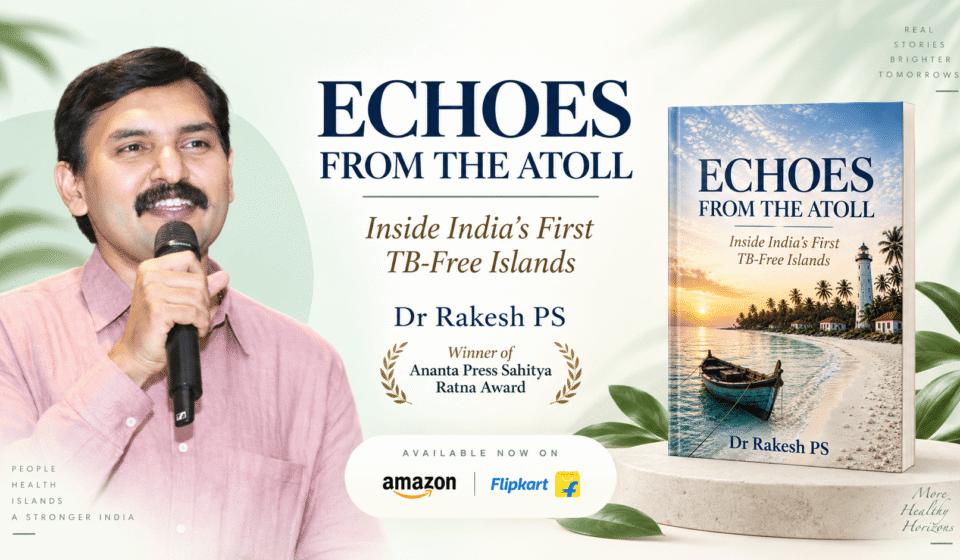

One of the most memorable qualities of Echoes from the Atoll: Inside India’s First TB-Free Islands is the way Lakshadweep emerges not as scenery but as a character with its own rhythms, distances, constraints and emotional force. Dr Rakesh PS uses the islands to show that place matters profoundly in the way people live, form relationships, imagine the future and organise healthcare. The result is a book that can be read as a public health memoir, but also as a thoughtful portrait of a community shaped by the sea.
Many books about remote locations begin with beauty. Lakshadweep certainly offers that possibility, with its islands, sea routes and distinctive geography. Yet this memoir appears interested in a more demanding question: what does remoteness actually mean when one is responsible for reaching people, delivering health services and building a collective public health mission? Distance between islands may look small on a map, but the lived reality is different. Travel depends on the sea. Weather can matter. Movement takes planning. Access cannot be assumed. These details transform geography from background information into a force that influences the design of the health system itself.
This emphasis is important because public health discussions often become abstract. Policies are written at national or state level, while programmes are assessed through broad indicators. Echoes from the Atoll brings the reader closer to the ground – or, more accurately, closer to the shore. It demonstrates that a programme can succeed only when it understands the physical and social landscape in which it operates. What works in a large mainland city cannot simply be copied into an island setting and expected to function in the same way.
That insight gives the book relevance beyond tuberculosis. The story of Lakshadweep becomes a case study in contextual thinking. Health systems are not machines that operate identically everywhere. They are relationships embedded in real places. Sea routes, island populations, community structures and local trust all influence whether people can be reached and whether an initiative becomes meaningful. Dr Rakesh’s account gives readers an opportunity to understand this principle not as a theory but as lived experience.
The author’s personal movement through the islands also appears to shape the book’s emotional tone. What begins as a professional assignment gradually becomes something more intimate. This transition is one of the memoir’s strongest features. A professional can arrive in a place with objectives, responsibilities and timelines, but prolonged engagement changes the relationship. The place starts to become associated with particular people, routines and memories. It can become familiar enough to feel like home while remaining distinct enough to continue teaching the outsider something new.
This gradual deepening of connection allows the memoir to explore belonging without becoming sentimental. The question “What makes a place home?” sits beneath much of the narrative. Home is often understood as a birthplace, permanent residence or inherited identity. The book complicates that idea. A place may enter a person’s sense of self because of work, service, friendships, shared challenges and repeated journeys. At the same time, the author remains attentive to the fact that the islands belong first to the communities who have lived there across generations. This tension gives the idea of belonging depth rather than simplicity.
The TB-free journey forms a powerful thread through this landscape. The achievement matters, but the memoir’s method is to show how it grew through people. ASHAs, health workers, families and community leaders are not presented as supporting actors in somebody else’s project. They appear to be central participants in turning an institutional goal into a community aspiration. This is perhaps one of the most important lessons of the book: a health programme gains strength when people begin to see the goal as their own.
In a geographically dispersed island setting, that shared ownership becomes even more significant. The image of a dream being carried from one home to another, from one island to the next, has both practical and symbolic power. It reminds the reader that public health is often built through repetition: conversations, visits, follow-up, trust, reassurance and persistence. These acts are not dramatic, but over time they can change what a community believes is possible.
The memoir also captures Lakshadweep at a moment of transition. Tradition and modernity meet throughout the book’s described themes, creating a bittersweet atmosphere. This is not merely a matter of new technologies or changing infrastructure. Modernity can bring expanded aspirations, new forms of mobility and new expectations, but it can also alter the relationships and practices through which a community understands itself. The book’s willingness to hold both sides of that process is one of its strengths.
It would have been easy to romanticise island life as timeless and untouched. It would have been equally easy to celebrate every form of change as inevitable progress. Echoes from the Atoll appears to resist both extremes. Instead, it asks what is preserved, what is lost and how communities negotiate the future without losing a sense of identity. These are universal questions, but the island setting makes them especially vivid because geographic boundaries often intensify the visibility of social change.
The author is particularly well positioned to tell this story. Dr Rakesh PS has more than fifteen years of experience in public health, including work with major health organisations and disease-elimination initiatives. His scientific background means he understands the structures behind the TB-free effort. Yet his decision to write a literary memoir rather than a technical report changes the experience for the reader. The focus shifts from explaining a programme to understanding a place and the people who made the programme possible.
That shift also reveals the evolution of the author himself. His earlier work in outbreak investigation emphasised the human dimensions of field epidemiology, including trust, empathy, uncertainty and ethics. Echoes from the Atoll takes that concern further. Here, the professional is not only interpreting events; he is reflecting on how the experience has changed him. The memoir therefore becomes an account of reciprocal transformation. The author contributed to public health work in Lakshadweep, but Lakshadweep also shaped the author.
This reciprocity is an important ethical quality in writing about communities. Too often, books about development or health portray communities mainly as beneficiaries, populations or subjects of intervention. That language creates a one-directional relationship: professionals act, communities receive. The material presented for Echoes from the Atoll suggests a more balanced understanding. Communities contribute knowledge, trust, commitment and meaning. The professional also learns, changes and carries something away.
The book’s accessibility deserves attention as well. A reader does not need a medical degree or knowledge of tuberculosis policy to appreciate its themes. Someone interested in travel writing may be drawn to the island journeys. Someone interested in sociology may focus on tradition, modernity and identity. A public health professional may recognise the importance of community ownership and context-sensitive systems. A general reader may simply connect with the universal question of how people become attached to places and to one another.
This wide appeal is part of the book’s uniqueness. It occupies a space between genres without feeling directionless. Travel memoir gives it movement. Social chronicle gives it context. Personal reflection gives it emotional depth. Public health gives it purpose and stakes. The strands reinforce rather than compete with one another because they all return to the same central subject: people living together in a particular place while trying to create a healthier future.
The title is especially effective when viewed through this lens. An atoll is geographically specific, but an echo is emotional and temporal. Echoes are what remain after an encounter. They can travel, weaken, return and take on new resonance depending on the space through which they move. Dr Rakesh’s memories of Lakshadweep seem to function in precisely this way. The assignment may have ended, but the questions of community, belonging and change continue to reverberate.
The international release of the book in the presence of global health leaders is fitting because the story is rooted in a local experience with wider relevance. TB elimination is a global goal, but the book shows why global goals are ultimately realised in very local settings. They are achieved through specific people working within specific cultural and geographic realities. That relationship between global ambition and local action gives the memoir significance beyond the islands themselves.
Echoes from the Atoll is therefore valuable not because it offers readers a simple formula for replicating success, but because it encourages a better way of seeing. It asks us to notice place. It asks us to notice the people whose work is often hidden behind official achievements. It asks us to understand change as both opportunity and loss. And it asks us to reconsider the meaning of home.
For readers who want to encounter Lakshadweep beyond postcard imagery, this book offers an unusual entry point. It presents the islands through service, travel, conversation, community effort and reflection. For readers interested in public health, it demonstrates why geography and culture cannot be treated as side issues. For anyone concerned with belonging, it offers a moving reminder that places shape us most deeply when we stop seeing them merely as locations.
In the end, the TB-free milestone gives the story historical importance, but Lakshadweep gives it soul. The islands are not simply where the events happen. They are part of why the events unfold the way they do. That is what makes Echoes from the Atoll a distinctive work of nonfiction and a memorable portrait of public health rooted in place.
Amazon Link: https://www.amazon.in/Echoes-Atoll-Inside-TB-Free-Islands/dp/9375002454