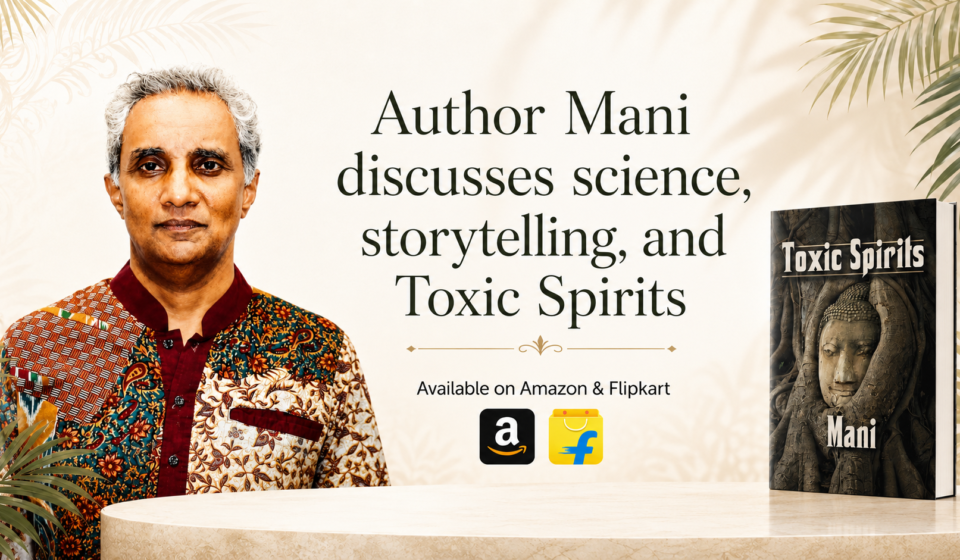
Inside Toxic Spirits: A Conversation with Mani on Thailand, Genetic Power, Identity, and the Ethics of Science

The writer, scientist, and former professor discusses the real-world experiences behind his debut novel, the creation of Benton and Pierre, the role of biodiversity, and why thrillers can ask serious moral questions.
Toxic Spirits is a highly atmospheric thriller set largely in Thailand, where the beauty of the landscape and the energy of expatriate life conceal a disturbing medical experiment. The novel follows Benton, a widowed African-American former intelligence analyst who becomes involved in the disappearance of Siri, a tribal singer who had spoken out about harmful drug trials conducted on her hill-tribe. His investigation leads him toward Pierre, a brilliant and deeply unstable doctor, and eventually turns Benton himself into an unwilling subject of genetic manipulation.
The novel brings together international intrigue, biotechnology, tribal healing, biodiversity, romance, violence, dark humour, and a genetics-inspired exploration of multicultural identity. Mani’s own life gives him an unusual perspective on these subjects. Born in India and educated across four continents, he has worked as a professor and scientist in the United States and held affiliations with institutions including Georgetown University, Yahoo, Cambridge University, MITRE, Brandeis University, and MIT. He later retired early from Silicon Valley to Thailand, where he volunteered in the Golden Triangle with a hill-tribe that helped inspire the community fictionalized in Toxic Spirits.
In this detailed interview, Mani reflects on the experiences and questions behind the novel. The responses below are publication-ready drafts prepared in the author’s voice from the biographical and book information supplied and should be reviewed and approved by the author before publication.
Q1. Toxic Spirits contains a thriller, a medical conspiracy, a love story, and a meditation on identity. What was the original spark for the novel?
The novel began after I retired to Thailand in 2008 to devote more time to writing. I volunteered as a mathematics teacher for hill-tribe children near Chiang Mai and, through the late anthropologist Otome Klein Hutheesing, came to know members of the Lisu community in Chiang Rai and their traditions of herbal healing. One afternoon, while sitting in a Lisu hut, I read a newspaper article about tribal communities in India being exploited in clinical drug trials. I found myself wondering whether something similar could happen in Thailand, where traditional medicine and modern biotechnology exist side by side. That question grew into Toxic Spirits, a thriller about the collision of science, corporate ambition, and indigenous knowledge. The title refers not only to toxic drugs but also to the world of spirits and the destructive ambitions that drive the story.
Q2. How did your experience with the hill-tribe community influence the fictional community in the book?
The fictional community isn’t a portrait of any one hill-tribe, but my time with the Lisu gave me a lasting respect for their way of life. Teaching mathematics to children, visiting families, and learning something of their traditions helped me see a world that most tourists never encounter. I was especially struck by the depth of local knowledge about medicinal plants and by the strong sense of community. Those experiences shaped the atmosphere of the novel far more than its plot. I wanted the hill-tribe characters to be real people with dignity, knowledge, and agency, not simply victims or exotic background, and I hope that comes across in the story.
Q3. Why did you choose Benton, a widowed African-American former intelligence analyst, as the protagonist?
I wanted a protagonist who could investigate a mystery without seeming like a conventional detective. Benton’s years as an intelligence analyst have taught him to observe carefully, connect disparate clues, and question appearances, but retirement and the loss of his wife have left him emotionally adrift. When I worked in Washington, I had to interact with intelligence analysts, so I knew some of their methods and mindsets. Benton’s mixed African-American, Native American, and East Asian heritage also reflects one of the novel’s central themes: identity is never simple. As an expatriate in Thailand, he is both insider and outsider—someone who can appreciate the country while gradually becoming aware of realities that many foreigners never see. Those tensions make him an observer, a participant, and ultimately a victim of the events he uncovers.
Q4. Siri’s disappearance launches the plot. What does she represent within the larger moral structure of the novel?
Siri is the moral heart of the novel. She speaks truth to power, refusings to remain silent about the drug trials affecting her community, even though she knows the risks. Her disappearance sets the thriller in motion, but it also reminds us how easily the voices of marginalized people can be erased when powerful interests are at stake. I wanted readers to see her as much more than the beautiful young woman who first catches Benton’s attention. She is courageous, compassionate, and determined to protect her people. Even after she disappears, her presence continues to shape Benton’s choices and the direction of the story.
Q5. Pierre is a scientist with a criminal mind, but he is also brilliant and culturally complex. How did you approach writing him?
I wanted Pierre to be more than a stereotypical mad scientist. At one point his brutality occupied my thoughts so completely that I escaped a remote town for a couple of weeks just to calm down and write his scenes. What interested me was not his cruelty but his conviction. He genuinely believes his work will benefit humanity, and that allows him to justify almost anything. His Indo-Cambodian background also reminds us that morality isn’t determined by culture or identity. Pierre is a warning about what can happen when intelligence becomes separated from empathy and accountability. And some of that is related of course to his own family upbringing.
Q6. Your career has included linguistics, artificial intelligence, and scientific research. How did you translate technical knowledge about proteins and DNA into fiction?
My scientific background helped me understand what was plausible, but I never wanted readers to feel they were reading a textbook. The challenge was to make the science part of the story rather than an interruption to it. Readers don’t need to understand every detail of proteins or DNA; they need to understand what the science means for the characters and the choices they face. In that sense, the real subject of the novel isn’t genetics but ethics. Science gives Pierre extraordinary power, but the question is how he chooses to use it.
Q7. The novel places tribal healing and high-tech medicine in conflict. Were you trying to argue that one is superior to the other?
Not at all. Modern medicine has transformed countless lives, and traditional healing preserves generations of observation and practical knowledge. My interest was never in choosing one over the other but in asking how knowledge is used. In Toxic Spirits, the real contrast is between science practiced with humility and accountability and science driven by ambition without ethical limits. The issue is whether people are treated with dignity and respect or merely as means to an end. I believe the best future lies in integrating different ways of understanding health.
Q8. Biodiversity and the botanical treasures of the Golden Triangle play a major role. Why was it important for the genetic crisis to spread beyond human bodies?
When I first visited the Golden Triangle, I was struck by its extraordinary biodiversity and by how closely the local communities lived with nature. If the same mindset that exploits vulnerable people also exploits nature, then the consequences shouldn’t stop with humans. By allowing the genetic crisis to spread into the surrounding ecosystem, I could show how deeply interconnected people and the natural world really are. The environmental dimension raises the stakes and also reflects one of the novel’s central ideas: when we forget that everything is connected, the damage spreads far and wide.
Q9. Toxic Spirits has been described as a genetics-inspired take on multiculturalism and personal identity. What connection do you see between genetics and identity?
Genetics tells us something important about our biological inheritance, but it can never tell the whole story of who we are. Identity is also shaped by family, culture, language, memory, experience, and the choices we make. Benton, with his mixed ancestry, embodies that complexity, while Pierre is seduced by the idea that biology can be controlled and perfected. I don’t share that view. The richness of our identities lies precisely in the fact that they can’t be reduced to a genetic sequence or any other single label.
Q10. The book moves from Prajawan to Washington, DC, and Auroville. What did these different locations allow you to explore?
Each place represents a different way of looking at the world. Washington reflects Benton’s past in intelligence and the institutions he has left behind. Prajawan offers the promise of reinvention that draws so many expatriates to Thailand, but it also reveals the gap between the tourist experience and local realities. Auroville, with its ideal of an international community, asks whether people from different cultures can truly live beyond the divisions of nationality and race. Together, these settings broaden the novel’s perspective and remind us that the ethical questions it raises—about science, power, and responsibility—are global rather than confined to any one country.
Q11. The tone combines macabre violence with dark hilarity. How did you balance those elements?
Life rarely unfolds in a single emotional register. Even in the darkest situations, people joke, misunderstand one another, flirt, drink too much, or behave absurdly. Thais tend to smile and laugh away small upsets, and they also are very ghost-obsessed and have an odd relationship with dead bodies, in some cases keeping them for as long as a year for state funerals. I have also been shocked at the sight of embalmed monks seated in temples. And I happen to have visited the killing fields of Cambodia. I wanted the novel to reflect similar horrors without making light of suffering. Used carefully, humour can actually intensify horror by reminding us how ordinary life continues alongside terrible events.
Q12. Reviewers have praised the regional speech and the glossary. Why was linguistic texture important to you?
I’ve always been fascinated by language. Every language and dialect carries its own history, humour, and way of seeing the world. I wanted to capture the Thailand I hear, which includes many languages and pidgins spoken by expats as well as Thais. In describing the ecosystem of the Golden Triangle, I use botanical names, along with a few invented ones. So the local expressions and glossary are there to preserve authenticity as well as enliven the reading experience.
Q13. You studied creative writing with Carlos Fuentes, Patricia Hampl, and Paul Harding. How did those experiences shape your transition from scientist to novelist?
Science and fiction require different forms of discipline, but both begin with close attention. Science requires a specific kind of imagination and vision, along with an expertise which can require a considerable amount of training and discipline, and of course long-term commitment. The skills needed to create stories require just as much expertise, training, and discipline. So at an abstract level, I saw it as a similar apprenticeship, one that is always ongoing.
Q14. What do you hope readers carry with them after finishing Toxic Spirits?
I hope they will have enjoyed the ride. A thriller has to work as a story before it can ask larger questions. Beyond that, I hope readers come away thinking about the relationship between knowledge and responsibility. Science has enormous power to improve our lives, but it must always be guided by ethics and humility. I also hope they see Thailand and the Golden Triangle as far more than exotic settings or pleasant getaway destinations. They are places of remarkable cultural and biological richness. Finally, if the novel leaves readers with a greater appreciation of our shared humanity as well as the actual complexity of identity, that would be a wonderful outcome.
About the Author
Mani (Inderjeet Mani) is a writer, scientist, and retired professor. Born in India and educated across four continents, he studied creative writing at the University of Pennsylvania, the Bread Loaf Writers’ Conference, and Harvard. His professional affiliations have included Georgetown University, Yahoo, Cambridge University, MITRE, Brandeis University, the Indian Institute of Science, and MIT. His books include works of fiction, narrative science, history, and translation.
Buy the book: Toxic Spirits on Amazon India