
A social reading of caste, marriage, reputation, and the price of silence
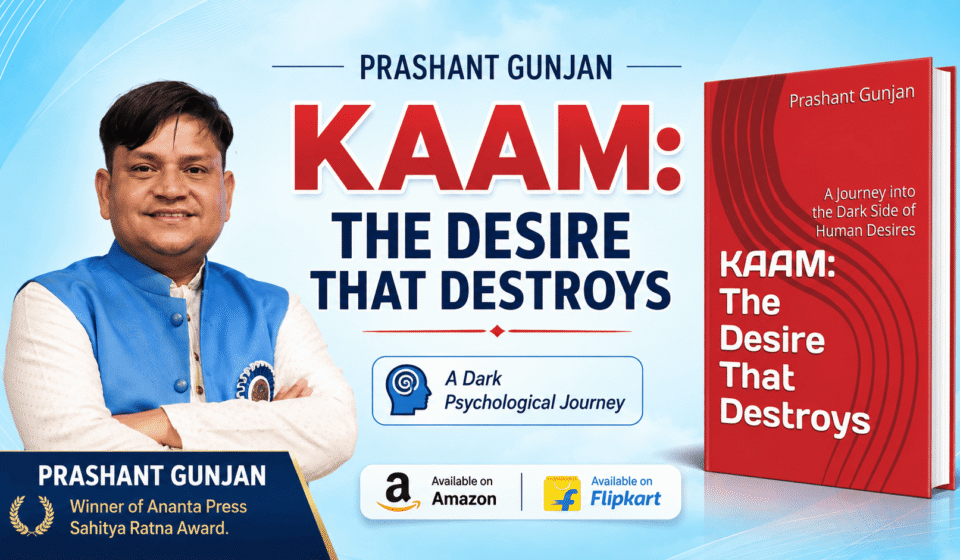
Book: KAAM: The Desire That Destroys | Author: Prashant Gunjan |
KAAM: The Desire That Destroys can be read as a thriller about betrayal and murder, but its deeper disturbance begins long before the crime. The story’s first act of violence is social: Suraj and Sonam are separated because their love is unacceptable to the world around them. Caste, family honour, and rigid tradition suffocate their relationship before it can bloom. Prashant Gunjan therefore places the personal tragedy inside a wider structure of control. The novel asks what happens when society denies people the freedom to choose, but it also asks what happens when those wounded people later respond through secrecy, obsession, and destructive decisions.
This social dimension gives the book a strong and relevant foundation. Forbidden-love stories are familiar, yet KAAM appears to avoid presenting social opposition as decorative background. The denial of Suraj and Sonam’s relationship shapes everything that follows. Their separation creates the emotional wound from which later events grow. Years pass, but the original injustice does not disappear. It survives as memory, resentment, fantasy, and longing. By the time they meet again, they are no longer the same people who once loved one another. Society has rearranged their lives, and the cost of that rearrangement has been paid in silence.
Sonam’s marriage to Ajay is especially important in this reading. She is described as trapped in a loveless marriage with a man of status and reputation. The phrase “status and reputation” signals that the marriage may function not only as a relationship but also as a social arrangement. Ajay’s public identity matters. Sonam’s emotional life, by contrast, appears hidden and secondary. The novel’s tension emerges from this imbalance between outward respectability and inward despair. A marriage can look successful to society while remaining emotionally empty for the people inside it.
Gunjan uses this contradiction to challenge a common social assumption: that obedience produces stability. Suraj and Sonam obeyed separation, yet the emotions surrounding that separation became more dangerous, not less. Sonam entered a socially acceptable marriage, yet that marriage did not erase her past or create fulfilment. Ajay possesses status, but status does not protect him from insecurity, betrayal, or rage. The institutions designed to preserve honour fail to preserve happiness. Instead, they create an environment in which truth is suppressed until it returns in a more destructive form.
At the same time, KAAM does not excuse its characters by blaming society for everything. This is one of the premise’s strongest qualities. Social injustice explains the wound, but it does not justify every later choice. Suraj and Sonam’s secret conversations lead toward an uncontrollable storm of betrayal and violence. The language of the synopsis suggests escalation: what begins privately becomes impossible to contain. Their pain may be understandable, yet secrecy places another person’s life inside their unresolved conflict. The novel therefore distinguishes between sympathy and absolution. Readers may understand why the characters are vulnerable without approving what they do.
This balance is essential because stories about forbidden love often divide the world too neatly into pure lovers and cruel society. KAAM appears more morally demanding. The lovers have suffered, but they can also cause suffering. The husband has been betrayed, but his rage becomes murderous. Society has imposed destructive norms, but individuals still make decisions within those conditions. The novel’s world is not divided between innocent and guilty people. It is populated by wounded people who respond to pain in different, sometimes unforgivable ways.
The theme of family honour also deserves attention. Honour, in such contexts, is often described as something collective, yet its burden is placed on individual bodies and choices. A family may fear social judgement, but the lovers are the ones forced apart. A husband may fear humiliation, but another person becomes the target of his rage. The language of honour can therefore hide the reality of control. KAAM reveals the violence that can grow beneath respectable words such as tradition, reputation, and duty.
The title sharpens this critique. “Kaam” is presented as raw, unfiltered sexual desire that lingers, burns, and corrupts. Yet the novel does not isolate desire from its social environment. Desire becomes dangerous partly because it is forced underground. What cannot be discussed openly becomes secret; what cannot be grieved honestly becomes obsession; what cannot be chosen freely may return as rebellion. This does not mean repression automatically causes crime, but it suggests that cultures of silence can intensify emotional instability.
Sonam’s position may be especially compelling to readers interested in the intersection of gender and social expectation. She is caught between a denied past and an unfulfilling present. Her choices have consequences, but the conditions surrounding those choices matter. A woman in a marriage defined by status and public image may have limited space to acknowledge emotional dissatisfaction. The return of Suraj offers not simply romance but recognition of a self that existed before compromise. That possibility makes the reunion psychologically believable even as the later actions become increasingly dangerous.
Suraj, too, represents the long afterlife of exclusion. He is described as consumed by obsession and loneliness. A society that once told him his love was unacceptable has left him with a powerful narrative of theft: something rightfully his was taken. That narrative can become poisonous. It may encourage him to treat the past as a debt the present must repay. In this way, the book shows how social humiliation can be internalised and transformed into entitlement. The victim of one form of injustice can still become the agent of another.
Ajay embodies the fragility of reputation-based identity. A person who depends heavily on status may experience betrayal not only as personal pain but as annihilation of the self he presents to others. His rage becomes lethal when he responds to humiliation through violence rather than reflection. The murder is therefore linked to the same social system that separated Suraj and Sonam: a system in which honour is valued above human life. Different characters occupy different positions, but they are all influenced by the demand to possess, control, and avoid shame.
The crime and subsequent police pressure move the novel into the thriller/mystery genre, but the social questions remain active. Burying a body does not bury guilt, and hiding a relationship does not erase the structures that produced it. Investigation becomes both literal and symbolic. The police search for evidence while the narrative invites readers to investigate the deeper causes of the tragedy. Who is responsible? The answer is not singular. Responsibility exists at the level of society, family, marriage, and individual choice.
Prashant Gunjan’s author profile describes a writer interested in ethics, human behaviour, consciousness, and personal responsibility. That background suits a story built around competing forms of accountability. His multidisciplinary outlook—combining an engineering emphasis on cause and consequence with a literary concern for emotion—helps make the premise feel structured rather than sensational. The tragedy unfolds through connected failures, each one increasing the pressure on the next.
What makes KAAM stand out is this layered understanding of violence. Violence is not limited to the murder. It appears in forced separation, emotional confinement, secrecy, possessiveness, humiliation, and the denial of another person’s humanity. The novel’s warning is therefore broader than “an affair ends badly.” It suggests that societies and individuals both create consequences when they treat love as property, honour as control, and desire as permission.
Readers who appreciate thrillers that engage with social realities will find much to consider here. KAAM promises suspense, crime, and emotional intensity, but it also offers a critique of the conditions that turn private pain into public tragedy. Its characters are not symbols alone; they are people caught between inherited rules and dangerous impulses. The novel’s uniqueness lies in refusing a comfortable answer. Tradition harms them, but rebellion does not automatically save them. Love is denied, but desire does not remain pure. Respectability fails, but secrecy also destroys. In that morally unstable space, Gunjan creates a thriller that can provoke discussion long after its final revelation.
Purchase on Amazon