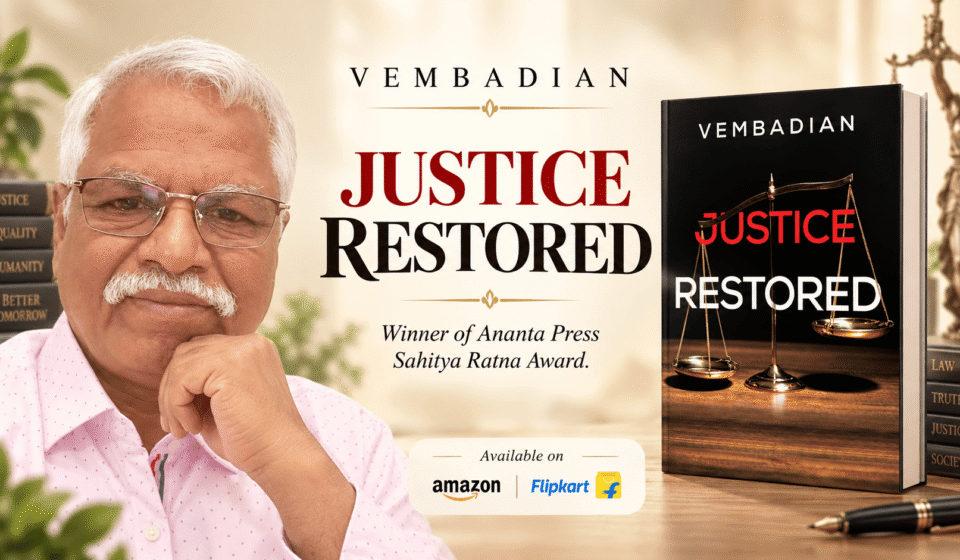

Justice Restored by Vembadian can be read as a social novel, an administrative drama, and a story about institutional failure, but one of its most compelling dimensions is its exploration of leadership. The novel asks a question that is relevant far beyond government offices: what does a responsible leader do after inheriting a wrong decision? Does he protect the comfort of the existing record, or does he investigate, accept uncomfortable facts, and use his authority to repair the damage? Through the newly appointed HRD Chief at the centre of the story, Vembadian offers a clear answer. Leadership begins where routine ends.
The case that comes before the HRD Chief appears, at first glance, to be one more service matter. A Lieutenant Colonel writes regarding the delayed pension and settlement concerns of Mahesh Gupta, a khalasi who had been removed from service for unauthorised absence. The earlier administrative position appears settled: since Gupta was removed, he is not entitled to normal retirement benefits beyond what may already belong to him. A less curious officer could have repeated the same conclusion. Instead, Mohan, the new HRD Chief, notices that the facts create questions. Why did a last-grade employee remain absent for so long? What happened before the absence was classified as misconduct? Was there evidence of deliberate abandonment of duty? The novel’s leadership lesson emerges immediately: good administration is not merely the ability to process a decision efficiently; it is the ability to recognise when a decision deserves to be questioned.
Mahesh Gupta’s story gives those questions urgency. He is injured while unloading a box at work and sustains a severe head injury. His physical wounds heal, but his speech and behaviour later become abnormal. Medical staff seek psychiatric opinion, and he is transferred for further treatment at Ranchi Mental Hospital. The problem is not that the system provides no care. In fact, the medical response initially appears attentive. The tragedy lies in the break between one part of the system and another. Information about his transfer does not reach the office responsible for attendance and salary. The administrative record then interprets his continued absence without the context of his treatment.
This distinction is important. Vembadian does not build the novel around a single cartoonishly malicious official. The injustice grows through fragmented responsibility, assumptions and failure to communicate. That makes the story more believable and, in some ways, more disturbing. Large organisations often divide responsibility across sections, officers and procedures. When nobody pauses to reconstruct the entire human story, each office can perform its narrow role while the person at the centre suffers. Justice Restored therefore becomes a study of how systemic injustice can arise even without an obvious villain.
Mohan’s response is the opposite of fragmented responsibility. He attempts to see the whole case. He sends a welfare inspector to investigate the circumstances directly. That act demonstrates a leadership quality the novel repeatedly values: verification. The HRD Chief does not rely solely on old files, nor does he accept representations without evidence. He seeks the missing facts. The investigation reveals that Mahesh Gupta’s hospitalisation had continued because of a mental-health condition associated with the head injury, but the relevant administrative office was never properly informed. What had been treated as misconduct was, in reality, a case of medical incapacity compounded by a communication failure.
The novel’s title becomes especially meaningful at this stage because “restoring” justice is not portrayed as merely feeling sympathy. Sympathy without action would leave the family in the same position. Mohan has to convert understanding into administrative remedy. He must persuade the general manager that the removal order was based on an incomplete and therefore unjust reading of the circumstances. He recommends cancellation of the disciplinary removal, medical retirement, settlement of benefits, and compassionate appointment for Mahesh Gupta’s son. Justice, in the world of the novel, requires both heart and procedure.
This is one of the book’s strongest qualities. It refuses the false choice between empathy and efficiency. The good administrator is not shown as someone who ignores rules out of kindness. Rather, he studies the rules and facts carefully enough to apply them fairly. Ethical leadership here means using institutional knowledge to protect the purpose of the institution instead of hiding behind technicalities. Mohan’s “smart working” is not shortcut culture; it is intelligent, conscientious decision-making.
Senior HR Manager Mishra also matters to this theme. Institutional reform rarely depends on one heroic individual acting alone. A leader needs colleagues who can assist with records, procedures, interpretation and follow-through. Mishra’s support helps ground the story in the reality of organisational work. Correcting an old administrative wrong requires cooperation across levels, not simply a moment of moral revelation. In that sense, the novel presents leadership as both individual and collective.
The human cost of delayed leadership is represented by the Gupta family. Mahesh Gupta’s salary stops during treatment, his family experiences poverty, and his son’s schooling suffers. Representations fail to produce relief. Eventually Mahesh Gupta dies, and his wife also dies before the case is finally corrected. This prevents the final resolution from becoming a conventional victory. The new decision is morally necessary, but it arrives after losses that cannot be reversed. The son’s compassionate appointment offers a path toward stability, yet the reader remains aware that proper leadership at an earlier stage could have prevented much suffering.
That tension gives the novel its cautionary force. Organisations often celebrate correction after a problem becomes visible, but Justice Restored invites readers to value prevention more highly. A careful initial investigation, timely communication from the hospital, or a humane review of prolonged absence might have changed the family’s entire trajectory. The book therefore treats leadership not only as crisis resolution but also as a duty to build systems in which such crises are less likely to occur.
Vembadian’s long career as an Indian Railway Personnel Service officer adds depth to this subject. His background includes decades in human-resource administration, including senior personnel roles and experience with disciplinary inquiry procedures. That professional knowledge is visible in the novel’s attention to removal orders, medical unfitness, pension and settlement dues, welfare investigation and compassionate appointment. These are not decorative details. They are the machinery through which the plot’s moral question must be answered.
For readers outside government service, the story still has broad relevance. Similar issues arise wherever institutions become larger than the individuals they are meant to serve. Hospitals, universities, corporations, banks and public departments all depend on records and processes. Justice Restored reminds us that systems need people who can recognise when the record is incomplete. A responsible leader must be willing to ask what is missing, who is affected, and whether an apparently lawful outcome is actually fair.
As general fiction, the novel is distinctive because its central heroism is administrative integrity. Mohan does not defeat an enemy through force. He restores a person’s dignity by reopening a file, investigating facts, admitting institutional error and persuading the proper authority to act. This may sound less dramatic than conventional heroism, but for people whose lives depend on official decisions, it can be equally consequential.
Justice Restored ultimately argues that authority is meaningful only when joined to responsibility. It presents ethical leadership as a disciplined practice: listen, question, verify, understand, act, and correct. Its optimism rests on the possibility that one conscientious officer can interrupt a chain of negligence and turn institutional power toward fairness. For readers interested in leadership, human resources, governance and socially grounded fiction, that makes the novel both thought-provoking and unusually relevant.
Amazon: https://www.amazon.in/Justice-Restored-Vembadian/dp/1804391484/ref=sr_1_1