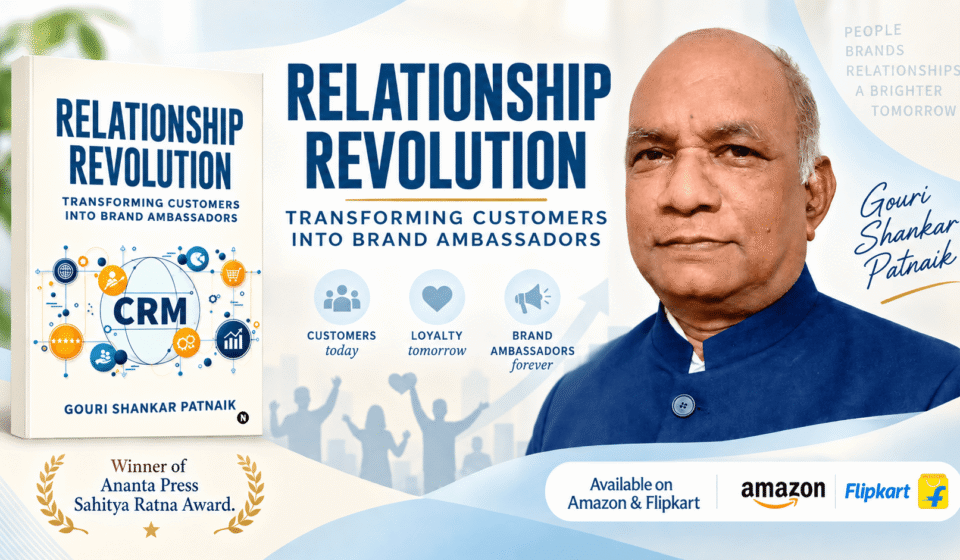

Relationship Revolution: Transforming Customers into Brand Ambassadors by Gouri Shankar Patnaik arrives at a moment when the language of Customer Relationship Management is everywhere, yet its meaning is often narrowed to software dashboards, lead records, automated emails, and sales pipelines. This book restores the larger managerial meaning of CRM. It treats customer relationship management as an organizational capability that connects strategy, people, process, technology, marketing, sales, and service. Its value lies in helping readers understand that CRM is not a tool that a company installs; it is a way of thinking about how a company creates, preserves, and expands customer value over time.
The book’s central emphasis on building brand strength through customer advocacy gives the discussion a useful destination. Many CRM texts focus heavily on acquisition, retention, or database management. Patnaik goes further by asking what happens when a relationship becomes strong enough that customers voluntarily recommend the brand. This is important because advocacy is an advanced form of loyalty. A customer may continue purchasing because of convenience, price, habit, or switching costs, but a brand ambassador is willing to attach personal credibility to a recommendation. Creating that level of confidence requires more than transactional efficiency; it requires a consistently positive experience.
The book is particularly effective for readers who want to connect theory with management practice. It covers CRM concepts, benefits, technologies, and implementation strategies while keeping the emphasis on how these elements should support business goals. That balance makes the text relevant to several audiences at once. Students can use it to understand the architecture of CRM as a discipline. Marketing and sales professionals can use it to think about customer journeys and coordinated engagement. Service professionals can connect post-sale interactions with long-term loyalty. Senior leaders can use the book to examine whether their organizational systems reinforce or undermine the customer promise.
An especially useful feature is that readers can enter the book from different points. The material does not demand a single rigid reading path. This reflects the reality of CRM itself: different readers encounter the subject from different functional positions. Someone responsible for marketing may be interested in customer insight and segmentation, while someone in sales may care more about relationship development and opportunity management. A service leader may focus on responsiveness, satisfaction, and complaint handling. A senior executive may be most interested in integration, governance, strategic alignment, and business outcomes. By allowing flexible access, the book becomes a reference as much as a conventional text.
Patnaik’s professional experience helps explain the book’s disciplined approach. He has spent more than four decades in the pulp and paper and manufacturing sectors and has held senior leadership positions at JK Paper Ltd. and ITC Limited. His expertise includes quality governance, ESG and sustainability oversight, enterprise risk management, regulatory compliance, quality systems, and board-level advisory work. These may initially appear to be adjacent to CRM rather than central to it, but in practice they are highly relevant. Customer relationships depend on organizational reliability. A business cannot credibly promise customer centricity if its internal processes are inconsistent, its controls are weak, or its decision-making lacks accountability.
This background gives the discussion an enterprise perspective. CRM is often implemented department by department, producing fragmented databases and disconnected experiences. A customer may receive one message from marketing, another from sales, and a third from service, with little evidence that the organization understands the relationship as a whole. Patnaik’s emphasis on alignment across marketing, sales, and service offers an antidote to this fragmentation. The book encourages organizations to view customer information as shared strategic intelligence rather than as departmental property.
The distinction between customer data and customer understanding is another important theme implicit in the book’s managerial focus. Businesses can collect vast amounts of information without becoming genuinely insightful. Purchase history, contact frequency, campaign responses, service tickets, and digital behavior are useful only when they contribute to better decisions. CRM technology therefore has value when it helps the organization recognize patterns, anticipate needs, personalize responsibly, and respond consistently. Patnaik’s balanced treatment of technology avoids the common mistake of allowing the platform to become the strategy.
This is one of the book’s most practical contributions. Organizations sometimes invest heavily in CRM systems and then discover that adoption is low, data quality is poor, workflows are unclear, or employees see the system as additional administrative work. These problems are not solved by more features. They require clarity of objectives, process design, leadership support, training, ownership, and a culture that sees customer information as useful. By presenting implementation in connection with business goals, the book helps readers appreciate that successful CRM requires managerial discipline as much as technical capability.
The customer lifecycle orientation also strengthens the book. Business relationships develop through stages: awareness, consideration, acquisition, onboarding, usage, service, repeat purchase, loyalty, and advocacy. Different organizations may define these stages differently, but the principle remains the same. Customers judge a brand through accumulated experiences. A good acquisition campaign cannot compensate indefinitely for poor service, and excellent service cannot fully repair a product that consistently disappoints. CRM becomes strategic when it helps the organization coordinate these experiences instead of optimizing them separately.
For marketing readers, the book is a reminder that the strongest brand messages are validated by customer experience. Brand building is often associated with communication, positioning, and visibility, but advocacy depends on what happens after the message is received. A brand promise becomes credible only when the organization fulfills it. CRM helps close the gap between promise and delivery by making customer interactions more visible and actionable. This is one reason the book’s subtitle, with its focus on transforming customers into brand ambassadors, is so effective: it links the internal discipline of relationship management with the external reputation of the brand.
For sales professionals, the book offers a wider perspective than short-term conversion. Sales relationships are more valuable when they create the foundation for repeat business, referrals, trust, and long-term account development. CRM can support this by preserving institutional memory, tracking commitments, enabling coordinated follow-up, and helping teams understand the customer’s history. The managerial value is not in recording activity for its own sake, but in ensuring that the organization learns from each interaction.
For service professionals, the book’s ideas are equally relevant. Service encounters often determine whether a customer becomes a critic or an advocate. A problem handled with responsiveness, empathy, and competence can sometimes strengthen a relationship, while an unresolved complaint can damage years of goodwill. CRM can make service more intelligent by giving employees context and enabling continuity across channels. The customer should not have to reintroduce the entire relationship every time they contact the company.
The book also carries a useful governance message. As organizations collect more customer data, questions of accuracy, access, accountability, consent, and responsible use become increasingly important. Patnaik’s background in governance, risk, regulatory compliance, and standards gives him a valuable foundation for discussing CRM in a mature business context. Even when a book is not primarily a compliance manual, a strategic treatment of CRM should remind readers that trust can be lost if customer information is handled carelessly. Relationship management must therefore include respect for the customer, not merely efficiency for the company.
Another reason the book stands out is its suitability for readers beyond specialists. A manager does not need to be a CRM administrator to benefit from understanding the principles. In fact, the subject becomes most powerful when leaders from different functions share a common understanding of how customer value is created. Patnaik’s approach helps demystify CRM by keeping the discussion connected to organizational purpose. The technology is important, but it remains a means rather than the end.
The author’s broader career also adds credibility to this focus on sustained value creation. His involvement with the Bureau of Indian Standards, TAPPI, IPPTA, and the Quality Council of India, along with his work on ESG, BRSR frameworks, environmental stewardship, audit readiness, and internal control systems, reflects a professional life centered on structured improvement. His previous authorship, including Quality Assurance in Industries, further reinforces the continuity between quality management and relationship management. Both disciplines ask organizations to define expectations, build processes, measure performance, learn from feedback, and improve consistently.
Relationship Revolution is therefore best read as a management book about CRM rather than merely a CRM book about software. Its strength is the integration of customer understanding with organizational execution. It speaks to the reality that successful relationships emerge from many coordinated actions: good information, clear processes, responsible technology, capable employees, responsive service, and leadership that takes customer value seriously.
For students, the book provides a strong conceptual foundation. For practitioners, it provides a framework for examining current systems and assumptions. For industry leaders, it raises a strategic question: is the organization using CRM to manage records, or to manage relationships? The difference is significant. Records tell a company what happened. Relationships help determine what happens next. By focusing on the path from customer interaction to customer advocacy, Patnaik gives readers a practical way to think about the future of brand building in increasingly competitive markets.
Amazon Purchase Link: https://amzn.in/d/04pCNjFr