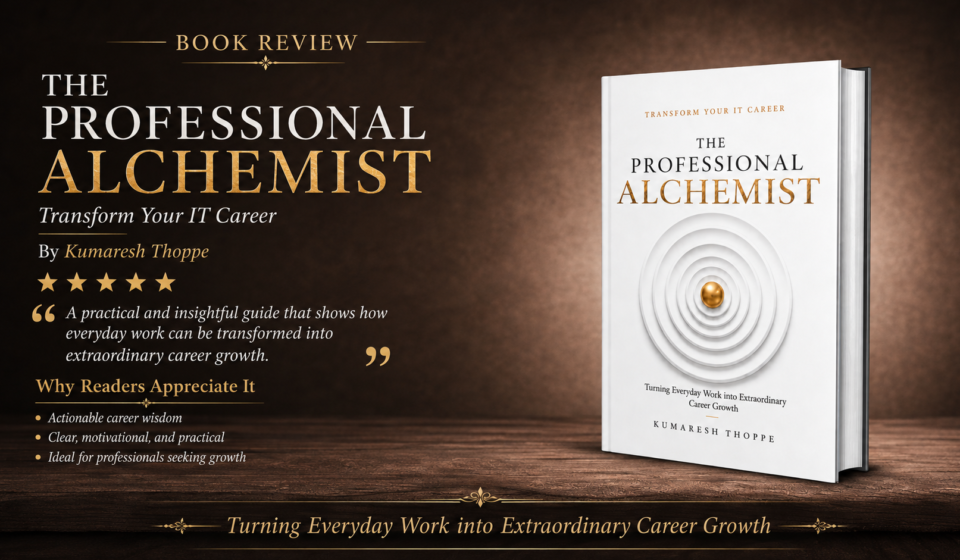
Book Review: The Professional Alchemist by Kumaresh Thoppe — Turning Everyday Work into Extraordinary Career Growth

In a professional world overflowing with productivity hacks, leadership theories, motivational advice, and promises of rapid career success, it is surprisingly easy to remain busy without actually moving forward. The Professional Alchemist: Turning Everyday Work into Extraordinary Career Growth by Kumaresh Thoppe enters this crowded space with a refreshingly practical proposition: meaningful career transformation does not necessarily require working longer hours, changing companies, or waiting for a promotion. Instead, it begins with changing the way we understand and perform the work already in front of us.
Published by Ananta Press, the book positions professional development as an ongoing process of turning ordinary experiences—projects, deadlines, responsibilities, conversations, mistakes, and challenges—into opportunities for extraordinary growth. The author describes this mindset through the metaphor of a “Professional Alchemist”: someone who continually transforms everyday professional experiences into skills, value, confidence, leadership, and impact.
What makes this concept compelling is that the book does not treat professional success as a single destination. Instead, it treats growth as a practice.
A Career Book Built Around Transformation, Not Motivation
One of the strongest qualities of The Professional Alchemist is its refusal to depend entirely on motivational language. There is encouragement throughout the book, but motivation is consistently tied to action.
Thoppe explains that the book distils decades of professional experience into 36 practical wisdom ideas, arranged not merely as disconnected tips but as parts of a larger philosophy of professional transformation. The ideas are intended to apply across roles, technologies, domains, and stages of a career.
This structure gives the book a mentor-like quality. It feels less like someone delivering a formal lecture and more like an experienced senior professional sitting across the table and saying, “Here is something I wish someone had explained earlier in my career.”
That tone makes the lessons accessible, particularly for professionals who know they want to progress but are unsure what exactly they should change.
The book is divided into progressive “Mastery Crucibles,” covering areas such as building a professional foundation, improving execution, developing the right mindset, becoming indispensable, and future-proofing one’s career. Along the way, shorter “Micro Mastery” sections reinforce the larger lessons through focused, actionable ideas.
The Survival-versus-Growth Framework
Perhaps the most useful framework in the book is the distinction between survival work and growth work.
Most employees are naturally focused on completing what they have been hired to do: meeting deadlines, maintaining quality, following processes, attending meetings, responding to clients, and completing assigned responsibilities. These things matter. But according to Thoppe, they largely help a professional “survive” in the current position.
Growth begins when the individual starts adding value beyond basic execution.
This may mean automating a repetitive task, helping a new colleague become productive faster, sharing knowledge with teammates, identifying a risk before it becomes a problem, improving a process, or finding a smarter way to achieve an outcome.
The book argues that professionals are hired for skills, retained for reliability, promoted for the value they add, and remembered for their differentiation. It therefore asks readers to continuously distinguish between work that maintains the present and work that builds the future.
This is one of the book’s most memorable ideas because it changes the question from “How hard am I working?” to “What value is my work creating?”
That is an important distinction.
Being busy can create the comforting impression of progress. Thoppe repeatedly challenges that assumption. His conveyor-belt-versus-escalator analogy is particularly effective: both involve movement, but only one takes you upward. Career growth, therefore, is not simply movement. It is intentional elevation.
Accountability as Leadership Before the Title
Another particularly strong section focuses on accountability.
The book distinguishes responsibility from accountability in a simple way. Responsibility means completing your assigned portion of the work. Accountability means caring about whether the final outcome succeeds.
That difference may appear small, but professionally it can be enormous.
Instead of immediately escalating every dependency to a manager, an accountable employee first asks whether there is another route forward. Instead of saying, “That isn’t my task,” the person begins thinking about what the project requires.
This philosophy runs through much of the book: operate at the level you want to reach before someone formally gives you the title.
Thoppe encourages professionals to take on responsibilities that are often avoided because they appear routine or outside the technical job description—coordination, onboarding, reporting, training, communication, tracking dependencies, and helping the manager keep the project moving. Such activities can expose professionals to leadership skills before formal leadership opportunities arrive.
For young and mid-career professionals especially, this is valuable advice because it explains how trust is actually accumulated inside organizations.
Practical Productivity Without the Usual Hustle Culture
Thankfully, the book does not translate “take ownership” into “work endlessly.”
One of its better productivity concepts is the Golden Hour Principle. Thoppe recommends protecting periods of uninterrupted time for important, high-impact work rather than allowing the entire day to be consumed by chats, emails, meetings, and notifications.
His suggested approach is simple: reserve one uninterrupted hour in the morning and another in the afternoon, adjusting the timing to suit individual working rhythms. During those blocks, distractions are intentionally minimized so complex work can receive complete attention.
The practicality matters. There are no complicated productivity systems to maintain. The advice can be tried immediately.
Similar thinking appears in the “Weekend Warrior” concept, which encourages a short period of advance planning for the coming week, and in “Set Your Own Algorithm,” which compares workplace distraction with the algorithms competing for our attention on social media.
These metaphors make productivity principles easy to remember.
Career Growth Is Also About Listening, People and Presentation
Although the book is strongly rooted in the IT and corporate environment, it wisely avoids treating technical competence as the whole career.
Thoppe gives substantial importance to communication, listening, teamwork, mentoring, professional presentation, attitude, confidence, and emotional maturity.
His discussion of active listening is especially effective. Listening, in the book’s framework, is not simply remaining silent until the other person finishes speaking. It involves paying attention to tone, pauses, intention, and what may remain unsaid. The author connects careful listening with better judgment, trust, leadership, and the ability to anticipate needs.
This is an important addition because many career books concentrate on how professionals should speak, present, negotiate, or promote themselves. The Professional Alchemist also asks whether they know how to understand others.
Professional polish receives similar attention. A carefully structured email, polished report, thoughtful presentation, or clear status update may seem like a small detail, but such details influence how competence is perceived.
The broader message is clear: excellence is not only what you know. It is also how reliably, thoughtfully, and professionally that knowledge reaches other people.
An Excellent Six-Month Career Checkpoint
One of the most immediately useful exercises in the book is the six-month self-assessment.
Rather than judging professional progress only through salary increases or promotions, Thoppe recommends asking every six months whether you have become more skilled, valuable, and confident.
The process includes reviewing the previous six months, identifying newly acquired skills, examining areas that were postponed, setting measurable goals, documenting progress, and planning the next period intentionally.
This may be one of the book’s most useful long-term practices.
Promotions depend partly on organizational circumstances. Vacancies, budgets, hierarchies, managers, and market conditions are not always within an employee’s control. Skill development, learning, contribution, and self-assessment are much more controllable.
That makes the framework empowering without being completely dependent on external recognition.
Moving Beyond the Corporate Ladder
The final sections expand the definition of professional success even further.
Thoppe distinguishes linear growth—the traditional sequence of designation, promotion, and hierarchy—from exponential growth created by knowledge, mentoring, teaching, writing, consulting, community-building, or expressing an individual “X-Factor.”
This is where The Professional Alchemist becomes more than a conventional corporate career guide.
Readers are encouraged to ask not only, “What is the next position available to me?” but also, “What unique strength can I develop and turn into value for others?”
The author suggests that teaching, communication, analysis, design, problem-solving, storytelling, mentoring, or other natural abilities may become platforms for influence beyond one’s official designation. The destination of the Professional Alchemist’s journey is therefore described as first mastering work, then mastering oneself, and eventually creating value that extends beyond both.
That is a satisfying conclusion because it prevents the book from equating a successful career merely with a bigger salary or job title.
Writing Style and Reading Experience
Thoppe writes in short, direct sections, frequently using analogies, scenarios, lists, reflection questions, and memorable one-line principles.
This makes the book highly accessible.
It is particularly suitable for readers who may not enjoy dense management theory. Chapters can be read independently, reflected upon, and applied before moving forward. In fact, the author specifically recommends treating the book as a career companion rather than something to finish once. Readers are encouraged to select one or two ideas, practise them for several weeks, turn them into habits, and then move to another concept.
That may actually be the best way to read it.
Finishing several chapters quickly is less valuable than implementing one idea successfully.
Where the Book Could Challenge Some Readers
The book’s greatest strength—its simplicity—may occasionally also feel repetitive. Ideas such as ownership, differentiation, visibility, value creation, continuous learning, and intentional action return in several forms. Readers who prefer tightly compressed business books may feel that certain principles could have been expressed more briefly.
The corporate and IT orientation is also very strong. Many examples involve managers, projects, technical skills, teams, clients, certifications, and organizational structures. Professionals outside IT can still apply much of the advice, but they may need to translate some examples into their own industries.
There is also a deliberately proactive philosophy behind the book. In healthy workplaces, volunteering, ownership, and additional responsibility can create opportunity. In poorly managed organizations, however, additional effort is not always rewarded fairly. Readers should therefore apply the principles intelligently rather than interpreting them as an obligation to accept unlimited work.
These limitations do not weaken the central philosophy; they simply make thoughtful application important.
Who Should Read The Professional Alchemist?
The book is particularly valuable for fresh graduates entering corporate life, IT professionals in the early stages of their careers, employees who feel professionally stagnant, mid-level professionals preparing for leadership, managers mentoring younger colleagues, and experienced professionals who want a structured framework for lessons they may already understand intuitively.
The author himself brings more than three decades of IT and corporate experience to the discussion, alongside exposure to management, leadership, mindfulness, counselling, and mentoring. That combination explains why the book frequently moves between performance, mindset, human behaviour, professional credibility, and inner development rather than focusing exclusively on technical success.
Final Verdict
The Professional Alchemist succeeds because it makes career development feel practical.
Its central argument is not that readers need to reinvent themselves overnight. It is that transformation begins through small changes in awareness—how you listen, how you prepare, how you take ownership, how you use time, how you learn, how you help colleagues, how you measure progress, and how intentionally you create value.
By the closing chapters, the book returns to this principle: small shifts become consistent actions, consistent actions become mastery, and mastery gradually changes both professional results and professional identity.
For readers expecting a secret shortcut to promotion, this is not that book.
For readers willing to examine their habits and actively apply what they learn, it offers something more useful: a framework for becoming the kind of professional whose growth is increasingly difficult to ignore.
Ultimately, the “alchemy” in Kumaresh Thoppe’s book is not mystical at all. It is the process of transforming ordinary work into knowledge, knowledge into value, value into trust, trust into opportunity, and opportunity into meaningful growth.
And that is precisely what makes The Professional Alchemist a thoughtful and practical career companion for professionals who want not merely to remain employed, but to keep evolving.