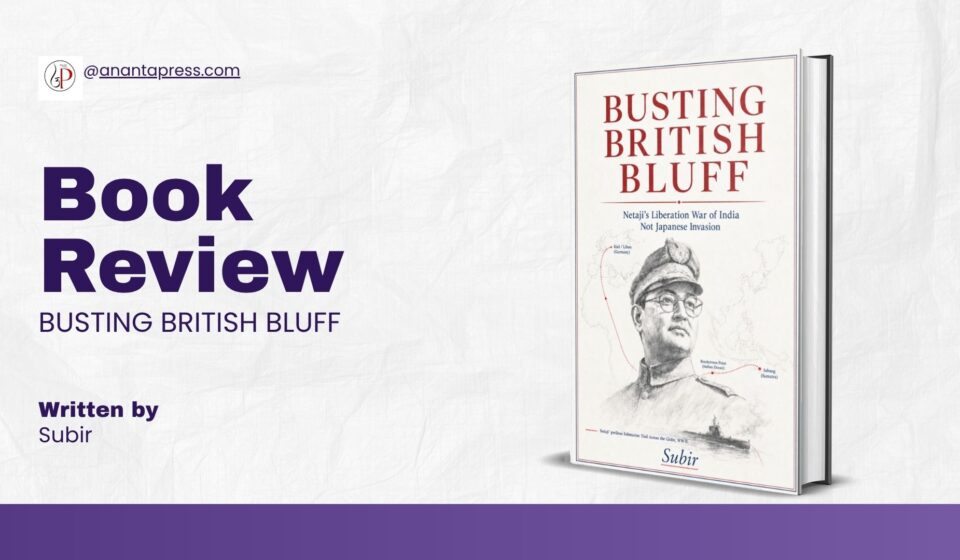
Book Review: Busting British Bluff by Subir — Re-examining Netaji, the INA, and a Contested Chapter of India’s Freedom Struggle

History is rarely a simple record of events. It is also a contest over interpretation: who tells the story, which evidence is preserved, which voices receive authority, and which experiences gradually disappear from public memory. Subir’s Busting British Bluff: Netaji’s Liberation War of India, Not Japanese Invasion enters precisely this contested space. Published in its second edition in September 2026 by Ananta Press, the book revisits the role of Netaji Subhas Chandra Bose and the Indian National Army during the Second World War and challenges what the author regards as a long-standing British interpretation of the Imphal–Kohima campaign. 9789378211270-BUSTING BRITISH B…
This is not a conventional biography of Bose, nor is it simply a military history of the INA. Instead, it is an argumentative historical narrative. Subir’s central proposition is that the campaign into northeastern India in 1944 should be understood principally as an Indian liberation effort undertaken by the INA with Japanese military assistance, rather than being remembered merely as a Japanese invasion of India. The book repeatedly examines the role of British wartime propaganda and asks whether colonial narratives deliberately minimized the INA’s nationalist purpose and military participation.
Whatever position a reader ultimately takes on that argument, Busting British Bluff succeeds in doing something valuable: it pushes readers to return to a complex episode of India’s independence movement and examine it from perspectives that are often less visible in popular retellings.
Challenging an Established Narrative
The book opens boldly with a chapter titled “Busting the Myth.” Subir begins with the battles of Imphal and Kohima, reminding readers of their extraordinary intensity. He notes that the Imphal–Kohima fighting was later recognized in a British National Army Museum poll as “Britain’s Greatest Battle,” yet argues that its connection with India’s struggle against colonial rule remains insufficiently appreciated. 9789378211270-BUSTING BRITISH B…
From here, the author establishes the thesis that drives the entire book. According to Subir, the joint INA-Japanese military advance was not simply a foreign invasion but part of Bose’s attempt to remove British rule through armed struggle. He argues that Winston Churchill and the Allied propaganda apparatus feared the possibility that Bose’s advance could encourage a wider Indian uprising and therefore portrayed the campaign predominantly as Japanese aggression. 9789378211270-BUSTING BRITISH B…
The language is unapologetically forceful. Subir does not write as a detached chronicler pretending that every interpretation carries equal weight. He has a thesis and spends the book making a case for it.
That clarity is one of the book’s greatest strengths. The reader always understands what question is being investigated: Was the northeastern campaign primarily a Japanese invasion, or was an Indian war of liberation obscured behind wartime propaganda?
Bringing Northeast India into the Story
One of the most rewarding aspects of Busting British Bluff is the attention it gives to northeastern India.
Discussions of India’s freedom struggle are frequently concentrated around national political centres, major Congress movements and familiar personalities. Subir instead spends considerable time on places such as Kohima, Imphal, Moirang, Ruzazho and other communities affected by the INA-Japanese advance.
The account of Ruzazho is especially memorable. The book presents it as a village liberated from British control and administered under the INA, describing Bose’s interaction with villagers and the appointment of local representatives. The broader point is not merely geographical. By incorporating local testimony and regional experience, the book asks readers to recognize that the Second World War was not a distant international event for northeastern India—it entered villages, roads, homes and local political life.
Subir further argues that local oral histories and administrative records deserve greater consideration alongside official imperial sources. The book explicitly warns against relying exclusively on British documentation and emphasizes evidence from Assam, Manipur and the Naga Hills when assessing the relationship between the INA and Japan. 9789378211270-BUSTING BRITISH B…
This regional emphasis gives the book an identity beyond yet another retelling of Netaji’s life.
From Student Rebel to Revolutionary Leader
The book then moves backward chronologically to explore episodes that shaped Subhas Chandra Bose before the dramatic events of 1944.
Chapter Two, “Oatenization,” examines the famous Presidency College incident involving Professor Edward Farley Oaten and Indian students. Bose was expelled and rusticated following the 1916 episode, and Subir presents it as an early turning point in his development into a political figure. The chapter also explores the conflicting versions of what actually happened, demonstrating the author’s wider interest in the gap between historical event and later historical memory. 9789378211270-BUSTING BRITISH B…
The following chapters move into the almost cinematic episodes of Bose’s life: his escape from house arrest, his movement beyond India, his wartime diplomacy, and his astonishing journey from Europe toward East Asia.
The book’s postscript neatly captures the scale of this journey: Calcutta to Gomoh, Peshawar and Kabul; onward through Soviet territory, Moscow and Berlin; then to Kiel and across oceans by submarine before reaching Asia and eventually the theatre of the INA’s advance into India. Subir describes the total journey as exceeding 40,000 kilometres. 9789378211270-BUSTING BRITISH B…
These passages are among the most naturally gripping parts of the book because the historical material itself carries the momentum of an adventure narrative. Bose emerges not merely as an ideological figure but as a man willing to accept extraordinary personal danger in pursuit of political independence.
Rash Behari Bose: The Forgotten Revolutionary
Another commendable feature is the substantial attention given to Rash Behari Bose.
In popular memory, the INA is overwhelmingly associated with Subhas Chandra Bose. Subir broadens that picture by exploring the revolutionary career, exile and organizational work of Rash Behari Bose in Japan.
The author emphasizes Rash Behari’s intellectual and cultural engagement with Japanese society, including his mastery of the language and extensive writing. According to the book, at least forty of his publications are preserved in Japan’s National Diet Library. Subir presents his decades in Japan not as passive exile but as sustained political preparation and advocacy for Indian independence. 9789378211270-BUSTING BRITISH B…
This chapter is valuable because it gives readers a stronger understanding of the groundwork that existed before Netaji assumed leadership of the INA movement in East Asia.
Bose and Japan: Partnership Without Submission
A difficult historical question surrounds Bose’s relationship with Japan. Busting British Bluff confronts it directly.
Rather than portraying the INA-Japanese relationship as uncomplicated, Subir includes moments of tension. Japanese commanders did not always regard the INA as a significant combat force. The book recounts Bose rejecting the idea that INA personnel should be restricted to propaganda or intelligence work and insisting that Indians must participate directly in winning India’s freedom. 9789378211270-BUSTING BRITISH B…
This material helps the book’s central argument considerably. The portrayal is not simply that Bose accepted Japanese assistance uncritically. Instead, Subir depicts him as a political actor attempting to exploit the international circumstances of the Second World War while preserving the independent purpose of the INA.
The result is a more interesting portrait: Bose as a strategist operating among larger powers, negotiating from a position of limited resources yet refusing to surrender the nationalist objective.
Defeat on the Battlefield, Victory in Political Consequence
The later chapters deal with military setback and the author’s interpretation of its historical consequences.
Subir does not deny the failure of the Imphal–Kohima offensive. Instead, he reframes what “failure” means. Chapter Six describes an INA suffering severe tactical defeat yet preserving, in the author’s telling, a political force capable of surviving beyond the battlefield.
The seventh chapter, appropriately titled “Finally, the Victory!”, develops the argument that the significance of the INA cannot be measured only by territorial conquest. Subir argues that the movement affected Indian public consciousness and later discontent within the armed forces, ultimately contributing to the conditions under which British rule became increasingly difficult to sustain. The book therefore distinguishes between losing a campaign and losing the larger political struggle. 9789378211270-BUSTING BRITISH B…
This is arguably the intellectual heart of Busting British Bluff. Its thesis is not that the INA captured Delhi—it plainly did not—but that its political legacy extended beyond its battlefield defeat.
Research, Evidence and Style
Subir has clearly assembled material from a broad range of historical accounts, memoirs, official records, newspaper reports, scholarly commentary and regional sources. The inclusion of an annexure of sources and references reinforces the research-oriented nature of the project.
At the same time, readers should understand the kind of book they are entering. Busting British Bluff is not written in the emotionally neutral tone of an academic monograph. Its language can be passionate, polemical and openly admiring of Bose and the INA. Terms such as “liberation army,” “British bluff,” and “disinformation” reveal the author’s interpretive position.
For general readers, that passion often makes the book energetic and accessible. For specialist historians, however, some of its most sweeping conclusions may invite further scrutiny and comparison with additional historiography. Claims about British motives, propaganda strategy and the precise relationship between Japanese strategic objectives and INA nationalism are inherently complex. A reader interested in a fully comparative historiographical assessment would benefit from placing Subir’s arguments beside British, Japanese, INA and modern scholarly interpretations.
That should not necessarily be viewed as a weakness. A provocative work of history can be valuable because it generates questions rather than because it closes every debate.
Final Verdict
Busting British Bluff is ultimately a book about historical memory.
Behind its military campaigns, submarine voyages, political negotiations and battlefield narratives lies a larger concern: Who gets remembered as the maker of history, and who decides how their actions are described?
Subir believes that Netaji Subhas Chandra Bose, Rash Behari Bose and the soldiers of the Indian National Army have not always received adequate recognition for the scale of their contribution and sacrifice. The book’s postscript makes that motivation explicit, asking readers to reconsider whether Netaji’s role has received the recognition it deserves. 9789378211270-BUSTING BRITISH B…
The book will be particularly engaging for readers interested in Subhas Chandra Bose, the INA, World War II in India, Northeast Indian history, colonial propaganda and alternative interpretations of the independence movement. It is also likely to appeal to readers who enjoy historical works that challenge inherited narratives rather than simply repeat them.
Its greatest strength is its determination to recover a story that the author believes has been misunderstood. Its most debatable quality is the same determination: Subir makes his case passionately enough that readers must remain aware that they are encountering a distinct historical interpretation rather than an uncontested final verdict.
Yet that is precisely why Busting British Bluff deserves attention. It asks readers not merely to admire the past but to interrogate it—to compare narratives, reconsider familiar labels and look again at a chapter of India’s freedom struggle whose military, political and psychological consequences continue to invite debate.
Rating: 4.5/5
A passionate, extensively researched and thought-provoking reconsideration of Netaji Subhas Chandra Bose and the Indian National Army, Busting British Bluff challenges readers to revisit the history of the Imphal–Kohima campaign and ask whether a battlefield remembered as a Japanese invasion also deserves to be remembered as a remarkable, if ultimately unsuccessful, armed attempt to liberate India.