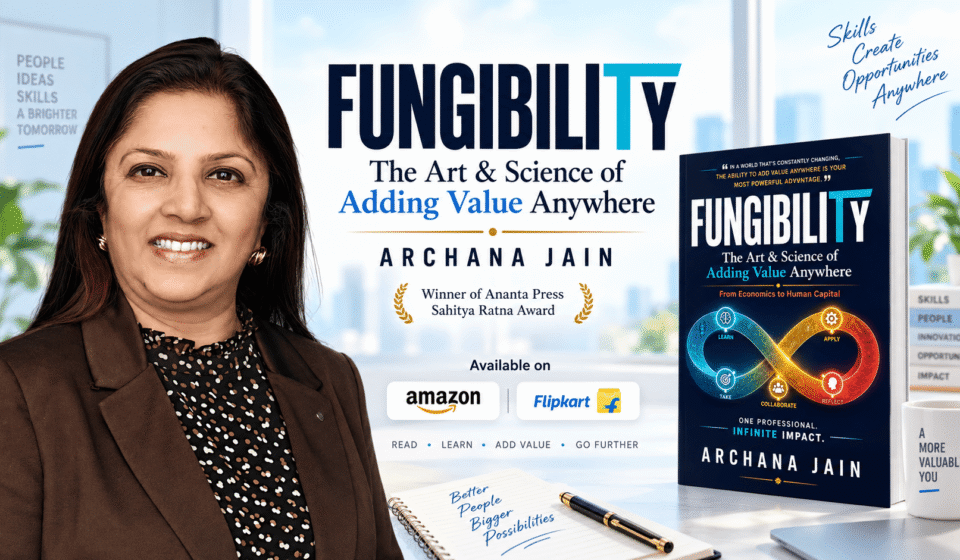

One of the most persistent habits in professional life is to confuse a role with a self. We ask people what they do, and they answer with a title. We evaluate progress through promotions, designations, departments, and organizational levels. We describe experience in the language of functions and companies. Fungibility: The Art & Science of Adding Value Anywhere challenges that habit at its foundation. Archana Jain’s book asks readers to consider a more durable question: not “What position do I occupy?” but “What value am I capable of creating across changing situations?” That shift makes the book more than a response to artificial intelligence. It becomes a book about identity, confidence, and the architecture of a sustainable career.
The word “fungibility” is an intriguing choice because in economics it usually refers to things that are mutually interchangeable. Applied carelessly to people, that idea could sound dehumanizing. Jain turns the concept in a different direction. Here, fungibility is not about making people replaceable. It is about making capabilities portable. A professional becomes more resilient when their usefulness can travel from one context to another. A communicator can become valuable in leadership, change management, customer experience, sales, education, or community building. A problem solver can move between operations, consulting, product work, or entrepreneurship. A person skilled at making complex ideas understandable may create impact in many industries. The individual remains unique; what becomes transferable is the ability to contribute.
This reinterpretation is important because the old psychological contract between employee and organization has weakened. A career can no longer be safely planned as a long sequence of predictable steps inside a stable structure. Teams are redesigned, technologies change workflows, companies merge, industries converge, and entirely new roles appear before education systems have names for them. In that environment, job-title identity becomes fragile. If a person believes their worth is contained in a specific designation, every disruption becomes personal. Fungibility offers a more empowering structure. It encourages readers to locate confidence in patterns of capability rather than in organizational labels.
The book’s strongest motivational idea is that relevance can be built. It is easy to talk about the future of work in ways that leave readers feeling behind. New AI tools appear constantly. Expertise that once required years can be partially automated. People see younger colleagues mastering new platforms quickly, while experienced professionals wonder whether their knowledge still counts. Fungibility reframes the situation. Experience matters, but only when it can be translated. New tools matter, but only when they are connected to judgment and purpose. The reader’s task is therefore not to chase every trend. It is to understand how to learn, adapt, combine strengths, and apply them to real problems.
Archana Jain’s own career journey gives the thesis a meaningful human backdrop. Her path has moved through children’s clothing design, advertising, public relations, customer service, coaching, team management, business operations, and technology. Looked at through a narrow career lens, those transitions could seem disconnected. Looked at through the lens of fungibility, they become evidence of accumulated capability. Each environment can teach something that transfers: communication, customer understanding, coordination, resilience, influence, facilitation, problem solving, leadership, or learning agility. This is one reason the book’s message feels credible. The concept reflects not only an abstract management idea but also a lived pattern of reinvention.
The focus on learning agility is especially valuable. Many professionals understand that they need to learn continuously, but learning is often treated as content consumption: take another course, earn another certificate, watch another tutorial, add another tool to a resume. The fungibility mindset asks for something deeper. Can you enter a situation where you are not yet competent, identify what matters, ask better questions, connect new information to what you already know, and become useful quickly? That is a different kind of learning. It is less about proving expertise and more about developing confidence in the process of becoming capable.
This matters psychologically because professional maturity often creates a paradox. The more senior people become, the more others expect them to know. That expectation can make it harder to admit uncertainty. Yet in a rapidly changing environment, the ability to say “I don’t know this yet, but I can learn” may be more powerful than defending outdated certainty. Jain’s philosophy embraces that humility. It recognizes that adaptability is not weakness, indecision, or lack of specialization. It is the discipline of remaining teachable while continuing to contribute.
The book also encourages a healthier relationship with expertise. Fixed expertise can become an identity trap when people protect it long after its context has changed. Fungibility does not dismiss expertise; rather, it asks readers to extract the transferable logic beneath it. A person who has spent years in customer service may know far more than scripts and escalation processes. They may understand emotional regulation, listening, conflict resolution, service recovery, pattern recognition, and human behavior. Those capabilities can be useful far beyond a contact center. A team manager may have learned decision making, motivation, delegation, coaching, and change communication. Such skills are not tied to one industry unless the professional assumes they are.
Another strength of the book is its broad audience. It speaks naturally to people in transition, but its ideas are also relevant to those who are currently successful. In fact, success can sometimes make adaptation harder because the rewards of the present discourage experimentation. Fungibility asks readers to prepare before disruption forces preparation. Students can use the framework to build capability portfolios rather than chase a single “safe” profession. Early-career professionals can seek assignments that broaden judgment. Mid-career professionals can translate experience into adjacent roles. Senior leaders can examine whether their influence depends on authority or on transferable leadership capabilities. Entrepreneurs can use the same thinking to move between strategy, customers, operations, people, and execution.
The book’s relevance extends beyond personal careers to organizational design. Companies often say they want agile talent but continue to define people narrowly by roles. Internal mobility becomes difficult because hiring managers look for exact prior experience instead of adjacent capability. A fungibility mindset could encourage organizations to ask better questions: What can this person learn? What patterns of problem solving have they demonstrated? Which capabilities are transferable? Where could their perspective be unusually useful? This does not mean abandoning standards. It means recognizing potential that traditional job matching can miss.
What makes this book unique within the self-help and motivational category is that it does not rely primarily on inspiration. Its motivational force comes from a change in mental model. Once readers begin to separate title from capability, career possibilities become easier to see. A setback can be interpreted differently. A lateral move can become strategic. A diverse resume can become an asset. A period of uncertainty can become a space for translating old strengths into new contexts. Motivation rooted in that kind of reframing is often more durable than motivation based on slogans because it changes how a person interprets evidence about themselves.
There is also a quiet philosophical message in the book: a career is not a fixed object that must be protected; it is an evolving practice of contribution. That idea can reduce the fear associated with change. If the core of professional identity is “I create value by learning, understanding, connecting, solving, and helping,” then a change of industry does not erase the self. It gives the self a new context. Such a view is particularly relevant in an era where workers may have multiple careers, not merely multiple jobs.
Fungibility therefore succeeds as both a career book and a mindset book. It invites readers to look beneath the visible structure of their work and identify the engines of value creation. It asks them to become deliberate about adaptability rather than waiting for necessity. It encourages humility without insecurity, versatility without shallowness, and ambition without overdependence on titles. Most importantly, it reminds readers that relevance is not something an employer grants permanently. It is something professionals renew through learning, reflection, and contribution.
For anyone who has ever wondered whether their experience can travel, whether a career change is possible, or whether AI will reduce the value of what they know, this book offers a constructive answer. Your value is not limited to your current job description. The real question is whether you can recognize, strengthen, and transfer the capabilities that make you useful. Fungibility turns that question into a framework for modern professional life, and that is what gives the book both urgency and staying power.Amazon link: https://www.amazon.in/Fungibility-Science-Adding-Value-Anywhere-ebook/dp/B0HCL37QY5/ref=sr_1_1?crid=P0MZP65RWR8P&dib=eyJ2IjoiMSJ9.VV1teaHHjTpxtBX2RBvlLl74tqW9136U99KQyxpg4RDGjHj071QN20LucGBJIEps.OavO35Ak7j3XXH2IbLtnlXKLJlM8jVhvqECGUfVrE_g&dib_tag=se&keywords=fungibility&qid=1787137886&s=digital-text&sprefix=fungibilit%2Cdigital-text%2C313&sr=1-1