
The literary appeal of दश्त-ए-सुख़न as a meeting place of cultures, memory and accessible poetry
The most memorable poetry often begins at the meeting point of language and feeling. A familiar word suddenly becomes unfamiliar because it has been placed next to an unexpected image. A phrase carries not only its dictionary meaning, but also the memory of songs, conversations and generations of literary use. Dr. Nazia Sheikh’s दश्त-ए-सुख़न draws its identity from this fertile space. Described as a collection that brings together the grace of Hindi and the emotional resonance of Urdu, it positions language not as a barrier to entry but as an instrument of closeness. This aspect of the book offers a particularly interesting way of understanding its literary promise.
The relationship between Hindi and Urdu is far richer than the artificial idea of two completely sealed worlds. Across everyday speech and literary culture, their vocabularies have long interacted, developed different registers and created innumerable opportunities for expression. A writer moving within this shared cultural field can evoke tenderness, sorrow, admiration or longing through words that seem to carry their own emotional weather. The title दश्त-ए-सुख़न announces an affinity for that heritage. Its cadence invites the reader to expect poetry attentive to the feel of words as well as the thoughts they convey. Such attention can make a collection attractive even before any individual verse becomes familiar.
Yet the true test of this sensibility is not the quantity of elaborate expressions. Beautiful vocabulary can decorate an empty thought as easily as it can reveal an important one. What matters is the relationship between expression and experience. The synopsis of दश्त-ए-सुख़न identifies emotional truth, evocative imagery and a quiet awareness of the unspoken as defining values. That is the more persuasive claim. The language of the poems is presented as a means of approaching love, separation, hope and reflection, not as a performance intended to impress readers with difficulty. The strongest poetry in any tradition allows verbal beauty to deepen feeling rather than distract from it.
For readers outside formal literary circles, this balance is crucial. It can be intimidating to approach verse associated with a respected linguistic tradition, particularly when one assumes that every unfamiliar word must be fully decoded before a poem can be enjoyed. But poetic understanding is often partial at first. Rhythm, tone and emotional context begin the conversation; exact shades of meaning arrive gradually. The collection is expressly presented as welcoming to both experienced poetry lovers and newcomers. That accessibility, if carried through in the individual poems, would make the book a meaningful bridge between a cherished literary inheritance and new generations of readers.
The themes reinforce this broad welcome. Love is recognizable across languages, but every language gives it particular textures. Separation can become a question of distance, memory, patience or an unfinished conversation. Hope may appear as a large declaration or as a hardly visible decision to continue. A poet working in a richly layered vocabulary has multiple ways to approach those variations. The fascination lies not in translating each feeling into the same predictable phrase, but in allowing different shades to coexist. Through the announced emotional range of दश्त-ए-सुख़न, language becomes a way of noticing distinctions that ordinary conversation often overlooks.
Consider the importance of silence in poetry. It might appear paradoxical that a form made of words could depend so strongly on what it withholds. Yet silence is often where the reader enters. When an expression stops just short of complete explanation, personal memory can supply the missing weight. The book’s description highlights the power of what remains unspoken, suggesting a poetics of suggestion rather than constant announcement. This is an important point of difference from writing that tries to explain every emotion directly. The reader is invited to become a participant in meaning, not merely the recipient of an already finished statement.
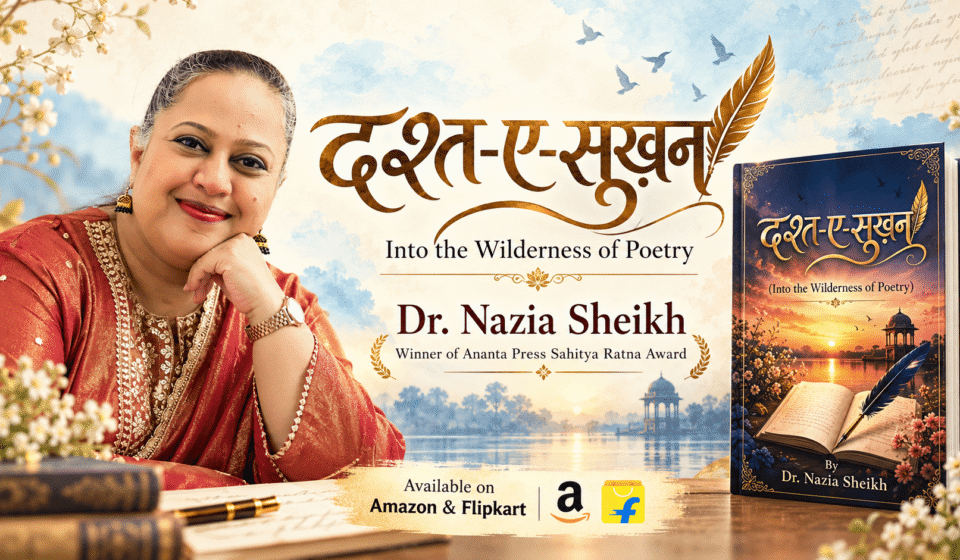
Imagery serves a similar purpose. The cover features a warm sunset landscape, an open book and a quill, setting up a visual atmosphere of contemplation, distance and storytelling. Cover art is not evidence of what every poem contains, but it communicates the intended reading experience: an encounter with inward landscapes. The title’s wilderness metaphor expands that idea. A wilderness can feel lonely, liberating or immense depending on the person crossing it. Likewise, the emotional territory of a poetry collection may shift under the reader’s gaze. The visual and verbal presentation work together to establish a mood of reflective exploration.
Dr. Sheikh’s sustained presence in poetry communities gives this literary approach a wider context. Her author biography describes performances and appreciation on open-mic platforms, alongside multiple individual poetry books and contributions to anthologies. A culture of spoken poetry demands a somewhat different form of attention from silent reading. Audiences respond to cadence, pause, clarity and emotional immediacy, often without the luxury of rereading a sentence. The book may appeal to people who value that oral dimension of modern Indian poetry, even while the printed page offers its own slower, more private encounter. The author moves between settings in which poems are heard collectively and settings in which they are contemplated alone.
A striking feature of contemporary Indian poetry is the coexistence of inherited literary forms with intensely individual voices. Readers may recognize familiar words of desire and loss, but they seek a perspective that feels alive now. Dr. Sheikh’s stated priorities place personal authenticity at the center of that negotiation. The collection does not need to claim that love or sorrow is a newly discovered subject. Its potential originality lies in the way a particular sensibility organizes and communicates those subjects. Individuality in lyric writing often comes through tonal decisions: what is emphasized, what is permitted to remain unresolved, and how much trust the writer places in the listener.
It is also valuable to distinguish this book’s promise from the easy assertion that poetry should be universally understood without effort. Every expressive tradition has cultural nuances that reward curiosity. A reader unfamiliar with certain Hindi or Urdu words may sometimes need to linger, listen or investigate. That is not a flaw. The key question is whether the emotional impulse remains available even when every resonance is not immediately clear. By presenting richness and approachability as compatible, दश्त-ए-सुख़न offers a model of reading based on invitation rather than exclusion. Such a model respects beginners without underestimating their intelligence.
Those who enjoy literary tradition will find the cultural positioning worth exploring. Those who read primarily for comfort may be drawn instead to its treatment of inner struggle and hope. And those who appreciate language itself may welcome the sounds and associations implied by its title and description. These audiences need not compete with one another. A successful poetry collection can be at once personal and culturally resonant, easy to enter and difficult to exhaust. The value of the work rests on its capacity to accommodate these layers without allowing any single one to dominate.
Seen through this lens, दश्त-ए-सुख़न is a celebration of expressive possibility. It proposes that the cultural richness of Hindi and Urdu can serve direct, recognizable emotions without sacrificing subtlety. It also reminds readers that poetic language is not merely a way of saying something prettier than everyday speech. At its best, it permits something important to be said at all. For people who want to explore love, absence and endurance through words that hold history as well as personal feeling, Dr. Nazia Sheikh’s collection offers an appealing literary invitation.
Amazon purchase link: https://amzn.in/d/0042oEEO