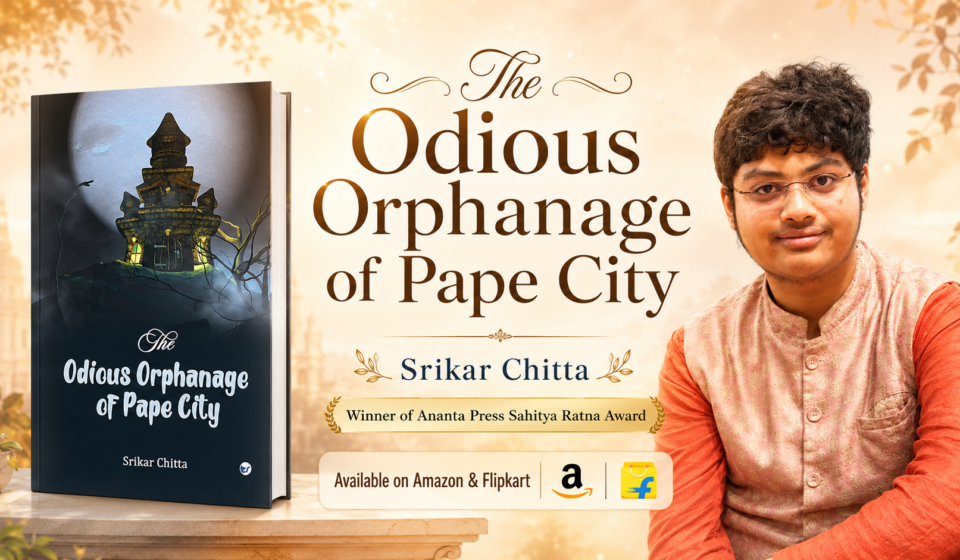

The Odious Orphanage of Pape City by Srikar Chitta may be a short and fast-moving novel, but its emotional and thematic impact extends far beyond its page count. On the surface, the story is a suspenseful adventure about a boy named Chris who is forced into a grim orphanage called the “House of Victory.” Once there, he discovers that the institution is ruled by an evil warden, filled with hostile children, and structured around bizarre punishments and daily humiliation. Yet beneath this dramatic and often chilling plot lies a deeper reflection on how young people endure harsh systems, preserve their dignity, and search for agency even in circumstances designed to strip it away.
One of the most striking features of the book is its portrayal of power. From the moment Chris arrives at the orphanage, it becomes clear that this is not merely a difficult environment but a system built on domination. The warden is more than just a cruel individual. He represents a corrupt authority structure in which fear is normalized and compassion is absent. His power shapes the mood of the institution, influences the behavior of the children, and turns daily life into a psychological ordeal. This is what gives the story much of its force. Chris is not simply trying to avoid punishment; he is trying to survive within a world where cruelty has become routine.
That framework makes Chris’s journey especially meaningful. He begins as a vulnerable child placed in an unfamiliar and hostile environment, but the story gradually reveals the quiet resilience that enables him to endure. The word “resilience” is often used loosely, yet this book gives it concrete form. Chris must cope with fear, uncertainty, isolation, and constant pressure. He must confront the emotional exhaustion of living where every day brings the possibility of humiliation or pain. His perseverance does not come across as theatrical heroism. Instead, it feels grounded in the kind of inner stubbornness that many readers, especially younger ones, can understand. He does not surrender his humanity, even when the institution around him seems intent on breaking it.
The title “House of Victory” is one of the book’s most important symbols. It is an example of how language can conceal reality rather than reveal it. A place with such a name should represent hope, shelter, or even triumph over adversity. Instead, it is a house of fear. This contradiction becomes central to the novel’s exploration of false appearances. Institutions often claim noble purposes, but sometimes those purposes are corrupted. By placing Chris inside such a space, the author invites readers to think critically about the gap between official identity and lived experience. The name becomes ironic, almost mocking, and that irony intensifies the horror of Chris’s situation.
Another strength of the book lies in the way it depicts the emotional experience of childhood under pressure. Adult readers may sometimes underestimate the seriousness of children’s fears, but Srikar Chitta does not. He gives those fears shape and legitimacy. The meanness of peers, the dread of an unpredictable authority figure, the disgust associated with the repeated potato soup, and the feeling of being trapped all become vivid components of Chris’s world. These details matter because they transform the orphanage into more than a scary backdrop. It becomes a lived environment of discomfort and intimidation. Young readers will likely respond strongly to that immediacy because it mirrors the way children often process distress—not abstractly, but through daily routines, repeated humiliations, and emotional tension.
The pacing of the book plays an important role in reinforcing its themes. Because the novel is compact, it does not diffuse its energy through unnecessary detours. Every chapter pushes Chris further into danger or insight. This narrative economy gives the story a feeling of compression, which suits the atmosphere of entrapment. Chris’s world feels tight, controlled, and relentless. There is no emotional breathing room, and the structure of the book reflects that. Readers move through the story with a sense of pressure, which deepens empathy with the protagonist.
At the same time, the book remains highly readable. This is one of its unique virtues. It takes serious themes—oppression, injustice, emotional endurance—and packages them in a form that young readers can engage with readily. There is no heavy-handed moralizing, no excessive complexity that slows the story’s momentum, and no sense that the author is trying to show off literary difficulty. Instead, the storytelling is clear, purposeful, and engaging. That clarity is not a limitation; it is an accomplishment. Writing for younger readers while preserving dramatic intensity requires control, and Srikar Chitta demonstrates that control effectively.
One of the reasons this book feels fresh is that it emerges from a youthful perspective. Since Srikar Chitta wrote it as a young author, the novel carries an immediacy that can be hard to imitate from a distance. The dynamics between children, the sense of helplessness before unfair systems, and the intensity of seemingly small humiliations all feel genuinely observed. There is something powerful about a story for youth that appears to understand youth from the inside rather than describe it from above. That gives the novel an authenticity that is central to its appeal.
The book also succeeds as a thriller because it understands that suspense is not only about plot twists. Suspense also comes from uncertainty, emotional stakes, and the possibility of moral defeat. Readers worry not just about whether Chris will escape, but whether the orphanage will crush his spirit. That is why the story has emotional weight. The dangers are external, but the real victory is internal. To remain hopeful, observant, and determined in such a setting is itself an act of resistance.
For teachers, librarians, and parents, The Odious Orphanage of Pape City offers several points of value. It can be a useful book for reluctant readers because of its brisk pacing and compact size. It can also stimulate thoughtful discussions about fairness, abuse of power, courage, and the meaning of freedom. Young readers may recognize in Chris’s situation a magnified version of real-life experiences with bullying, unfair rules, or adults who misuse authority. The novel can therefore serve as both entertainment and a prompt for reflection.
Its uniqueness lies partly in its form. At only around 58 pages, the book proves that a story does not need to be lengthy to be memorable. In fact, its brevity contributes to its effectiveness. The absence of excess gives the narrative sharpness. It is lean, direct, and emotionally concentrated. In a marketplace crowded with long series and extended fantasy worlds, this kind of focused thriller feels refreshingly intentional. It respects the reader’s attention while still delivering a complete emotional arc.
Ultimately, The Odious Orphanage of Pape City is more than a dark adventure. It is a story about endurance under pressure and the refusal to let cruelty define one’s inner life. Chris’s journey through the so-called House of Victory exposes the ugliness of unchecked authority, but it also affirms the possibility of courage in the most hostile spaces. Srikar Chitta has crafted a book that is suspenseful, meaningful, and highly accessible. It is a notable achievement not only because of the author’s age, but because it genuinely understands the emotional truths it wants to explore. Readers looking for a gripping youth thriller with heart, tension, and purpose will find much to admire here.
Amazon Link: https://www.amazon.in/Odious-Orphanage-Pape-City/dp/9394437614/