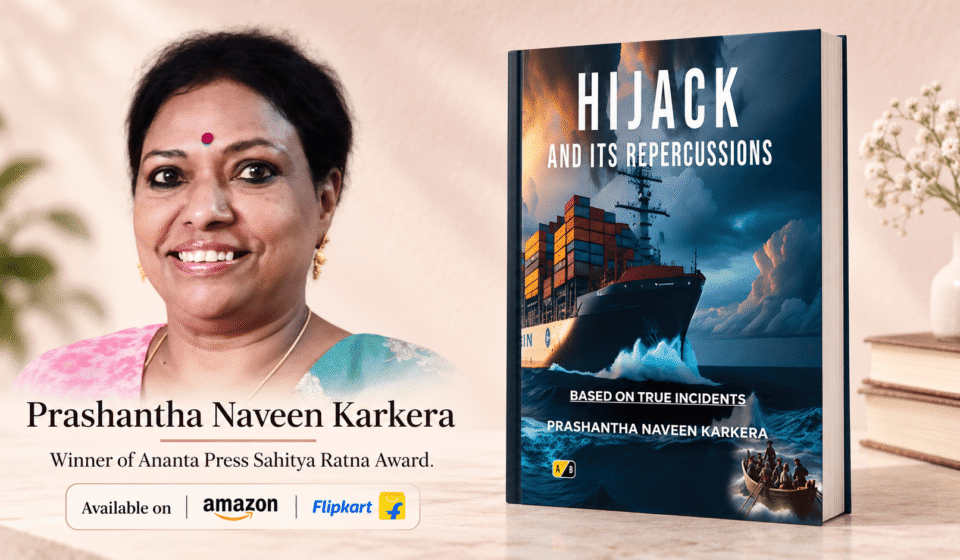

Book: Hijack: And Its Repercussions | Author: Prashantha Naveen Karkera | Category: Non-Fiction (General)
Hijack: And Its Repercussions by Prashantha Naveen Karkera is a notable piece of general non-fiction because it occupies a fascinating space between personal memoir and the history of an international crisis. The book’s subject is dramatic enough on its own: a cargo vessel, Princess Kash, is caught in the dangerous environment of Sri Lanka’s civil war, seized in territory influenced by the LTTE, placed under suspicion, and destroyed while the fate of those on board remains uncertain. Yet the book’s real value lies not in sensationalising those events. Instead, it reveals how many systems collide when a civilian maritime incident takes place in a war zone: military decision-making, diplomatic responsibility, media reporting, national identity, professional reputation, humanitarian intervention, and the desperate concerns of families far from the scene.
The historical context gives the narrative immediate tension. The incident occurred in 1998, when the conflict between the Sri Lankan state and the Liberation Tigers of Tamil Eelam had already created a climate in which movement, supplies, territorial control, and maritime activity could be interpreted through the lens of security. The preface by Shivshankar Menon is particularly useful in establishing that context. From the Indian High Commission’s perspective, information was difficult to verify and the atmosphere was shaped by what he calls, in effect, the uncertainty generated by war. The Sri Lankan authorities suspected the vessel of carrying supplies to LTTE-controlled territory, while the Indian mission’s urgent concern was the welfare of the Indians on board and the establishment of facts.
That gap between suspicion and certainty is one of the most thought-provoking aspects of the book. A vessel can be seen by one party as a commercial ship, by another as a possible logistical asset, and by an armed group as something that can be seized. The captain, meanwhile, remains responsible for the lives of those aboard even when normal command has been disrupted. The author’s account adds the dimension of a family trying to understand how a respected merchant navy captain could suddenly become associated, however unfairly, with allegations emerging from a conflict he did not create. The book therefore raises serious questions about how quickly individuals can become entangled in geopolitical narratives larger than themselves.
The destruction of the ship intensifies those questions. Once a physical object that might contain evidence is destroyed, certainty becomes even harder to achieve. Menon’s preface explicitly acknowledges that the precise facts and roles of the actors cannot be established conclusively in every respect. That candour gives the book credibility. Rather than promising a perfectly resolved historical puzzle, the material recognises that war produces incomplete records, conflicting claims, and decisions made under pressure. This makes the book valuable not only as a survival story but also as an illustration of the limits of knowledge during conflict.
For readers interested in diplomacy, the book provides a particularly human view of what diplomatic work means in practice. Diplomacy is often imagined as formal meetings, ceremonial visits, and policy statements. Here, its relevance is immediate: citizens are in danger, their families need reassurance, authorities must communicate across national lines, and the welfare of individuals depends on sustained institutional engagement. The author’s repeated attempts to contact officials show diplomacy from the outside, from the point of view of someone desperately seeking access. The preface shows it from the inside, where the High Commission’s priority was to secure the safety and eventual return of those caught in the crisis. Together, these perspectives make diplomacy feel less abstract and more like a practical mechanism of protection.
The humanitarian dimension is equally important. The author’s supporting account credits the Red Cross with a significant role in the rescue process and describes the immense relief that followed confirmation that the Indian crew members were safe. This is one of the book’s most effective reminders that in conflict zones, humanitarian actors can become crucial bridges between armed forces, governments, civilians, and people trapped in circumstances they did not choose. The narrative does not reduce the outcome to a single heroic actor; rather, it conveys a chain of appeals, interventions, communications, and decisions that eventually made survival and return possible.
Another strength is the way the book deals with professional integrity. For a ship’s captain, reputation is not an incidental matter. Command depends on judgement, responsibility, and trust. The author’s fear was therefore twofold: she feared for her husband’s life and for the possibility that his name might be permanently damaged by accusations arising from the incident. This concern adds depth to the narrative because survival alone does not automatically restore normal life. A person may return physically while still carrying the burden of interrogation, suspicion, public attention, and the need to explain decisions taken under extreme conditions.
The book is also a useful meditation on the role of media during crisis. The author first encounters the catastrophe through a newspaper report, not through a private communication from the ship. That detail is striking. It captures a pre-social-media era in which families could learn world-changing information through headlines while still lacking direct confirmation. Media coverage can alert the public and generate pressure, but it can also amplify fear when facts are incomplete. The author’s emotional response to reports suggesting that the crew may have died shows the enormous human consequences of uncertain information.
Stylistically, the narrative is strongest when it remains close to memory. It is not written as a detached maritime investigation or scholarly history, and readers should approach it on those terms. Its power comes from immediacy: fear, repeated appeals, sleeplessness, prayer, concern for a child, worry about elderly family members, and the refusal to accept silence. These personal details give weight to the geopolitical framework. They prevent the reader from viewing the episode only through maps, acronyms, and institutions.
The word “repercussions” in the title deserves attention because it accurately reflects the book’s wider scope. The consequences include family trauma, altered attitudes toward life, gratitude for survival, renewed awareness of uncertainty, and a lasting respect for those who wait for loved ones placed in danger by conflict. The author describes the event as something that changed her permanently. She becomes more conscious of the fragility of ordinary happiness and more empathetic toward families who live with the possibility that someone serving at sea or in uniform may not return.
This is what makes Hijack: And Its Repercussions unique among general non-fiction narratives. It connects an incident at sea with the domestic space of a family home, and it connects a family’s fear with the mechanisms of governments and diplomacy. It is both intimate and international. It shows that geopolitical events do not remain on the pages of foreign affairs; they enter kitchens, living rooms, offices, telephone calls, and the minds of children.
Readers interested in true incidents, maritime history, South Asian conflict, diplomacy, humanitarian intervention, and personal resilience will find several entry points into the book. Its most important contribution is to preserve an episode not merely as a matter of policy or security, but as a lived human experience. By recording the emotional cost alongside the institutional response, the author gives the event a dimension that official archives alone could never supply. It is a book about danger, yes, but also about how governments, humanitarian agencies, families, and individuals respond when lives hang in uncertainty. That combination makes it a meaningful and memorable work of non-fiction.
Amazon: https://amzn.in/d/3x4P3nN