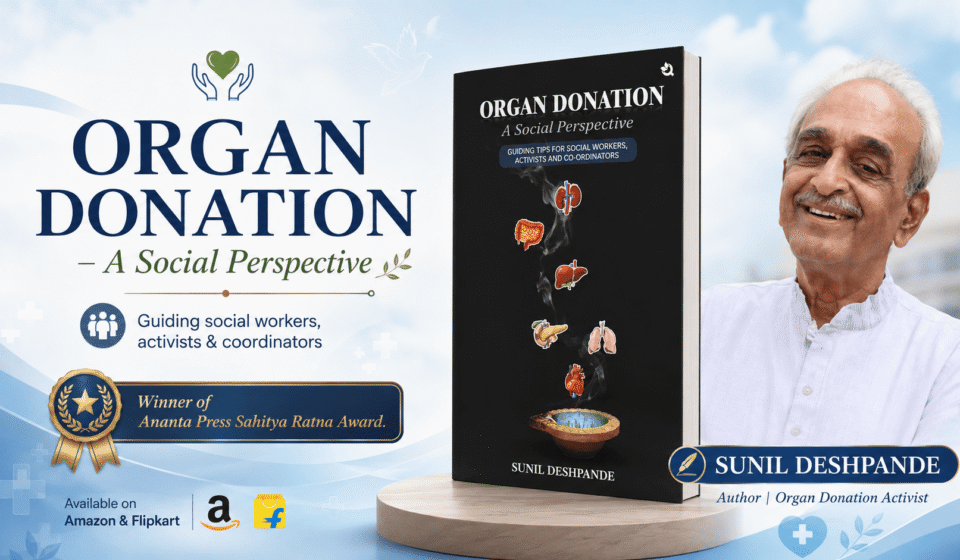

Organ donation is often discussed through numbers: the number of patients waiting, the number of available donors, the number of transplants completed, the number of lives that might be saved. Those numbers are important, but they can never tell the whole story. Behind every statistic is a family, a moment of decision, a network of doctors and coordinators, a set of beliefs, and a society trying to understand what it means to give after loss. Organ Donation – A Social Perspective by Sunil Ranganath Deshpande is important because it directs attention toward this wider human environment. It asks readers to see organ donation not only as a medical procedure but as a social responsibility that depends on awareness, communication, trust, and collective participation.
A subject that demands trust
The social side of organ donation is often the most difficult part to address. Medical science can establish what is possible, but public willingness depends on something less measurable. People need to trust hospitals, understand procedures, feel that their values are respected, and receive information in a form that does not frighten or confuse them. Families may carry myths that have circulated for years. Some may have religious questions. Others may simply never have discussed donation before. In such situations, the social worker or awareness activist becomes a crucial figure. They are not merely distributing information; they are helping people move from uncertainty toward understanding.
This is where the book’s target audience becomes one of its greatest strengths. Deshpande does not write only for specialists. The subtitle explicitly addresses social workers, activists, and coordinators, acknowledging them as central participants in the organ-donation movement. That choice is significant. In many public causes, there is a gap between expert knowledge and public awareness. The people who fill that gap require their own resources, their own language, and their own practical guidance. Organ Donation – A Social Perspective appears to have been created with that need in mind.
Why the author’s background matters
A book on social awareness is most convincing when it is written by someone who has actually worked among people. Deshpande’s record gives this book a strong foundation. His long involvement with organ-donation advocacy includes leadership in the Mrutyunjay Organ Foundation, the Federation of Organ and Body Donation, Rotary-related awareness work, and participation in a Maharashtra government authorization committee connected with organ transplantation. This combination gives him exposure to both grassroots and institutional realities.
Perhaps the most telling part of his journey is the series of Avayavdaan Vaari walk rallies. Between 2016 and 2020, he and his initiatives covered around 4,000 kilometres across Maharashtra through four padayatras. The purpose was awareness, and the scale was substantial: hundreds of programs, a strong rural focus, and direct communication with many thousands of people. It is difficult to imagine a better education in the social dimensions of organ donation. Walking into towns and villages, speaking to different age groups, answering repeated questions, witnessing hesitation, and learning which forms of communication actually work would give any writer a perspective that no desk-based research could fully reproduce.
The meaning of a social perspective
The phrase social perspective is more than an attractive subtitle. It identifies the core challenge of donation. An organ can move from one body to another only through a complex medical process, but the possibility of that process often begins with a social decision. Someone must know that donation is possible. A family must understand the meaning of consent. A community must be able to discuss death without immediate avoidance. Volunteers must know how to raise awareness without creating pressure. Coordinators must be prepared to speak with dignity and accuracy.
Seen this way, organ donation is a chain of human relationships. The strength of Deshpande’s book is that it treats those relationships as worthy of study and guidance. This is particularly relevant in India, where language, religion, rural-urban differences, family structure, and levels of access to medical information can shape public attitudes in very different ways. A message that works in one community may not work in another. Awareness therefore requires flexibility and cultural intelligence. A useful guide for field workers should help them think about that reality rather than rely on one universal script.
Communication as public service
Deshpande’s contribution to the official Marathi organ-donation pratidnya approved by the Government of Maharashtra is a revealing example of how communication can become public service. A pledge is short, but it must carry clarity, seriousness, and emotional meaning. It must transform a complex subject into language that ordinary citizens can understand and accept. The author’s involvement in this work suggests a long-standing concern with how organ donation is communicated, not merely what is communicated.
That is also why the multilingual dimension of his career is noteworthy. He has written books in Marathi, participated in works in Hindi and English, and even used a Hindi musical album to spread awareness. These are not random creative activities. They demonstrate an understanding that social messages travel through different forms. Some people respond to a lecture, some to a book, some to a song, some to a personal conversation. Effective advocacy is rarely one-dimensional.
A book for people who carry the message
The most obvious readers for Organ Donation – A Social Perspective are social workers, NGO members, transplant-awareness volunteers, student groups, Rotary and civic-service members, and coordinators who are regularly expected to speak about donation. But its usefulness can extend further. Families who want a clearer social understanding of the subject, teachers planning awareness sessions, community leaders, health-communication students, and even journalists may find value in a book that frames donation through public engagement rather than medical jargon.
Its educational value lies especially in orientation. Before a person can become an effective advocate, they need to understand not only the importance of the cause but the responsibilities attached to advocacy. They need to know that sensitivity matters. They must separate myths from facts. They must recognize the limits of their role and know when specialist guidance is required. They must be able to communicate with respect across different communities. A book built around guiding tips can provide that foundation.
The ethical dimension
One of the reasons organ-donation awareness must be handled carefully is that it sits close to grief. This makes tone crucial. The best campaigns encourage informed generosity, not guilt. They create understanding, not fear. They recognize that a family making decisions after a death is experiencing something deeply personal. A social approach can help volunteers keep this ethical dimension at the centre of their work.
Deshpande’s long public-service record gives the book a tone of commitment rather than abstraction. At the age of seventy-six, after years of campaigns, lectures, writing, and organizational work, he continues to be associated with the cause. That longevity gives the book an intergenerational value as well. It shows younger activists that social change is rarely the result of one event. It grows through repeated effort, disciplined communication, and the willingness to return to the same issue even when progress is slow.
Why the book stands out
What makes Organ Donation – A Social Perspective distinctive is its attempt to strengthen the human infrastructure around organ donation. Hospitals need trained doctors. Transplant programs need legal and administrative systems. But societies also need informed citizens and trustworthy communicators. Social workers, activists, and coordinators form part of that human infrastructure. When they are better prepared, conversations can become more accurate, awareness can become more respectful, and myths can be challenged more effectively.
The book therefore occupies an interesting space between healthcare education and civic education. It is about organ donation, but it is equally about how a social cause is carried into the public sphere. It reminds readers that medical breakthroughs cannot achieve their full social value unless communities understand them and feel able to participate.
Ultimately, this is a book about service. The service is not dramatic; much of it involves explaining, listening, organizing, repeating, and building trust. Yet those quiet acts can become the beginning of life-changing decisions. Organ Donation – A Social Perspective recognizes the people who perform this work and gives their role the seriousness it deserves. For that reason, the book is not only relevant to the organ-donation movement. It is also a thoughtful example of how public awareness, when guided by experience and empathy, can become a form of social transformation.