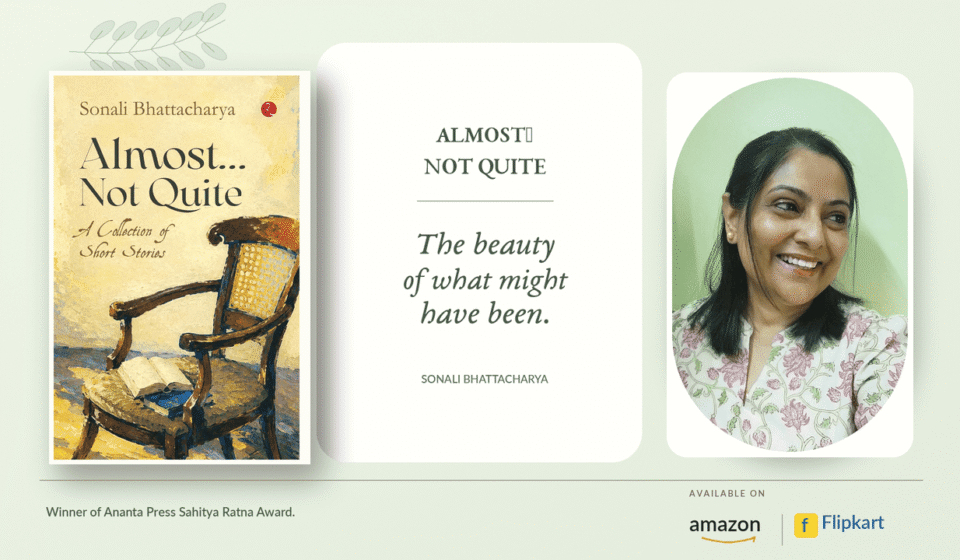
Twenty-Four Stories, Three Movements, One Quiet Question: The Thoughtful Architecture of Almost… Not Quite

A short-story collection faces a challenge that a novel does not: every piece must have room to establish its own emotional world, while the book as a whole needs a reason to exist beyond the convenience of gathering separate narratives. Almost… Not Quite, Sonali Bhattacharya’s collection of twenty-four stories, proposes an unusually clear answer. Its organizing principle is na pawa, a Bengali expression for the longing attached to something deeply desired but not obtained. Rather than offering a series of unrelated portraits, the book is presented as a sustained exploration of this one emotion in its many forms. The result, at the level of concept and design, is an appealing example of how a collection can be diverse in subject while coherent in feeling.
The book’s title is its first structural decision. “Almost” opens the door to an imagined event, while “not quite” stops just short of completion. The ellipsis between them provides a pause in which the reader can supply a personal memory. That pause is not a decorative flourish: it represents precisely the emotional space the stories aim to inhabit. A conventional title might declare the theme as heartbreak or regret. This one leaves the boundaries deliberately porous. It can hold a missed relationship, an unrealized vocation, a departure without return, a delayed achievement or the strange ache of arriving somewhere changed. Such flexibility is essential when twenty-four different narratives are intended to speak to a shared idea without becoming twenty-four versions of a single plot.
The named sections give the collection a second level of order. The Echoes addresses what was never had; The Storm turns toward what was lost; and The Harvest concerns what a person eventually carries forward. There is insight in separating these experiences. Not having something and losing something are not identical. An imagined relationship can wound us even when it never existed; the end of a real relationship carries the further weight of shared history. Likewise, what remains after disappointment is not necessarily what was expected at the beginning. By distinguishing these categories, Bhattacharya’s framework suggests an attentiveness to the changing vocabulary of absence rather than treating every unhappy experience as interchangeable.
The Echoes is a particularly evocative name for the collection’s opening movement. An echo depends on something that seems to have passed, yet continues to be heard. Applied to missed possibility, the metaphor becomes more interesting still: sometimes we hear the resonance of an event that never fully occurred. The wish for a different education, a conversation never attempted or an early talent left uncultivated can produce an enduring sound in the mind. This is rich territory for short fiction because a brief encounter or recalled object may illuminate years of private longing. The collection’s stated first movement encourages attention to the remembered possibilities surrounding a life, not only to its visible events.
The transition to The Storm changes the emotional temperature. The word introduces disruption and consequence rather than reverberation alone. Loss can reorder daily habits, personal identity and the meaning of familiar places. A person who has lost a relationship may continue to inhabit its rituals. Someone separated from a home may feel that absence through ordinary details rather than grand declarations. The book’s described situations include love becoming memory and a home that cannot be reclaimed, both of which demonstrate how loss exceeds a single moment. This movement offers the possibility of stories that treat the aftermath of change as seriously as the event itself. That is a welcome counterpoint to narratives that race toward the most dramatic scene and consider the emotional work finished afterward.
Finally, The Harvest changes the question from “What is missing?” to “What can be carried?” The metaphor is carefully chosen. Harvest is not the same as triumph, nor does it erase storms that preceded it. It suggests seasons, labor, the passage of time and outcomes that may differ from the original plan. The publisher’s description refers to a journey undertaken by a child in a parent’s place and a song finding a different voice. Without needing to claim details beyond those brief indications, we can see why such images belong in the final movement: an unrealized wish can pass into another generation or reappear in a form that its first dreamer did not anticipate. Completion, then, may not look like fulfillment of the original desire.
There is a further linking element in the publisher’s account: Tara, described as a keeper of thresholds, guides the reader through these movements. A threshold is both an ending and a beginning. One stands on it while belonging fully to neither side. As a conceptual presence, Tara suits a book devoted to the almost-reached and not-quite-crossed. The image offers potential continuity without requiring all twenty-four stories to share a conventional protagonist. It also supplies an imaginative counterweight to the grounded geography of Bengal. The framing asks the reader to think of each story as an encounter at a boundary: between intention and action, memory and present life, loss and what may follow.
Another strength of the arrangement is its invitation to compare stories without flattening their differences. Read separately, a narrative about vocation might seem unrelated to one about kinship; placed within a common emotional architecture, each may illuminate the other. A person may surrender a dream willingly yet grieve it later. Another may pursue a desired future so intensely that the present becomes difficult to inhabit. The shared theme does not tell readers that these people have identical experiences. Rather, it gives them a common question: how do the things that never became ours continue to affect what we do with what is ours? A well-conceived short-story collection can generate that kind of conversation across its own pages.
The geographic setting strengthens the architecture. Kolkata and other towns of West Bengal are not merely coordinates; they represent networks of memory, family and social expectation within which the “almost” of one person may be tied to the decision of another. A future left behind is sometimes an individual choice, but it can also be shaped by migration, opportunity, obligations or changing attitudes across generations. Locating these stories within identifiable cultural circumstances gives the theme specificity. At the same time, the governing emotion is portable. Readers unfamiliar with Bengali culture need not know every social reference to understand the ache of an unfinished possibility. They can encounter the local setting as a meaningful world rather than a barrier to entry.
There is an interesting creative contrast in Bhattacharya’s background. She is trained as an engineer, graduated from Jadavpur University and has worked in information technology for nearly three decades. One should not assume that engineering produces a particular kind of prose. Yet her book’s carefully stated thematic sequence invites discussion of design: sections are linked, distinctions matter, and an overarching idea gives separate experiences a shared form. This is a useful reminder that literary structure is not merely a matter of arranging pages. It can guide the reader’s understanding of what the stories are trying to investigate.
The question, for any collection so strongly unified by a theme, is whether coherence leaves enough space for surprise. Twenty-four stories about longing could become monotonous if every character reached the same conclusion or if each ending translated disappointment into wisdom. The collection’s own conceptual range suggests a more interesting possibility: different kinds of na pawa should lead to different emotional outcomes. Some may sharpen gratitude, some may remain unresolved, and some may be difficult to name at all. The organizing idea is most powerful when it works as a lens rather than a moral instruction. Readers drawn to literary short fiction will likely value that openness more than an insistence on neat consolation.
It is also useful to consider the book’s scale. With twenty-four stories in a single volume, the collection invites reading in intervals. A short story can offer a complete encounter while leaving the reader with questions that continue into ordinary life. This makes the format well suited to Bhattacharya’s subject: an unfinished possibility often announces itself not during a crisis but in a quiet moment between other responsibilities. Readers can take one narrative, consider the form of longing it explores and return later to meet a different one. The three movements provide continuity across those pauses, allowing the book to feel curated rather than episodic.
Almost… Not Quite is distinctive not because regret is a new literary subject, but because it gives regret, missed possibility and inheritance a particular arrangement and vocabulary. Its title introduces uncertainty; na pawa gives that uncertainty cultural and emotional depth; the three movements map different relationships to absence; and Tara’s threshold imagery suggests a guiding consciousness. Those elements form a coherent promise of literary reflection. Readers who enjoy interlinked themes, carefully grouped stories and emotional questions more durable than plot twists should find much to consider here. The collection asks us to see not one story of a life going wrong, but many stories of people becoming themselves in the presence of what could not be completed.
Amazon purchase link: https://amzn.in/d/0bpjpD81