Karmic Medicine — A Reflective Invitation to Understand Life, Consciousness, and the Meaning of Healing

Healing is among the most universal human aspirations. Regardless of culture, age, or background, people seek ways to manage suffering, regain emotional stability, understand difficult experiences, and build more meaningful lives. Yet the idea of healing cannot always be reduced to one definition. For some, it concerns physical recovery; for others, it involves emotional reconciliation, spiritual growth, or the development of a more peaceful relationship with uncertainty.
Dr. Renu’s Karmic Medicine: 38 Years of Healing Wisdom enters this broad conversation with a title that is both distinctive and thought-provoking. By bringing karma and medicine together, it suggests an exploration of the relationship between personal experience, philosophical understanding, and the human desire for wholeness.
The subtitle introduces another important dimension: time. Thirty-eight years represent a substantial span of accumulated experience. While the cover alone does not establish the nature of the author’s professional journey or the specific experiences discussed in the manuscript, the phrase Healing Wisdom positions lived understanding as a central part of the book’s appeal.
There is something particularly engaging about wisdom that emerges through sustained observation and reflection. The most enduring life lessons are often those that cannot be learned through theoretical explanation alone. They develop gradually, through changing relationships, personal challenges, mistakes, achievements, disappointments, and encounters with the unexpected.
A title such as Karmic Medicine naturally encourages readers to consider how such experiences influence the way people interpret their lives.
Its conceptual starting point is the word karma. In popular culture, karma is often presented as an immediate cosmic reaction to human behaviour. Someone makes a poor decision, and an unfortunate event follows; someone acts generously, and good fortune supposedly returns.
Such simplified interpretations do not capture the richness of karmic thought across Indian philosophical traditions. Karma can involve questions of intention, action, consequence, moral responsibility, and continuity. Different traditions interpret these questions differently, and the concept cannot be reduced to a single universally accepted explanation.
For a contemporary reader, one useful approach is to view karma as an invitation to examine choices. What motivates our actions? How do habits develop? Why do certain behaviours recur? How do intentions differ from consequences? And how can greater awareness influence the decisions we make?
These questions are relevant far beyond explicitly spiritual settings.
Consider everyday relationships. A person who regularly responds to disagreement with anger may gradually damage trust. Another who practises attentive listening and respectful communication may strengthen connections. These are not examples of supernatural punishment or reward; they illustrate the ordinary consequences of behaviour.
Similarly, habitual avoidance can prevent difficult conversations from taking place, while deliberate honesty can create opportunities for resolution. In this sense, karmic reflection may be valuable as an ethical and psychological exercise, even for readers who do not subscribe to its metaphysical interpretations.
The healing dimension adds emotional depth to these questions.
Many people associate healing with returning to a previous state. After an injury, illness, or difficult experience, they hope to regain the stability they once enjoyed. Yet some experiences change individuals permanently. Personal growth may require adapting to a new reality rather than recreating the past.
Emotional healing is especially complex because it involves memory, interpretation, relationships, and identity. A painful event may continue influencing a person’s expectations long after the circumstances have changed. Recognising such patterns can be an important part of self-reflection.
This is where the philosophy suggested by Karmic Medicine becomes particularly compelling. The relationship between past experience and present behaviour offers fertile ground for examining how people change.
A reader approaching this subject might consider whether recurring emotional difficulties arise from unexamined expectations, habitual responses, or unresolved conflicts. Such reflection does not imply that individuals are responsible for every hardship they experience. Trauma, illness, discrimination, and many other challenges can involve circumstances beyond personal control.
Rather, self-awareness can help individuals identify the choices and sources of support available to them in the present.
The difference is important. Any responsible discussion of karmic healing should promote compassion rather than blame. Individuals living with illness or adversity need understanding, appropriate care, and support, not suggestions that their suffering is a punishment for previous actions.
Seen through this ethical lens, the combination of karma and healing can encourage a humane approach to life’s difficulties.
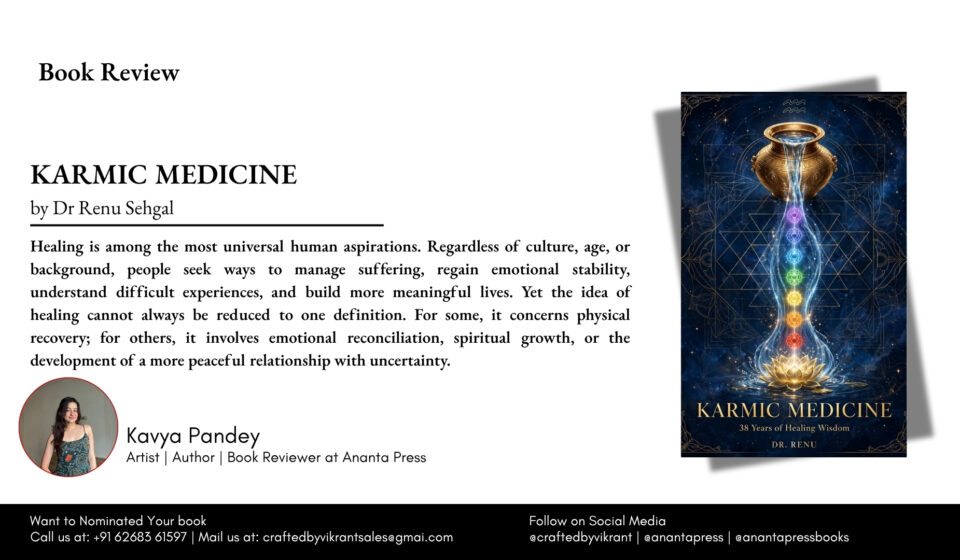
Another notable aspect of the book’s presentation is its visual language. Its deep-blue cover creates an atmosphere of contemplation, while intricate golden geometric patterns establish a connection with spiritual and symbolic traditions.
At the centre stands an ornate golden vessel pouring a stream of light and water. A series of chakra-inspired symbols follows the stream downward, culminating in a luminous lotus.
This imagery is rich in possible interpretations.
The vessel may be understood symbolically as a source of accumulated knowledge or spiritual nourishment. The flowing water suggests movement, continuity, and renewal. The coloured symbols invoke traditional concepts of inner balance and spiritual development, while the lotus represents awakening and transformation.
The composition moves the viewer’s attention from the vessel through the stream toward the flower, creating a visual journey from origin to emergence. It is an effective artistic choice for a work whose title suggests transformation through deeper understanding.
The cover also avoids the appearance of conventional clinical literature. Instead of medical instruments, anatomical illustrations, or technical diagrams, it uses spiritual symbolism to establish its thematic identity.
That difference signals an intended reading experience grounded in philosophical inquiry, contemplation, or personal meaning rather than an ordinary medical textbook.
One of the strongest questions raised by this positioning concerns the place of spirituality in contemporary life.
Modern society often encourages measurable achievement. People evaluate progress through qualifications, income, professional success, social recognition, or visible productivity. These measures can have practical value, but they do not fully capture emotional satisfaction or a sense of purpose.
An individual may achieve considerable external success while remaining uncertain about personal identity, relationships, or the direction of life.
Spiritual literature often addresses these less measurable aspects of human experience. It asks questions that cannot always be settled through external accomplishment: What makes life meaningful? How should a person respond to suffering? What responsibilities do individuals have toward others? How can inner stability be developed?
Karmic Medicine appears conceptually relevant to readers interested in such questions.
Its title also encourages reflection on the relationship between control and uncertainty. Human beings naturally seek explanations for unexpected events. When experiences are painful, the desire for certainty can become particularly strong.
Karmic language may offer a sense of narrative order, but there is also value in recognising that life is not always predictable or morally proportionate. Good people experience hardship, and harmful actions do not invariably produce immediate visible consequences.
A thoughtful philosophical approach allows space for these complexities rather than promising simple explanations.
The idea of healing becomes more compassionate when uncertainty is acknowledged. People need not understand every cause of suffering before taking steps toward recovery, seeking professional help, or rebuilding their lives.
Indeed, the willingness to live with unanswered questions can itself be a form of maturity.
The book’s suggested themes also connect with mindfulness and reflective practice. Mindfulness, in its broad contemporary usage, involves paying attention to present experience with greater awareness. Reflective practices can help individuals notice thoughts, emotions, and reactions before acting automatically.
These approaches do not require readers to accept particular beliefs about karma. They can instead function as methods of improving attention, examining behaviour, and creating space between impulse and response.
In everyday situations, such awareness may support more considered decisions. A difficult conversation might become an opportunity for listening rather than escalation. A professional setback might lead to reassessing expectations rather than immediately assuming personal failure.
Small changes in attention and behaviour can influence the way individuals experience daily life.
There is also an important social dimension to healing. Personal well-being is not created in isolation. Supportive relationships, safe environments, access to healthcare, financial circumstances, and community connections can profoundly influence a person’s ability to cope with adversity.
A broad understanding of healing therefore benefits from combining individual reflection with recognition of external realities.
The most convincing spiritual discussions of well-being are those that make room for both personal agency and compassion for circumstances beyond individual control.
Another reason this subject may appeal to readers is its connection with India’s philosophical heritage. Concepts such as karma, dharma, consciousness, and liberation have inspired centuries of debate and interpretation. They remain relevant because they address fundamental concerns about ethical living, human responsibility, and the nature of existence.
A contemporary book drawing upon these traditions can potentially help introduce longstanding philosophical questions to readers navigating modern circumstances.
However, clarity remains essential. Spiritual interpretations should be identified as spiritual interpretations, while medical or scientific claims require appropriate evidence. Such distinctions allow readers to appreciate symbolic and philosophical wisdom without confusing it with established clinical treatment.
This is particularly important in any discussion involving the word medicine.
Healing as a personal or spiritual metaphor can be powerful, but medical diagnoses and treatments must be assessed according to reliable scientific standards. Readers can embrace reflection, hope, faith, and personal meaning while continuing to rely on qualified healthcare professionals for medical concerns.
The two approaches occupy different but potentially complementary roles in human life.
Ultimately, the appeal of Karmic Medicine: 38 Years of Healing Wisdom lies in the depth of the questions its concept raises.
It invites consideration of how past experiences influence present choices, how individuals develop emotional understanding, and how spiritual traditions may offer perspectives on personal transformation.
Its distinctive title creates curiosity, while its evocative cover presents an artistic vision of energy, renewal, and awakening. The emphasis on thirty-eight years of wisdom adds a sense of accumulated perspective, suggesting a reflective approach to a subject that touches some of the most intimate aspects of human experience.
For readers interested in spirituality, self-awareness, Indian philosophical ideas, or the broader meaning of well-being, the book’s subject offers an inviting starting point.
Perhaps the most valuable insight suggested by its premise is that healing is not always about eliminating every difficulty. Sometimes it begins with learning to interpret experiences more compassionately, recognise patterns more clearly, and approach the future with greater awareness.
Karmic Medicine offers a compelling thematic invitation to consider healing not merely as an outcome, but as an ongoing process of reflection, understanding, and conscious living.