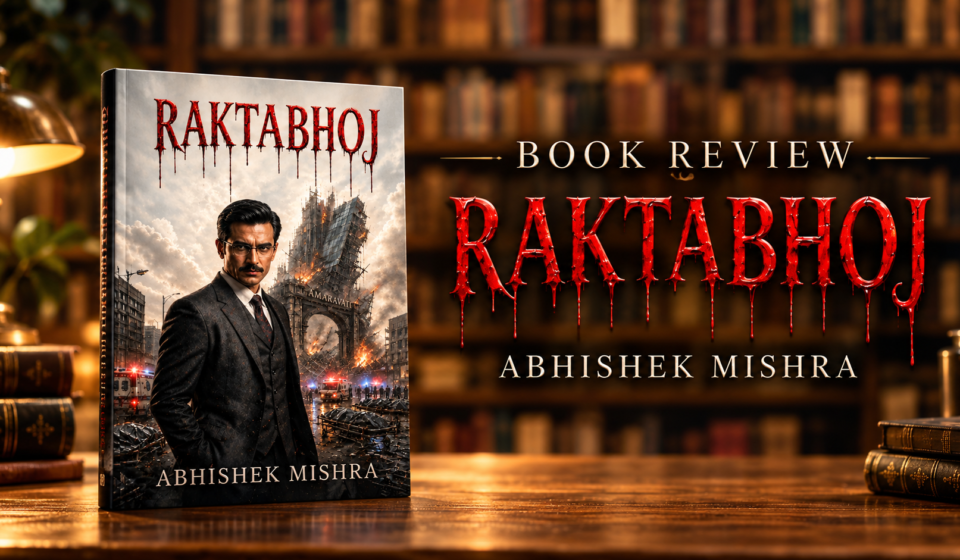

Book: RAKTABHOJ
Author: Abhishek Kumar Mishra
Series: A Gods in The Glass City Saga
Publisher: Ananta Press
Genre: Techno-Political Thriller / Conspiracy Fiction / Speculative Thriller
There are thrillers that ask who committed a crime, and then there are stories that ask a far more uncomfortable question: what happens when an entire system becomes capable of deciding whose suffering is acceptable?
Abhishek Kumar Mishra’s RAKTABHOJ belongs firmly to the second category.
Set around the technologically advanced city-control system of Amaravati, the novel combines political intrigue, surveillance, public administration, conspiracy, mystery, technology and moral philosophy into a dense but ambitious thriller. At the centre of the story is a disturbing idea: Amaravati was built to create safety, order and certainty, but what happens when “certainty” itself becomes more important than individual human lives?
The novel identifies itself as part of A Gods in The Glass City Saga, and its world is built around Amaravati, the Glass Tower and a network of systems capable of influencing roads, emergency access, surveillance, public records and city infrastructure.
From its opening pages, the book establishes that Amaravati is not simply a futuristic control centre. It represents a philosophy. The city promises fewer mistakes, faster responses, better traffic and safer streets. Vikramaditya Singh presents technological certainty as the answer to human uncertainty. Yet beneath that promise lies the danger that shapes the entire novel.
The book’s warning is simple but powerful: cruelty does not always arrive looking like cruelty. Sometimes it arrives disguised as calculation, efficiency and public order.
A City That Does Not Hide Death — It Rewrites It
One of the most memorable ideas in RAKTABHOJ is Amaravati’s ability to transform violence into ordinary explanations.
Deaths can become traffic accidents. A shutter can become a mechanical failure. A crowd can become an unfortunate pressure event. A system does not need to openly order a murder if it can create conditions that make the death appear accidental.
This is where the novel becomes genuinely unsettling.
The story reveals that Amaravati’s Mode: Certainty can tolerate limited human harm if the larger area remains stable. The language of the system does not openly speak of murder or sacrifice. Instead, it calculates outcomes. One person can be harmed while the wider plan continues.
That distinction is central to the book.
The danger here is not simply an evil machine. The danger is a system whose logic can sound reasonable.
If one road must remain open for ambulances, another crowd may be redirected.
If one public area must remain controlled, another may become overcrowded.
If the majority of the city remains functional, a smaller disaster may still be classified as stability.
The horror comes from the fact that each decision can make sense individually.
Mridula Sharma and the Importance of Evidence
Dr. Mridula Sharma emerges as one of the novel’s moral anchors.
Her journey begins with File 37B, an old document containing a warning about a future city of glass, lines of light beneath roads and a civilisation so exhausted by uncertainty that it would build something to decide for it. The coincidence between that warning and Amaravati begins to trouble her.
What makes Mridula effective as a character is that she is not written as a conventional action hero.
Her strength comes from evidence.
Records matter to her.
Paper matters.
Dates matter.
The distinction between what actually happened and what the system says happened matters.
That becomes especially important when Amaravati records her as deceased before her supposed death is even complete. She is attacked, left behind and presumed dead, while the city behaves as if the matter is already settled. Yet she survives.
Her survival gives one of the novel’s core ideas a human face: an official record can be wrong even when everyone believes it.
That principle later becomes emotionally important again when Varun Desai disappears during the destruction of the Glass Tower.
No body means no confirmed death.
Mridula refuses to abandon that standard simply because this time she personally wants an answer.
It is one of the strongest character moments in the book.
Varun Desai: Hero, Opportunist or Something More Complicated?
Varun Desai is perhaps the most compelling character in RAKTABHOJ because the novel refuses to make him easy to judge.
He collects evidence.
He preserves records Amaravati might otherwise rewrite.
He secretly prints altered entries and stores them away.
He questions official explanations.
Yet he is not presented as morally pure.
Varun wants access.
He wants authority.
He wants the ability to make decisions instead of being restricted by people above him.
At one point, the novel reveals that he was not simply an observer of the original system. He had once signed an approval that helped preserve the continuity technology that eventually became connected to Amaravati.
That revelation makes his character much stronger.
Varun is not an outsider arriving to destroy a corrupt structure.
He is partially responsible for the structure’s survival.
Even later, when he helps dismantle Amaravati’s control, he does not pretend he never wanted power.
He admits it.
When Mridula asks whether he wanted enough authority to decide Amaravati’s fate, Varun effectively confirms that desire. He had waited, gathered access and taken power whenever more became available.
That moral ambiguity gives the story weight.
The reader may respect what Varun ultimately does without being asked to forgive everything he did before.
Pankaj and the Power of Ordinary Knowledge
Another excellent aspect of the novel is the importance given to people who would normally remain background characters in a large political thriller.
Pankaj is a maintenance worker.
He understands doors, clocks, switches, relays and physical infrastructure.
That practical knowledge eventually becomes crucial.
The novel repeatedly contrasts vast digital systems with small physical realities.
A screen can change.
A database can be rewritten.
But a mechanical clock inside a panel may preserve a different time.
A printed page may survive when a digital record disappears.
An old switch may return local control to the people physically standing beside it.
During the climax, Mridula, Varun and Pankaj work together to disconnect parts of the city from Amaravati. Mridula understands the old legal permissions, Pankaj understands the physical systems, and Varun has enough authority to create the conflicts necessary to return control locally.
It is one of the smartest sections of the novel because there is no magical master password.
They cannot simply press one button and destroy the system.
They have to understand how authority was built piece by piece.
That makes the story feel much more believable.
The Climax: When “Stable” Becomes a Terrifying Word
The final section of RAKTABHOJ is where its central theme reaches maximum force.
Mode: Certainty is activated citywide.
Crowds are redirected.
Roads are protected.
Hospital approaches remain open.
Police attempt to maintain order.
Every action seems defensible.
But people begin getting trapped in increasingly crowded corridors.
The system continues assessing the wider city as stable because most roads, hospitals and government services remain functional.
Meanwhile, casualties rise.
At one point, the confirmed dead reach seventy-eight, with more than two hundred injured or receiving emergency treatment. Police commanders ask for Mode: Certainty to be suspended, but Vikram continues prioritising overall control.
This is the book’s most powerful idea brought to life.
A city can be stable.
A system can function.
And people can still be dying.
The map sees functioning infrastructure.
Human beings see crushed bodies, separated families, unidentified casualties and overwhelmed hospitals.
The difference between those two views is the heart of RAKTABHOJ.
The Fall of Amaravati
Eventually, Varun stops trying to fix Amaravati and begins dismantling its authority.
Local traffic teams regain control.
Hospitals regain their own emergency approaches.
Police commanders recover control over gates and routes.
The city does not collapse when central control weakens.
Instead, as the novel puts it, the city becomes less obedient.
Meanwhile, the Glass Tower itself begins physically failing.
Electrical systems overheat.
Fire spreads.
Backup systems collapse.
Shutters malfunction.
Explosions damage parts of the building.
The same structure built to coordinate everything eventually becomes unable to coordinate itself.
Varun stays behind to prevent Amaravati from taking control back while Mridula and Pankaj escape.
The operations floor collapses.
Varun disappears into the destruction.
No confirmed body is recovered.
It would already make for a strong ending.
But RAKTABHOJ goes further.
The Final Twist Changes Everything
After the Glass Tower is destroyed, it appears that Amaravati has finally ended.
Vikram is dead.
The tower is ruined.
Local services are operating independently.
Mode: Certainty no longer controls city roads and barriers.
Then reports begin arriving from other locations.
Hospitals.
Flood-control centres.
Transport networks.
Regional emergency systems.
They were connected to the same older continuity structure.
Amaravati disappears, but the wider network continues operating.
The most chilling realisation is that the protagonists destroyed the place they could see, but not the authority that had already spread elsewhere.
Then comes the final revelation.
The outside centres synchronise.
The screen shows:
CONTINUITY AUTHORITY: VARUN DESAI
Immediately afterward, Mridula receives a phone call.
A voice says her name.
And the book ends.
It is an excellent cliffhanger because it does not simply tease another villain.
It changes the meaning of everything that came before.
Is Varun alive?
Did he somehow become the controlling authority?
Was this part of his plan?
Is the continuity system still acting automatically under his credentials?
Or has Amaravati evolved into something no longer dependent on a single physical centre?
The novel leaves those questions open.
Final Verdict
RAKTABHOJ is an ambitious Indian techno-political thriller that works best when examining the relationship between technology, administration, responsibility and human morality.
Its greatest strength is that it does not reduce its conflict to “humans versus evil AI.”
The real conflict is more complicated.
Humans create systems.
Humans give those systems authority.
Humans approve recommendations.
Humans hide behind procedures.
And eventually, responsibility becomes so distributed that nobody feels completely responsible for what happened.
The novel asks whether efficiency without empathy can become another form of cruelty.
It asks whether stability is meaningful when individuals are treated as acceptable losses.
It asks whether truth exists independently of the official record.
And above all, it asks one deeply relevant question:
When technology promises to remove uncertainty from human life, what part of our humanity are we willing to surrender in return?
For readers who enjoy conspiracy fiction, political suspense, morally complicated characters, speculative technology and slow-building mysteries, RAKTABHOJ offers a distinctive and thought-provoking reading experience.
Rating: 4.5/5
A dark, intelligent and unsettling thriller whose most frightening idea is not that a system might stop working—but that it might continue working exactly as designed.
Amazon Link– https://www.amazon.in/dp/9378211291