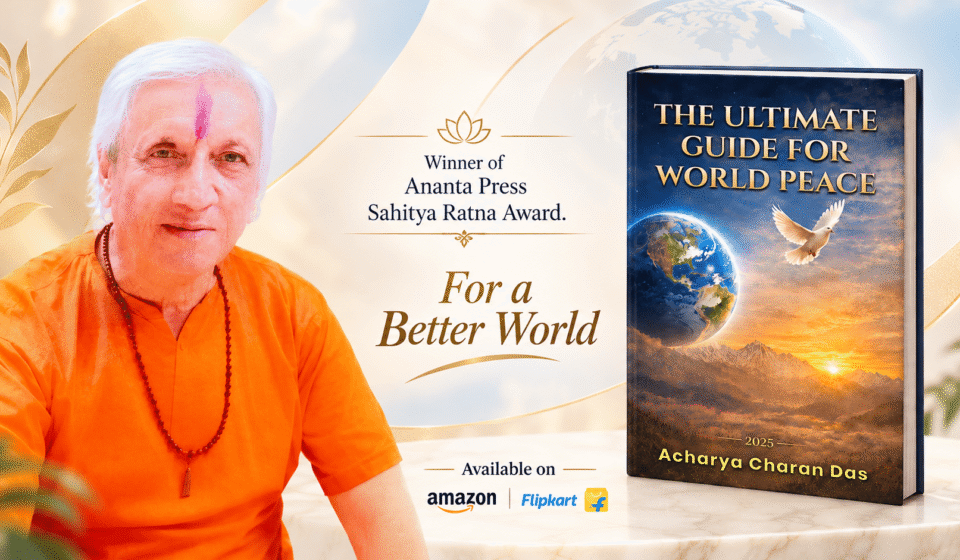

One of the most compelling ways to read The Ultimate Guide for World Peace is as a book about interdependence. Acharya Charandas does not define peace narrowly as the absence of armed conflict. He connects peace with the condition of the mind, the treatment of animals, patterns of consumption, care for the environment, the use of natural resources, family responsibility, and the moral examples set by leaders and communities. In this broad framework, war is not an isolated eruption. It is the visible symptom of deeper habits of exploitation and separation. The book’s unusual power comes from its insistence that the way human beings treat the smallest and most vulnerable forms of life is related to the way they eventually treat one another.
This ecological and ethical perspective is introduced very early. The author asks the reader to understand “nature” before trying to understand peace. He describes nature as a system that governs life and uses examples from animals, plants, food, and ordinary human behavior to make a larger point: consequences follow actions. To live peacefully, therefore, is to live with awareness of relationships and limits. The book rejects the idea that technological progress alone can save a society whose values are disordered. Scientific advancement, material comfort, media expansion, and economic growth may make life more convenient, but the author argues that convenience without self-restraint can intensify greed, anxiety, and environmental damage.
That argument becomes particularly visible in the book’s long discussions of food, animal life, and ecology. Charandas places exceptional emphasis on the cow, both as a spiritual symbol and as part of a larger critique of industrial meat consumption. The manuscript includes photographs and resource comparisons and repeatedly argues that animals are sentient beings rather than objects. It links compassion toward animals with the cultivation of compassion more generally. The author also presents claims about land, water, feed, emissions, and the environmental cost of meat production in order to argue that dietary choices have consequences beyond the individual plate. Some of the numerical and scientific claims in the book should be checked against current primary research before being treated as established data, but the ethical connection the author is trying to draw is clear: peace should include our relationship with the nonhuman world.
This makes The Ultimate Guide for World Peace different from many spiritual books. It does not keep spirituality in a private interior space. The text continually brings metaphysical ideas back to material behavior. If all living beings contain spirit-soul, as the author argues from the Bhagavad Gita, then compassion cannot logically stop at the boundary of the human species. If nature is an interconnected system, then human consumption cannot be considered morally neutral. If the pursuit of unlimited gratification creates ecological pressure, then self-control becomes not only a religious discipline but also an environmental virtue. This combination of spirituality, ethics, and ecology is one of the book’s most original features.
The manuscript’s images strengthen this aspect of the reading experience. Early pages include visual material concerning drought, wildfire, cattle, and animal treatment, and later sections continue the pattern of presenting photographs, quotations, and textual commentary together. The book often resembles an illustrated archive or a moral dossier rather than a standard philosophical treatise. The visuals can be emotionally intense, and readers should be prepared for graphic material connected with animal slaughter. Their purpose within the book is rhetorical: Charandas wants the reader to see practices that are usually hidden behind consumption and to ask whether comfort purchased through suffering can coexist with a serious philosophy of peace.
Another valuable theme is the author’s skepticism toward partial solutions. Environmental policy, political institutions, and international organizations are discussed critically because, in his view, they address symptoms without transforming the consciousness that produces the symptoms. This is a radical claim, but it gives the book a consistent internal logic. A society cannot consume without restraint, compete without limit, normalize violence toward weaker beings, and then expect peace to emerge only because institutions have adopted the language of cooperation. For Charandas, the missing component is moral and spiritual education: the cultivation of a consciousness that sees life as connected rather than disposable.
The book’s concept of universalism is closely tied to this idea. It repeatedly returns to the notion that the sun, nature, hunger, pain, birth, death, and the basic conditions of embodiment are not restricted by nationality or sect. The author uses these common experiences to argue that the deepest truths must be universal rather than owned by a single group. His preferred language for that universal order is Vedic and explicitly theistic, but the ethical question extends beyond any one tradition: what would change if humanity organized its institutions around the recognition that life is interconnected and that harm eventually returns through the same web?
The answer offered by the book is not a single policy program. It is a transformation in values. Reduce unnecessary violence. Control the senses rather than allowing desire to dictate behavior. Work responsibly. Respect the natural order. Treat animals as living beings capable of suffering. Replace material excess with restraint. Examine teachings by their results. Seek self-knowledge. Cultivate love that is not limited by temporary labels. These recommendations appear throughout the text in different forms, and their repetition creates a kind of ethical rhythm.
The book is also challenging because the author often makes sweeping judgments about religions, institutions, history, and social behavior. The language can be severe, and some readers will strongly disagree with his interpretations. It is important to distinguish the book’s spiritual and ethical argument from factual claims that may require independent verification. The work should not be approached as a neutral textbook on comparative religion or as a peer-reviewed environmental study. It is a polemical spiritual work whose evidence, quotations, anecdotes, and examples are selected to support a particular worldview. Recognizing that helps the reader engage with the text more intelligently rather than expecting it to be something it is not.
Within that category, however, the book has considerable force. Charandas has a recognizable thesis and follows it across hundreds of pages: the outer crisis of humanity reflects an inner crisis of consciousness. Ecological imbalance, violence, social distrust, and conflict are related because they emerge from the same failure to understand limits and responsibility. Even readers who question parts of the author’s historical or theological argument may find themselves returning to this central proposition.
The Ultimate Guide for World Peace is therefore valuable not because it offers a quick formula, but because it widens the definition of peace. It asks the reader to see peace in diet, consumption, family life, treatment of animals, ecological responsibility, self-control, and the everyday examples that shape culture. It turns the word “peace” from an abstract ideal into a test of daily behavior. That breadth makes the book demanding, occasionally controversial, and undeniably distinctive. For readers interested in spirituality, environmental ethics, nonviolence, and the relationship between personal discipline and global well-being, it offers a vast field of ideas to examine and debate.
Amazon Link: https://www.amazon.in/ULTIMATE-GUIDE-WORLD-PEACE-ebook/dp/B0H27JGP8W/