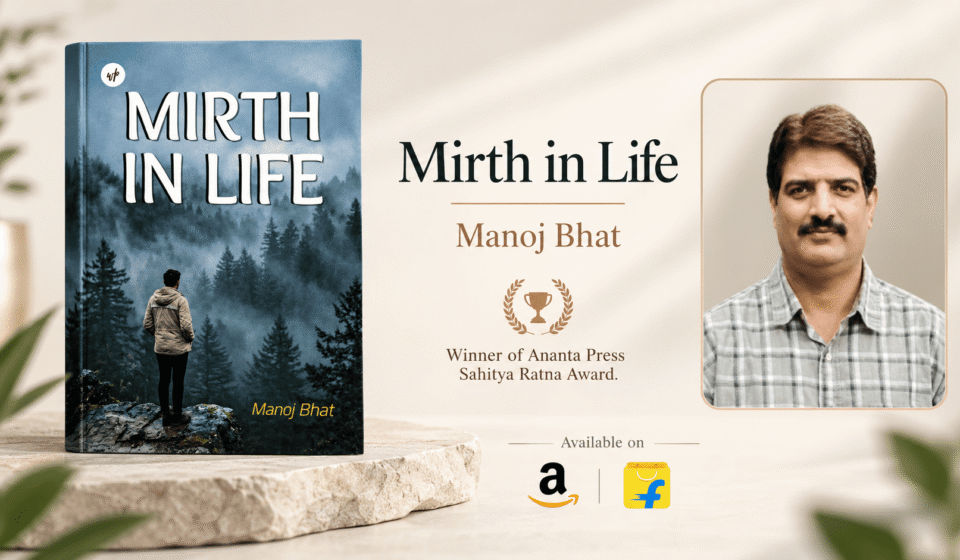

At the heart of Mirth in Life lies a group of friends trying to understand a problem that cannot be solved by intelligence alone. Manoj Bhat’s general fiction novel follows Rohan, Gurdeep, Akriti, Irfan, and Tapas as they move through adulthood with plans, ambitions, doubts, regrets, and the stubborn hope that life can become more meaningful. The book’s most engaging feature is not simply its search for happiness, but the way that search unfolds within friendship. Rather than treating fulfillment as a private achievement, the novel places it in a social and emotional context.
Rohan stands at the center of the story, but he is not presented as a solitary hero. He is intelligent, observant, and capable of imagining the consequences of both small and large decisions. He wants to make an impact and to choose a path that others may not have taken. Yet his intellectual confidence is gradually challenged by experience. The novel understands a truth that adulthood often teaches slowly: knowing how the world works is not the same as knowing how to live well within it.
This distinction gives Rohan depth. He is not naive, nor is he portrayed as someone lacking ambition. On the contrary, he and his friends enter adult life with structure, objectives, and the determination to break what they see as a vicious cycle. They want to ignore negativity, skepticism, and the prevailing melancholy around them. This beginning has a youthful energy. It captures the optimism of people who believe that sufficient clarity and discipline can protect them from confusion. The later complications are therefore more meaningful because they challenge a worldview that initially seems reasonable.
The friendship group allows Manoj Bhat to explore several layers of emotional life at once. Gurdeep, Akriti, Irfan, and Tapas are part of Rohan’s experiment in living. Their collective presence suggests that personal growth often happens in conversation, disagreement, support, and shared memory. Friendships can become mirrors: they reveal what we are avoiding, what we value, and how we have changed. In a novel dealing with the difficult territory of regret and misfortune, companions also make suffering less abstract. Pain is not merely something the protagonist thinks about; it is something witnessed and carried within a community.
This makes the book especially appealing as a narrative about adulthood. Many coming-of-age stories focus on the discovery of ambition. Mirth in Life goes in another direction. Its characters already possess goals. Their more difficult task is to discover whether those goals are enough. The story therefore concerns a second kind of maturation: the moment when adults begin to reconsider definitions of success that once seemed unquestionable. Rohan’s journey asks whether achievement without inner joy can truly be called success.
The novel’s language of roads, destiny, clocks, and changing winds gives this maturation a strong symbolic framework. The explicit connection with Robert Frost’s “The Road Not Taken” reinforces the idea that life is composed of choices that cannot be fully reversed. Rohan’s path is described as a kind of yellow wood in which alternatives represent different opportunities and ways of living. The metaphor is familiar, but in this context it remains effective because the novel is specifically concerned with what happens after choices have been made. It is easy to romanticize the road less travelled; it is harder to confront the consequences of walking it.
Time is another important element. The prologue notes that the clock is always ticking quickly. This sense of movement gives urgency to the search for mirth. Happiness cannot be postponed forever without cost. People can spend years preparing for a future moment of contentment only to discover that life has been passing meanwhile. The book quietly challenges the habit of treating joy as something that will arrive after the next promotion, financial milestone, marriage, achievement, or resolution of difficulty.
The treatment of financial freedom is particularly interesting. Rohan manages to achieve it early, yet cheerfulness remains obscured. This reversal prevents the novel from becoming a conventional success story. Material security is acknowledged as valuable, but it is not allowed to dominate the definition of a good life. The emotional problem survives the economic solution. For many readers, that may be one of the book’s most recognizable ideas. Contemporary culture often teaches people to optimize earnings, performance, and productivity, while giving less attention to the quality of consciousness with which those achievements are experienced.
Bhat’s inclusion of scriptures and meaningful messages suggests that the characters’ search eventually requires a moral and spiritual vocabulary. When ordinary problem-solving proves insufficient, they look toward accumulated wisdom. This does not make the novel a simple sermon. Rather, it expands the range of possible answers. Rohan and his friends are not merely asking how to feel better; they are asking what sort of understanding might make life itself feel coherent.
The word “stoic” used for the group is also telling. Stoicism implies endurance, self-control, and the ability to withstand difficulty without being overwhelmed. Yet the book does not seem satisfied with endurance alone. The characters want mirth, not merely survival. That creates a productive tension. A person can become skilled at bearing pain and still yearn for joy. The emotional arc of the novel lies in this movement from coping toward a fuller conception of happiness.
Manoj Bhat’s biography adds credibility to the book’s interest in perseverance and work. His path from a modest upbringing in Kashmir to higher education, corporate success, recognition as a Star Performer, and then twenty-eight years of government service suggests familiarity with discipline, targets, responsibility, and long-term effort. Those experiences naturally resonate with a story that asks what achievement can and cannot provide. His academic training in English Literature also helps explain the novel’s engagement with literary allusion and reflective themes.
As a work of general fiction, Mirth in Life will likely appeal most to readers who enjoy narrative combined with thought. Its plot is not merely a sequence of external events. The real action often occurs in the characters’ interpretation of those events. The question “Will they succeed?” therefore has two meanings. It concerns the practical challenges they face, but it also concerns whether they can redefine success itself.
One of the book’s valuable qualities is its refusal to reduce happiness to a slogan. The characters struggle, consolidate their efforts, question their assumptions, and confront unexpected turns of destiny. Their journey suggests that contentment may demand a change in ideology rather than a change in circumstances alone. That is a mature and worthwhile idea. People often imagine that peace will arrive when life finally becomes easier. Mirth in Life asks whether peace might instead depend on developing a different relationship with difficulty.
The novel’s emotional appeal comes from this honesty. Life does not proceed exactly as planned. Even carefully constructed objectives are disrupted. Friendships are tested. Regrets accumulate. Yet the possibility of meaning remains. Rohan and his companions continue to search, and that persistence gives the book its hopeful core. Hope here is not blind optimism; it is the willingness to keep examining one’s choices and to believe that a better understanding of life may still be possible.
Mirth in Life is ultimately a book about the inner geography of adulthood: the roads we choose, the companions who travel with us, the burdens we carry, and the moments when our old maps stop working. Manoj Bhat uses Rohan’s journey to remind readers that intelligence can guide a decision, money can create options, and planning can provide direction, but none of these automatically creates joy. The novel’s uniqueness lies in bringing those realities together within a story of friendship and self-inquiry. It is reflective fiction that encourages readers to ask not only where they are going, but whether the path they are on is allowing them to truly live.
Amazon Purchase Link: https://amzn.in/d/0aKhgiLE