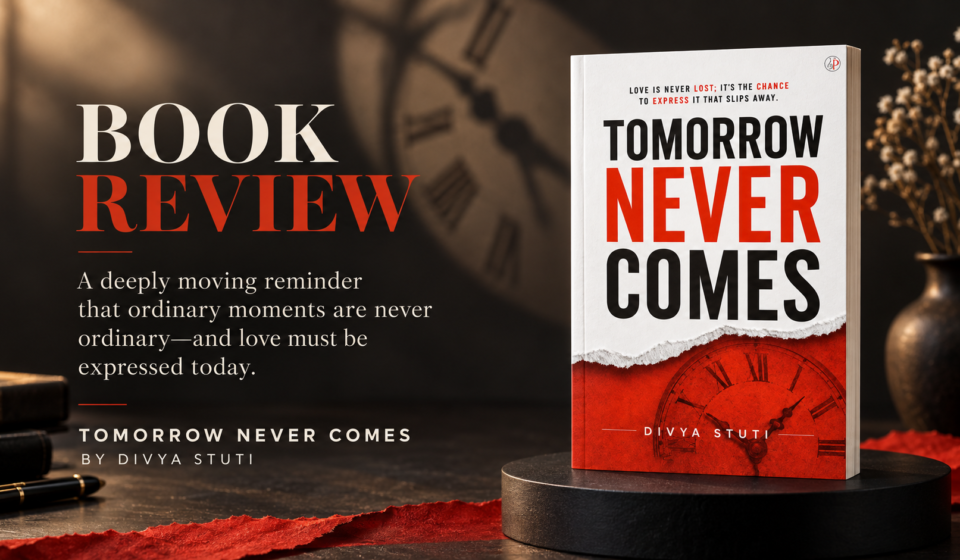

Tomorrow Never Comes by Divya Stuti is a grief memoir built from the ordinary materials of family life: a packed lunchbox, a mother waiting awake, a familiar recipe, a saree chosen for a celebration, a request answered too hurriedly, and a conversation postponed because there appears to be no urgency. The book’s emotional force comes from its insistence that these apparently minor details are not minor at all. Once the author’s mother dies, the domestic world is reclassified. Routine becomes evidence of devotion; objects become memorials; silence becomes a language; and every casual assumption about “later” becomes a source of reckoning. The title therefore does more than announce mortality. It identifies the mistaken bargain on which much of ordinary life rests: we behave as though affection can be delayed without consequence, while time makes no such promise.
Stuti begins from confession rather than instruction. She does not present herself as someone who has mastered grief or earned the authority to tell others how to mourn. Instead, she describes writing as the only place left to put pain. That choice establishes the memoir’s ethical center. The narrator is not trying to make her relationship with her mother look perfect, nor is she polishing loss into an inspirational story. She admits distraction, impatience, avoidance, and the complacency created by dependable love. Her mother seemed so constant that constancy became confused with permanence. This is a difficult admission because it exposes a common but rarely voiced contradiction: people may love deeply and still fail to make that love visible in daily conduct. The book’s honesty lies in refusing to let sincere feeling erase missed action.
The ten-chapter structure follows a clear emotional progression. The opening chapters restore the texture of the “ordinary days” that the author once overlooked. Her mother’s love is shown through repetition rather than spectacle. She keeps the household moving, cooks through discomfort, waits, reminds, protects, and absorbs strain without making her sacrifices the center of attention. The chapter on pain folded into everyday life is especially important because it complicates the culturally familiar praise of maternal strength. Stuti initially reads her mother’s endurance as proof that things are manageable. In retrospect, she recognizes a more troubling question: why should a mother have had to be strong all the time? The memoir honors care while also revealing how easily silent resilience can prevent a family from seeing that the caregiver needs care herself.
The narrative’s turning point arrives with the account of 26 November 2025. A controlled phone call from the author’s father, the instruction to come to platform number eight at Patna Junction, and the mind’s frantic search for manageable explanations pull the book from reflective remembrance into crisis. Low blood pressure, weakness, and dehydration are imagined because they belong to a familiar cycle of illness and recovery. Death does not. The public setting sharpens the shock: trains arrive, vendors call, strangers continue with their journeys, and the world remains offensively normal while one family’s sense of time is breaking apart. Stuti captures a defining cruelty of bereavement here. Catastrophe is total for the bereaved person but almost invisible to everyone passing nearby.
The book’s strongest images are concrete and recurring. Sarees, slippers, food, kitchen work, bangles, perfume, a chair, an open almirah, and the sound of a mother’s voice accumulate into a domestic archive. These details keep the memoir grounded when its feelings become overwhelming. The final scene of the mother packing for a wedding anniversary is particularly affecting. Mother and daughter discuss which sarees will photograph best; the exchange is cheerful, useful, and wholly unprepared for its later significance. Nothing in the moment announces itself as a farewell. This is precisely Stuti’s point: the last time is usually lived as an ordinary time. Memory later places a frame around it, but life offers no such frame in advance.
Stylistically, Tomorrow Never Comes depends on direct address, repetition, short emphatic lines, rhetorical questions, and recurring variations on regret. “I wish” becomes both lament and structural rhythm. Silence is described not as an absence of sound but as a pressure that occupies rooms. Unsaid words become stones or splinters lodged in the body. These repetitions reproduce the looping character of early grief, when the mind returns to the same moment and asks the same impossible questions. A reader seeking a detached or analytically restrained account may find the emotional intensity relentless. Yet restraint would serve a different book. This memoir records a wound close to its source, and its unguarded language is consistent with that purpose.
The spiritual dimension is handled as a search rather than a completed solution. References to the Bhagavad Gita, the soul’s continuity, karma, dharma, surrender, prayer, the Hanuman Chalisa, and the Gayatri Mantra give the author a vocabulary for imagining connection beyond bodily absence. At the same time, the book does not pretend that belief cancels attachment. Stuti explicitly holds resistance beside surrender. She may choose to believe that her mother continues in a form she cannot understand, but she still longs for the physical person: the hands, heartbeat, voice, cooking, touch, and presence that defined home. That tension makes the spirituality credible. Faith does not solve grief; it gives grief somewhere to speak.
One of the memoir’s most meaningful achievements is its gradual movement from punishment toward responsibility. For much of the book, the author treats regret as proof of failure. She replays neglected requests and postponed tenderness, fearing that any softening of guilt might loosen her bond with her mother. By the final chapters, however, remembrance begins to change function. She prays as her mother prayed, cooks her recipes, carries forward habits of patience and service, and tries to love the living with greater attention. The past cannot be corrected, but it can alter the present. In this transformation, memory stops being only a courtroom in which the daughter prosecutes herself and becomes a form of seva, an active continuation of love.
The chapter on the universal language of mother-daughter love expands the memoir beyond one household without erasing its specificity. The phrase “maa ke haath ka khana,” protective rituals, festival labor, and habitual reminders will be immediately recognizable to many Indian readers. Yet the deeper pattern travels across cultures: children often experience maternal labor as the natural background of life and understand its magnitude only when it is interrupted. Stuti addresses daughters who may still have time, daughters who do not, and mothers whose care goes unnoticed. The book therefore creates a community around an isolating feeling. It tells bereaved readers that regret is not evidence that their love was false; often, it is the painful afterlife of love that was assumed rather than articulated.
This universality is strengthened by the book’s refusal to make the mother an abstract symbol. She remains an individual woman with humor, preferences, physical limitations, a distinctive way of cooking, and an excited interest in selecting the right saree for the right event. That individuality matters. Public language about motherhood can sometimes flatten mothers into endlessly giving figures and overlook the private person who existed before and beyond the role. In the epilogue, Stuti wishes she had asked about her mother’s own dreams, sacrifices, memories, and regrets. The wish opens one of the book’s most productive questions: how well do children know their parents as people? The memoir thus asks for more than gratitude. It asks for curiosity, the willingness to hear a parent’s unfinished story while the telling is still possible. Such curiosity would not remove mortality, but it would give love a fuller, more reciprocal form.
The closing sequence gathers the memoir’s emotional argument with clarity. The epilogue imagines the impossible tomorrow the author wants: serving her mother breakfast, learning recipes and stories, asking about dreams sacrificed before motherhood, recording her voice, taking photographs, massaging her tired body, and speaking admiration without hesitation. The fantasy is powerful because it cannot be fulfilled. Stuti then redirects each wish toward today. She asks more questions, takes more pictures, speaks affection, and treats presence as finite. The accompanying letter to her mother does not claim completion. It acknowledges that healing may begin while regret remains. This refusal of a neat ending respects the reality of bereavement.
Tomorrow Never Comes is ultimately valuable not because it offers a new theory of grief, but because it gives intimate form to a truth people repeatedly forget. Love may be understood inwardly and still need outward expression. Caregivers who appear tireless may be concealing pain. The routine moment may be the last moment. Regret cannot return the dead, but it can teach the living to become more attentive. Divya Stuti turns a daughter’s private anguish into a public invitation: notice the person whose devotion has become so familiar that it has disappeared into the background. Sit beside her. Ask what she has carried. Say what seems obvious. The memoir leaves the reader with sorrow, but also with a practical and humane urgency: do not reserve tenderness for a tomorrow that has never promised to arrive.