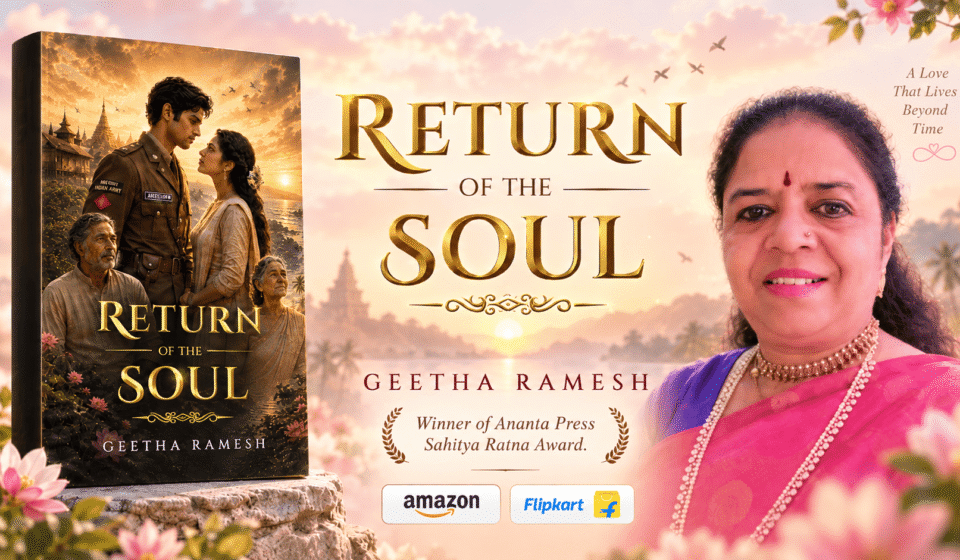

At its core, Return of the Soul by Geetha Ramesh is a novel about memory: what we remember, what we choose to dismiss, and what may continue to exist even when a life has ended. The book begins during the Second World War, but its deepest concern is not the chronology of war. It is the possibility that an intense human bond can leave an imprint strong enough to cross the boundary between death and rebirth. Through Roopini and Amudhan, and later Sreeja and Sridhar, the novel builds a romantic narrative around one of the oldest spiritual ideas in Indian thought: that life may continue in different forms and that unfinished relationships may return with us.
Roopini is introduced as the eldest daughter of an Indian family settled in Burma. The war brings difficulty and uncertainty to the family, and Roopini shares business responsibilities with her father. This is an important foundation for her character. Before the romance begins, she is established as someone capable of participating in adult responsibility. She is part of a family navigating danger and disruption. Her encounter with Amudhan, a South Indian soldier and poet, therefore enters a life already shaped by duty.
The soldier-poet identity of Amudhan is especially attractive from a literary standpoint. Soldier and poet are almost opposite symbolic roles: one is associated with discipline, action and mortality, the other with feeling, imagination and expression. Bringing them together in one person gives the love story a certain tenderness even before its tragedy unfolds. Amudhan is not simply a wartime hero; he is also someone who can plausibly speak to the emotional world of Roopini. Their relationship arises in circumstances where time cannot be taken for granted, and this gives their connection urgency.
When Amudhan dies in Roopini’s lap and assures her that he will return to live with her, the novel makes its decisive turn. In another story, such a promise might be understood as a comforting final sentence spoken by a dying lover. In Return of the Soul, it becomes almost a contract with destiny. The rest of the narrative explores what it would mean if such words were not metaphorical. What if love did return? What if the person waiting for that return had also died and been reborn? What if both people came back at different times and under conditions that made fulfilment difficult?
The rebirth of Roopini as Sreeja is one of the novel’s most intriguing ideas. Sreeja is born within the same family line, as a daughter of Roopini’s own sister. This means the past is not geographically or emotionally remote. It remains folded inside the family itself. Sreeja remembers her earlier life from childhood, yet with maturity she begins to doubt those memories and treat them as imagination. This progression gives the supernatural premise a human psychological dimension. Memories may be vivid, but social reality has enormous power. An adult is expected to make decisions based on the present, not on a mysterious past life that no one else may understand.
This is where the book becomes more than a fantasy of destined lovers. Sreeja does not simply spend her life waiting for Amudhan’s reincarnation. She marries someone else because of family pressure and gratitude. That decision immediately complicates the moral landscape. If Sreeja had remained unmarried and Sridhar appeared, the narrative would be easier. Instead, the novel places destiny in conflict with commitments already formed. It asks a difficult question: does the recognition of a previous life automatically outweigh the obligations of the current one?
Sridhar’s position is equally interesting. He is Amudhan reborn, but he returns later in the timeline and is in his mid-forties when the two meet. He is unmarried, and at one stage he too remembers the previous birth. The asymmetry between the two characters matters. Sreeja has already travelled through a life shaped by doubt, family pressure and marriage, while Sridhar arrives with a different personal history. Their reunion is therefore not a reset button. It is an encounter between memory and consequence.
This is one reason the book’s reincarnation theme feels meaningful rather than ornamental. Rebirth is not used simply to create a magical happy coincidence. It generates ethical and emotional difficulty. If the same souls meet again, are they entitled to reclaim what they once lost? Or are they now different people who must respect the realities of their present lives? The story’s power lies in this uncertainty. It allows readers who believe in reincarnation to approach the story spiritually, while readers who see it as imaginative fiction can still engage with its themes of memory, identity and unfinished grief.
The idea of childhood past-life memory is also effective because childhood occupies a special place in the novel’s logic. Geetha Ramesh describes herself as having been highly imaginative from a young age, creating imaginary houses, towns, characters and stories out of everyday surroundings. That biographical detail does not mean the novel is autobiographical, but it does make her interest in childhood imagination particularly resonant. Sreeja’s earliest memories exist in that ambiguous zone where adults may dismiss extraordinary experiences as fantasy. The novel uses that ambiguity productively. What is fantasy? What is memory? At what point does disbelief become a defence against something too difficult to accept?
The title Return of the Soul carries this ambiguity beautifully. It can be read literally as reincarnation, but also metaphorically. A soul may “return” when a forgotten part of oneself resurfaces. It may return through memory, through recognition, through love or through a promise that refuses to disappear. The title therefore supports both the spiritual and psychological readings of the novel.
Another strength is the structure created by two interconnected lives. The first part contains historical danger, youthful love and sudden death. The second part contains recollection, doubt, adult choices and delayed recognition. These two movements give the book emotional contrast. The past is intense and tragic; the present is more morally complicated. The narrative gains momentum from the reader’s awareness that something unresolved in the first life must eventually confront the realities of the second.
Ramesh’s decision to set the original romance in wartime Burma adds additional weight. War is a period when human lives are interrupted by forces larger than individual desire. Reincarnation, by contrast, represents the ultimate extension of time. The novel therefore places the smallest unit of experience, two people in love, against the largest scales of history and existence. A war can end a life, but perhaps not a bond. A lifetime can pass, but perhaps not a promise. This contrast is one of the novel’s most appealing conceptual features.
Readers who enjoy reincarnation fiction will likely appreciate the gradual return of recognition rather than a purely magical reunion. Readers of romance may find the emotional stakes unusually layered because the lovers are separated not simply by distance or misunderstanding but by death, rebirth, age and social obligation. Readers interested in philosophical fiction may be drawn to the questions of identity: if memories return, are we the same person? If the soul persists but circumstances change, what part of love remains constant?
Return of the Soul is unique because it treats reincarnation not as an escape from tragedy but as a second chance complicated by reality. The novel’s most compelling idea is that destiny may bring people together again, but destiny does not remove the consequences of time. Love returns, memory returns and the soul returns, yet the world into which they return is different. That is what gives the story emotional maturity and makes it worth exploring.
Amazon Link