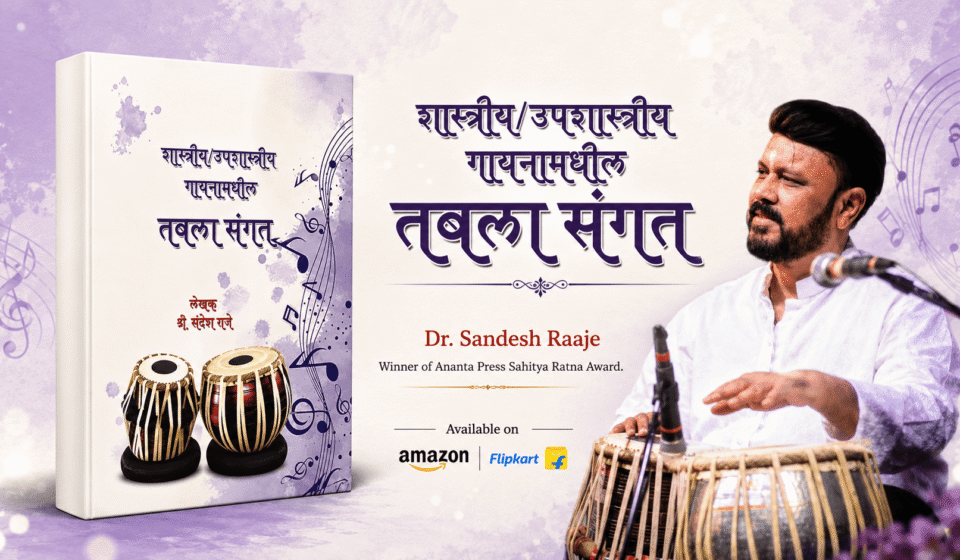

There are books that explain an instrument, books that catalogue its repertoire, and books that emerge from a lifetime of living inside a musical tradition. Dr. Sandesh Raaje’s “Shastriya/Upashastriya Gayanamadhil Tabla Sangat” belongs most meaningfully to the third category. Its subject is the role of tabla in Hindustani classical and semi-classical vocal music, but beneath that subject lies a deeper theme: how a musician learns to become responsible to another musician on stage.
That responsibility is at the heart of accompaniment. The tabla player is visible and audible, yet the accompanist must constantly negotiate presence and restraint. A performance can lose its balance if the rhythm is dull, but it can also lose its musical center if the accompanist tries to dominate. Good accompaniment therefore requires maturity. It asks the player to listen before responding, to understand the form before decorating it, and to recognize that technical ability is only one part of musical intelligence. Dr. Raaje’s choice to write specifically about accompaniment gives the book a strong artistic identity because it focuses on this difficult balance.
The author’s personal history makes the book especially resonant. He comes from a family with a rich legacy of tabla and pakhavaj, and he studied for twenty-eight years under Pt. Bhai Gaitonde, the legendary tabla maestro and Sangeet Natak Akademi Award recipient. Twenty-eight years with a guru is not a brief course or a collection of lessons; it suggests prolonged formation. In a traditional performing art, such time allows a student to absorb not only compositions and techniques, but also attitude, discipline, listening habits, stage conduct, and the subtle values that may never be fully expressed in formal definitions.
This background helps explain why the subject of accompaniment is so appropriate for the author. Tabla accompaniment is full of knowledge that is difficult to reduce to formulas. A student may be able to recite a tala flawlessly and still not know how to place it behind a khayal vocalist. Another may possess impressive speed but fail to control dynamics. A technically trained player may not yet understand when silence, simplicity, or a lightly shaped theka is more musical than an elaborate response. These distinctions are generally learned by close observation of experienced artists. A book that tries to articulate them performs an important educational service.
The work also carries the spirit of gratitude. Dr. Raaje describes how his family legacy, the invaluable teaching of his guru, and his association with many talented and legendary artists created within him a sense of social, moral, and musical bonding with the field. That feeling ultimately led him to ask how he could contribute. The book is the answer to that question. This makes it more than a technical manual. It is also a gesture of continuity: knowledge received through relationships is being organized and offered to a wider circle of learners.
One of the most admirable features of the author’s approach is his acknowledgement of existing scholarship. He does not suggest that tabla lacks literature. On the contrary, he recognizes that many stalwarts have written extensively about the instrument, including its evolution, creation, physical structure, compositions, and related subjects. His contribution is narrower and therefore, in many ways, stronger. He identifies accompaniment—especially tabla’s role in classical and semi-classical vocal music—as an area that should be explored more deeply and illustratively. This clarity prevents the work from becoming a generic survey and allows it to concentrate on a specific performance reality.
The uniqueness of the book becomes clearer when one considers how tabla is often taught. Early training understandably emphasizes tala identification, theka, bol clarity, hand technique, compositions, and the grammar of rhythmic development. These are essential foundations. Yet when students begin accompanying vocalists, they encounter a new world of decisions. The same tala can feel different depending on tempo, genre, the singer’s phrasing, the composition, and the atmosphere of the performance. The accompanist must follow not only the mathematical cycle but the emotional trajectory of the music. This transition from rhythmic correctness to artistic sensitivity is precisely where many learners need guidance.
A book on accompaniment can therefore encourage the student to develop a different kind of practice. Instead of asking only, “Can I play this?” the learner begins to ask, “Should I play this here?” That second question marks a major stage of musical maturity. It shifts attention from display to appropriateness. In a collaborative form, appropriateness is often more important than complexity. The tabla player has to support the vocalist’s architecture while preserving rhythmic vitality. This requires attention to sam, khali, lay, tempo changes, climactic points, lyrical emphasis, and the overall contour of the presentation.
The book’s inclusion of semi-classical vocal music further strengthens its relevance. Semi-classical genres may demand a different touch, different use of embellishment, and different awareness of text and expression. An accompanist who approaches every form identically risks flattening musical character. The very idea of studying both classical and semi-classical accompaniment reminds students that rhythmic support is genre-sensitive. Technique must serve style.
For music lovers who are not performers, the book can open a new way of listening. Audiences often concentrate on the vocalist and may notice the tabla most when a striking tihai or energetic rhythmic exchange occurs. Yet masterful accompaniment is present throughout the performance, often in small decisions that keep the music breathing naturally. Understanding the accompanist’s responsibility can deepen appreciation for the entire ensemble. It reveals Hindustani performance as a conversation rather than a solo voice with background support.
The author’s qualifications demonstrate that his engagement with music has been both traditional and formal. Alongside his long discipleship, he holds a Master of Performing Arts from Shivaji University, Kolhapur, has earned B High grade from All India Radio, holds Sangeet Alankar from ABGMV, and has received recognitions including the Rashtriya Gaurav Award and an honorary doctorate in Music and Performing Arts. He also holds a B.Com from Mumbai University. This combination of academic training, institutional evaluation, and traditional mentorship is significant because the subject itself sits between theory and lived performance.
Another strength of the book is its potential to preserve knowledge. Indian classical music remains a living oral tradition, and that oral dimension should never be replaced. At the same time, documentation has an important role. As generations change, books can preserve frameworks, terminology, observations, and approaches that support future teaching. They can give students a base from which to ask better questions of their gurus. Written knowledge is most valuable when it leads back to attentive listening and practice, and a book on accompaniment is well positioned to do exactly that.
There is also an ethical lesson embedded in the topic. The accompanist must learn humility without becoming passive, confidence without becoming overpowering, and responsiveness without losing rhythmic stability. Those are musical qualities, but they are also qualities of collaboration in any field. The best accompanist respects another artist’s space while contributing fully. This makes the subject surprisingly rich: tabla accompaniment becomes a study in communication, discipline, and artistic empathy.
For students, the book can become a companion during the gradual movement from classroom to stage. For teachers, it can serve as material for discussion and demonstration. For performers, it can encourage reflection on habits that may otherwise remain unconscious. For listeners, it can make concerts more intelligible. And for the wider tabla community, it adds attention to an aspect of the art that deserves dedicated study.
Ultimately, “Shastriya/Upashastriya Gayanamadhil Tabla Sangat” stands out because it is rooted in relationship: relationship between guru and disciple, between tradition and documentation, between tabla and voice, and between individual skill and collective music-making. Dr. Sandesh Raaje’s work reflects a desire to return something meaningful to the field that shaped him. That sense of gratitude gives the book warmth, while its specialized subject gives it practical importance. It is a valuable read for anyone who wishes to understand that the greatness of tabla is not found only in solo brilliance, but also in the refined art of making another musician’s performance stronger, more balanced, and more alive.