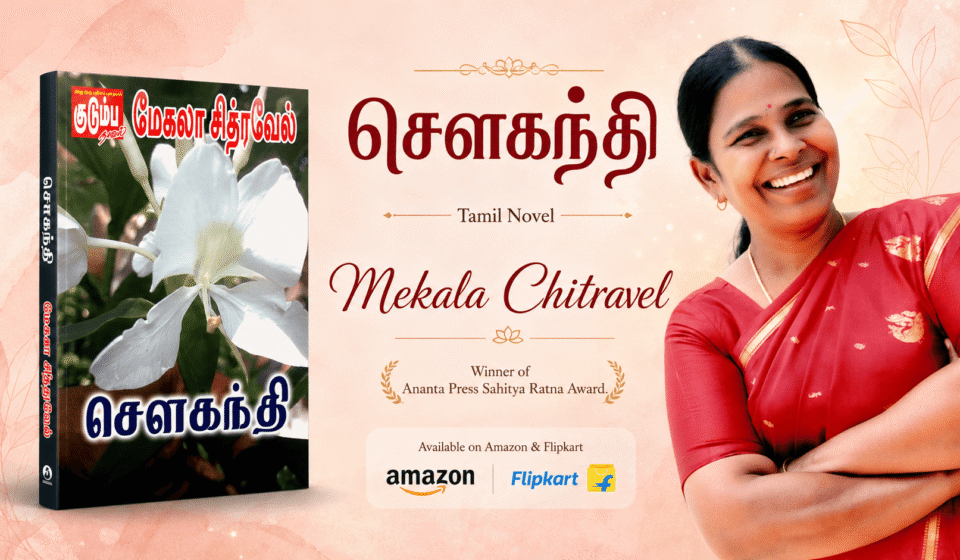

The first thing that drew me to Sowganthi was not a dramatic plot point but a name. “Sowganthi” carries the meaning of a divine flower, and the author connects it with the Mahabharata tradition in which Bhima brings a heavenly flower for Panchali. That single cultural reference gives the novel an appealing symbolic doorway. Before we even think about the central mother-son relationship, the title suggests fragrance, beauty, rarity, devotion, and the willingness to go in search of something precious for someone one loves. It is an excellent frame for a novel built around affection. The book may be grounded in the everyday emotional world of a mother and her son, but the title quietly lifts that relationship into a larger cultural and poetic space.
I find this especially effective because the novel does not appear to use mythology merely as decoration. The epic reference has thematic relevance. Bhima’s journey for the flower is remembered as an act connected with desire, effort, and devotion. In Sowganthi, the important emotional movement is also about what one person is willing to give another. A mother gives years of attention and sacrifice to her child, often without asking for repayment. When a son grows into someone who responds with love and care, that return of affection can feel almost like the bringing of a rare flower: not because filial love should be rare, but because genuine attention has become precious in hurried modern life. The title therefore creates a beautiful tension between what should be natural and what can sometimes feel exceptional.
The novel’s central pair, Sowganthi and Rishi, represents one of the oldest and most intimate relationships in human life. Yet the book’s treatment of this relationship feels relevant to the present. Families today may live in the same house but occupy different emotional worlds. Work, migration, technology, ambition, and changing lifestyles can reduce meaningful conversation. Parents may not ask directly for care because they do not want to become a burden. Adult children may assume that providing money or practical help is enough, while emotional presence slowly disappears. Against this background, a story that consciously celebrates a son who loves and cares for his mother has a quiet social value. It brings emotional responsibility back into the conversation.
One of the strengths of such a theme is that it resists cynicism. The book does not need to prove that all families are perfect; obviously they are not. Its value lies in presenting an emotionally desirable relationship and inviting the reader to consider why it matters. Literature has always had two broad powers: it can expose what is broken, and it can imagine what is worth preserving. Sowganthi belongs strongly to the second tradition. It places tenderness at the centre. That may sound simple, but simplicity can be artistically demanding. When the central subject is love rather than scandal, the writer depends on emotional truth, recognisable behaviour, and the reader’s own memories to create depth.
Tamil literature has a long tradition of giving family relationships moral and emotional importance, from classical expressions of love and duty to modern social novels that examine changing households. Sowganthi participates in that larger cultural conversation in an accessible form. The mother is not only an individual character; she also evokes a familiar figure in Indian life – the woman whose labour holds together the daily rhythm of the family, whose contribution is often immense but unofficial, and whose emotional needs may be discussed less frequently than her responsibilities. By focusing on a mother who is fortunate enough to receive her son’s care, the novel offers an affirmative counter-image to stories of neglect.
The Mahabharata association enriches this cultural dimension because it links the domestic world with epic memory. Indian readers often live with epics not only as ancient texts but as a storehouse of names, metaphors, moral questions, and family references. A word can carry centuries of association. The use of “Sowganthi” as both a name and an image allows the book to participate in that cultural continuity. The heavenly flower becomes more than an object from mythology. It can be read as a symbol of the mother herself – precious, life-giving, fragrant in memory – or as a symbol of the son’s care, something lovingly offered. The best symbols are flexible enough to support more than one interpretation, and this one invites exactly that kind of reflection.
Another reason the book interests me is the author’s unusually wide creative background. Mekala Chitravel has completed one hundred books in Tamil across very different areas: fiction, children’s literature, cookery, folk material, spirituality, biography, traditional arts such as kolam, and a substantial body of writing on MGR. Such variety suggests a writer who does not see literature as a single genre but as a broad public conversation. She has also been a stage debater on nearly a thousand stages and is an experienced storyteller. Those are important details because oral communication teaches a writer about rhythm, audience attention, clarity, and emotional timing. A storyteller learns that an idea must reach the listener, not merely impress the speaker.
Her academic and educational background adds another dimension. With M.A., B.Ed., and Ph.D. qualifications, and experience running a matriculation school and educating hundreds of students, she has spent years in environments where character formation and human development are central concerns. Many of her former students now occupy good professional positions, and university researchers have studied her novels at doctoral level. These facts suggest both social reach and literary endurance. Sowganthi can therefore be read not as an isolated experiment but as part of a much larger lifetime of writing, teaching, and public speaking.
What I particularly like about the novel’s concept is the way it can speak to different generations without changing its central message. Younger readers can approach it as a reminder that parents need affection, not only obedience. Middle-aged readers may recognise the difficult balance between caring for children, careers, and ageing parents. Older readers may find in Sowganthi a deeply personal emotional wish: to remain valued, included, and loved by the children for whom they once rearranged their entire lives. A good family novel allows readers to occupy more than one position, and this theme naturally encourages that movement.
The book also raises an interesting question about what “care” means. In family life, care is rarely a grand heroic act. It is usually made of smaller things: asking how someone feels, remembering a need, giving time, respecting dignity, offering companionship, and making decisions with another person in mind. When these gestures are repeated, they become a language. That language is especially important between adult children and parents, where affection can become assumed rather than expressed. By celebrating Rishi as a son who loves and cares for Sowganthi, the novel highlights this everyday language of love. It suggests that devotion is not confined to temples, epics, or spiritual ideals; it can be practised at home.
That connection between the sacred and the ordinary may be the book’s most attractive quality. The title evokes a flower from heaven, while the central relationship belongs to the most familiar human setting. The result is a gentle reminder that what we call “divine” often becomes visible through ordinary acts of kindness. A mother who feels cherished may experience that love as something extraordinary precisely because it appears through daily attention. The mythological image does not pull the novel away from reality; it gives the reality a poetic glow.
Sowganthi therefore stands out for me as a culturally rooted, emotionally positive Tamil novel with a clear moral centre. Its uniqueness is not based on complexity for its own sake. It comes from the combination of a universal family theme, a resonant epic symbol, and the perspective of an author whose career spans literature, education, public speaking, and traditional knowledge. Readers who enjoy books about family bonds, gratitude, Indian cultural memory, and emotional values should find this novel especially appealing. It leaves behind a simple but lasting thought: the people who nurture us deserve not only our respect but our visible, active affection. Like the heavenly flower in its title, such affection becomes precious when it is deliberately offered.Amazon Purchase Link: https://www.amazon.com/%E0%AE%9A%E0%AF%8C%E0%AE%95%E0%AE%A8%E0%AF%8D%E0%AE%A4%E0%AE%BF-Tamil-Megala-chitravel-ebook/dp/B08QHXX1YX/ref=sr_1_1?crid=14UCY7JUZSG76&dib=eyJ2IjoiMSJ9.T9HpY4IwtsVh4EPOLSOJOw.elPq1AOHf0OkGkPQwJUvaX8h39c6ftPIQISOfgKV5A4&dib_tag=se&keywords=megala+chitravel&qid=1779947276&s=books&sprefix=megala+chitravel%2Cstripbooks-intl-ship%2C366&sr=1-1