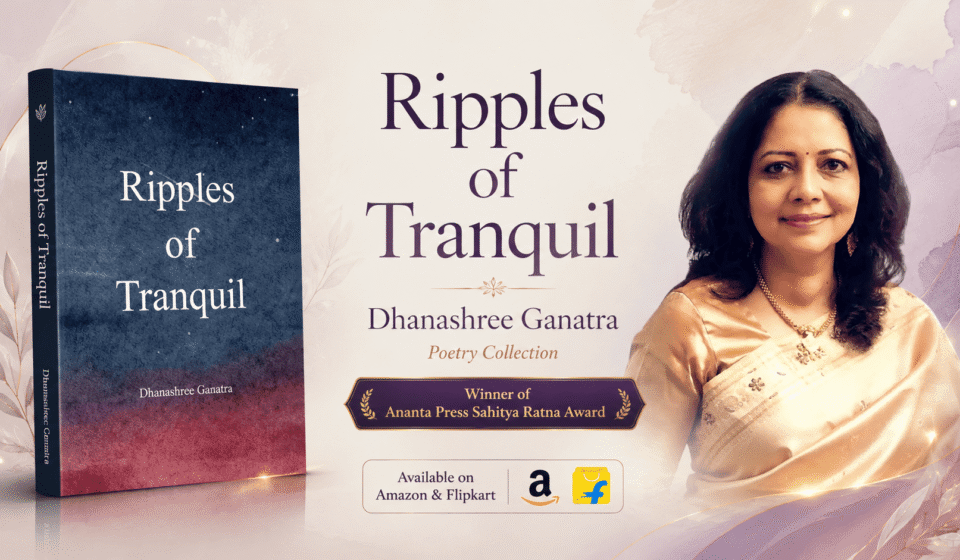

Ripples of Tranquil by Dhanashree Ganatra can be approached as a map of the inner landscape. Rather than organising experience around external events, achievements, or conflicts, the collection turns toward the subtler territories that often determine the quality of human life: thought, silence, longing, hope, love, dreams, and self-recognition. This inward emphasis gives the book a philosophical character, but its philosophy is rooted in emotion. It is less concerned with constructing a system of ideas than with observing how consciousness moves. In this sense, the collection belongs to a tradition of reflective poetry in which the smallest interior shift can carry as much meaning as a visible event.
The phrase “the silence between thoughts” offers a useful key to understanding the book’s imaginative world. Most of daily life is filled with mental commentary. We name, judge, compare, plan, remember, and anticipate. Poetry that deliberately turns toward the interval between these activities performs a special function. It reminds the reader that identity is not identical to mental noise. There is an observing self, a quieter awareness, from which emotions and thoughts can be noticed rather than simply obeyed. Ripples of Tranquil repeatedly invites attention to that possibility. Its spiritual quality arises not from doctrine but from awareness itself.
This makes the collection especially interesting as poetry of self-realisation. The term is often associated with grand spiritual attainment, yet Ganatra’s approach appears gentler and more intimate. Self-realisation is suggested through contact with one’s own emotional truth. Love becomes not only a relationship with another person but also a mirror through which the self is recognised. Dreams are not merely fantasies but spaces of possibility. Silence is not an absence of communication but a form of listening. Thought is not simply an intellectual instrument; it is a force capable of creating disturbance or clarity. These interconnections give the collection conceptual depth while preserving its lyrical accessibility.
One of the book’s strongest qualities is its understanding of emotional subtlety. Human beings rarely experience one feeling at a time. Hope may contain fear; love may contain vulnerability; tranquility may emerge after unrest rather than in the absence of it. A reflective poetry collection is most successful when it does not flatten these contradictions. Ripples of Tranquil, through its emphasis on “fragments of feeling” and “shadows of thought,” appears to embrace incomplete and transitional states. That choice is important. A shadow changes according to light; a fragment implies a larger whole that may never be fully visible. The imagery therefore allows uncertainty to remain part of the poetic experience.
The collection’s philosophical strength also comes from its refusal to separate mind and emotion. Modern life often encourages a division: rational thought belongs to one domain, feeling to another, and spirituality to yet another. Ganatra’s work suggests a more integrated view. The “subtle colors of the mind” are emotional, intellectual, and spiritual at once. The mind is not presented as a machine to be controlled but as a living field to be understood. Such a perspective can be deeply resonant for readers who are interested in mindfulness, contemplation, or psychological self-awareness, yet the book does not need to be classified as therapeutic writing. Its primary vehicle remains poetry, with all the ambiguity and openness that poetry permits.
The author’s long creative journey gives this inward focus additional credibility. Dhanashree Ganatra has reportedly been writing poetry since childhood, and her artistic life extends across singing, songwriting, music composition, and filmmaking. That range matters because it suggests that contemplation for her is not a temporary theme but part of a sustained creative identity. Different forms allow the same inner questions to be explored through different media. A poem can become a song; a feeling can become a melody; an image can be carried into cinema. “Life is Beautiful,” the opening poem of the collection, is an especially clear example because Ganatra later wrote, composed, and sang it as an original song. The transformation shows how her poetic ideas are designed to resonate beyond the page.
The message associated with “Life is Beautiful”—optimism, resilience, and gratitude—is also significant in relation to the rest of the collection. Tranquility in this book does not appear to mean denial of difficulty. Genuine tranquility has value precisely because human life includes uncertainty, disappointment, restlessness, and emotional strain. A poetry that simply declares everything peaceful would feel superficial. A poetry that seeks peace while recognising the complexity of consciousness can feel earned. The collection’s emphasis on self-discovery suggests such a process: tranquility is not a decorative mood placed over life; it is something approached through awareness.
The international recognition associated with the book further demonstrates the universality of this inner journey. The author profile identifies honours such as the 21st Century Emily Dickinson Award and the Tagore International Cultural Award, while the musical adaptation of “Life is Beautiful” has reportedly received accolades at international film festivals. What is notable here is not simply prestige but translatability of feeling. Poetry grounded in inward reflection can cross national boundaries because the basic experiences it explores are shared. Readers may belong to different cultures, languages, and histories, yet most know longing, silence, hope, love, and the desire for meaning.
From a literary perspective, the collection’s central metaphor is particularly effective. Ripples suggest consequence. An inward realisation may seem private, but it can influence relationships, choices, and the atmosphere a person creates around others. A calm mind can change a conversation; a compassionate insight can alter behaviour; a moment of gratitude can reshape a day. The metaphor therefore extends the book beyond private meditation. Inner tranquility is not necessarily withdrawal from the world. It can become a source from which more thoughtful engagement emerges.
This distinction gives the collection relevance for contemporary readers. The modern attention economy encourages constant reaction. Notifications, commentary, deadlines, and digital comparison create an environment in which stillness may feel almost unnatural. Against that background, a book devoted to reflective attention carries a quiet countercultural force. It asks the reader to recover an interior pace. Importantly, the collection does not need to make an explicit social argument for this to matter. The act of reading poetry slowly is itself a resistance to speed. A line that cannot be absorbed in a glance teaches a different kind of attention.
Ripples of Tranquil will therefore appeal to several kinds of readers. Those drawn to philosophical poetry will appreciate its concern with consciousness and self-knowledge. Those interested in spiritual reflection may value its non-dogmatic inwardness. Readers who seek emotional reassurance may find comfort in its gentle tone. Artists may be inspired by the author’s ability to move between written verse, music, and film. Even readers who usually avoid poetry may find this collection approachable because it begins with universal experiences rather than literary display.
What makes the book unique is ultimately its balance between depth and gentleness. It does not demand that the reader become someone else. It invites the reader to become more attentive to what is already present. That difference is central to its appeal. Self-realisation is not framed as acquisition but as recognition. Silence is not emptiness but presence. Tranquility is not escape but a quality of seeing. These ideas give the collection coherence and make its themes larger than individual poems.
Ripples of Tranquil is best read with patience. It is a book to underline lightly, revisit, and perhaps read aloud. Its purpose is not exhausted by interpretation because its value also lies in mood and resonance. The poems function like small meditative spaces, each capable of producing a different response depending on the reader’s state of mind. By turning toward the quiet movements beneath ordinary consciousness, Dhanashree Ganatra has created a collection that speaks to one of the most enduring human desires: to understand the self without violence, to meet life with awareness, and to discover within the restless mind a place that can still be called home.
Buy / View on Amazon: https://amzn.in/d/0doJNpxh