From Complex Systems to Clear Leadership — A Management Book Grounded in Real-World Execution

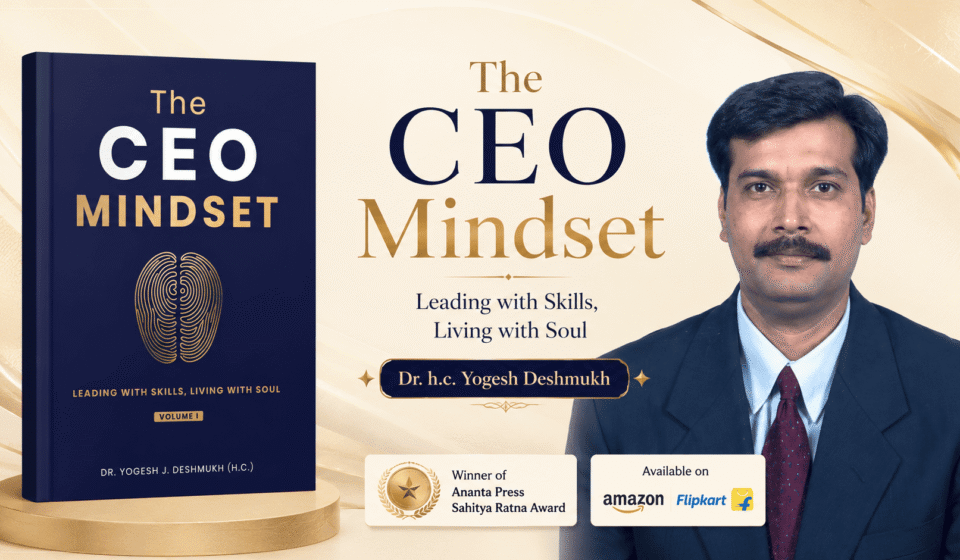
The most convincing management books are often written by people who understand what happens after a strategy presentation ends. Plans move from slides into schedules, interfaces, budgets, technical decisions, stakeholder negotiations, team pressures, and unforeseen constraints. The CEO Mindset: Leading with Skills, Living with Soul, Volume I is compelling because Dr. h.c. Yogesh Deshmukh approaches leadership from that execution-heavy world. His career in railway signalling, metro systems, high-speed rail, software engineering, and large infrastructure programmes gives the book a distinctive foundation: leadership is not an abstract exercise in inspiration, but the continuous work of aligning systems and people under pressure.
This perspective makes the book especially valuable for managers in complex organisations. In simple environments, leaders can sometimes rely on direct control and a narrow chain of command. In mega projects and multidisciplinary programmes, that approach quickly reaches its limits. Different teams hold different pieces of the truth. Engineers, commercial specialists, software teams, safety experts, operations personnel, suppliers, clients, regulators, and senior management may all view the same problem through different lenses. Leadership therefore becomes an integration discipline. The person at the top cannot personally solve every technical problem; instead, the leader must create the conditions in which accurate information can move, interfaces can be resolved, priorities can be reconciled, and specialists can work toward a shared purpose.
The CEO Mindset treats this integrative responsibility as both technical and human. That is one of its most important contributions. Management literature sometimes divides leaders into two broad types: the hard-nosed operator who cares about systems and results, and the people-centered leader who cares about culture and relationships. Deshmukh shows why this division is misleading. A poorly designed system can exhaust good people, while a toxic culture can defeat even a technically excellent system. Strategy requires structure, but structure requires trust. Execution requires accountability, but accountability functions best when people are able to communicate openly. A leader who understands only one side of the equation is operating with incomplete information.
The author’s experience on mission-critical projects adds weight to his emphasis on listening and emotional composure. In safety-critical domains, suppressed concerns are dangerous. When a team member hesitates to speak because a leader is impatient, dismissive, or overly invested in a preferred answer, the organisation loses access to information it may urgently need. The book’s focus on hearing people who “speak truth to power” is therefore more than a statement about kindness. It is a principle of risk management. Psychological safety and respectful leadership can directly improve the quality of decisions by increasing the likelihood that weak signals, uncomfortable facts, and emerging problems reach the people responsible for action.
The book’s treatment of pressure is similarly practical. Leadership is easy to romanticize from a distance. Real programmes, however, involve deadlines, late meetings, conflicting objectives, resource constraints, changing requirements, and moments when no available option is ideal. Deshmukh brings attention to what leaders do in those moments. Do they blame, or investigate? Do they become louder, or clearer? Do they treat fatigue as weakness, or recognise it as a genuine operational factor? Do they protect their status, or protect the integrity of the decision? These questions reveal the difference between positional authority and mature leadership.
For project and programme professionals, the book also carries an implicit lesson about interfaces. Deshmukh’s current work on the Mumbai-Ahmedabad High-Speed Rail Project and his specialisation in system integration and multidisciplinary interface management are relevant to his leadership philosophy. An interface is not only a technical boundary between systems; organisations themselves are full of human interfaces. Departments connect to departments, strategy connects to execution, executives connect to specialists, and organisational purpose connects to individual motivation. Failures often occur at these boundaries. The CEO Mindset can therefore be read as a call for leaders to become better integrators—not only of technology and process, but of perspectives and people.
This is also why the book’s language of the “analytical and the emotional” works so well. Analysis helps leaders understand what is happening; emotional intelligence helps them understand how people are experiencing what is happening. The first may reveal a delay, a cost variance, or a technical dependency. The second may reveal fear, disengagement, confusion, defensive behaviour, or loss of trust. Neither category of information is sufficient by itself. Effective leadership requires both.
Another strength is the book’s challenge to the traditional CEO archetype. The familiar image of the executive as invincible, relentlessly competitive, and permanently certain may still appear attractive, but it can produce fragile organisations. If the leader must always appear right, others learn to hide disagreement. If decisiveness becomes a refusal to reconsider, adaptation slows. If confidence becomes emotional distance, the organisation may comply without committing. Deshmukh does not argue against confidence or determination. He argues for a more complete form of strength: one that includes humility, ethical judgment, and the ability to remain open to information that contradicts one’s assumptions.
The concept of the CEO as a custodian of culture is particularly relevant in large organisations. Culture is often treated as an HR subject, separate from core business execution. Yet culture determines how people respond when procedures do not cover a new situation. It influences whether quality issues are escalated, whether collaboration crosses departmental boundaries, and whether people take ownership or protect themselves. The book’s human-centered leadership model therefore has operational consequences. Culture is not something leaders discuss only at annual events; it is reinforced by what they reward, tolerate, question, and model every day.
Deshmukh’s academic direction further strengthens the book’s intellectual context. As a Doctor of Business Administration researcher focused on strategic coherence, governance, and project lifecycle management in mega infrastructure projects, he is concerned with the gap between intent and delivery. His creation of the ORBIT framework—Operational Resilience, Business Integration and Transformation—also signals a sustained interest in how strategy can remain coherent through complex execution. The book is not presented as a technical exposition of that framework, so readers should not approach it as such. However, knowing this wider professional and research background helps explain the seriousness with which the author treats alignment, governance, and responsibility.
The book will speak strongly to senior managers who have discovered that leadership becomes less about personally having answers and more about improving the quality of collective thinking. It is equally useful for emerging leaders who are still developing their professional identity. The temptation early in a career is to equate leadership with visibility, authority, or being the smartest person in the room. The CEO Mindset offers a healthier model. Credibility is built through competence, but sustained through behaviour. A leader earns trust by being reliable, fair, willing to learn, and capable of making difficult decisions without dehumanising the people affected by them.
One of the book’s most refreshing qualities is that it does not promise an easy formula. Complex leadership is inherently contextual. The correct decision in one situation may be ineffective in another. The book’s deeper invitation is to develop a way of seeing: to recognise that every system contains people, every metric has a human story, and every strategic choice shapes culture. This orientation is more durable than a set of fashionable techniques because it can travel across industries and roles.
The CEO Mindset is therefore not only a book for CEOs. Its real audience includes anyone responsible for integrating work across boundaries: project directors, engineering managers, programme leaders, transformation heads, entrepreneurs, functional leaders, and professionals moving into broader responsibility. It is a reminder that technical sophistication must be matched by relational maturity. Organisations need leaders who can interpret complexity without becoming overwhelmed by it and who can pursue performance without reducing people to resources on a chart.
In a business environment obsessed with speed, the book makes a case for depth. In a culture that often rewards certainty, it makes room for reflection. In sectors where technical systems can become extraordinarily complex, it reminds readers that the most difficult system to lead is still a human organisation. That combination of execution experience, managerial seriousness, and human concern is what gives The CEO Mindset its distinctive place on the management shelf.
Purchase on Amazon: https://www.amazon.in/dp/9371399201