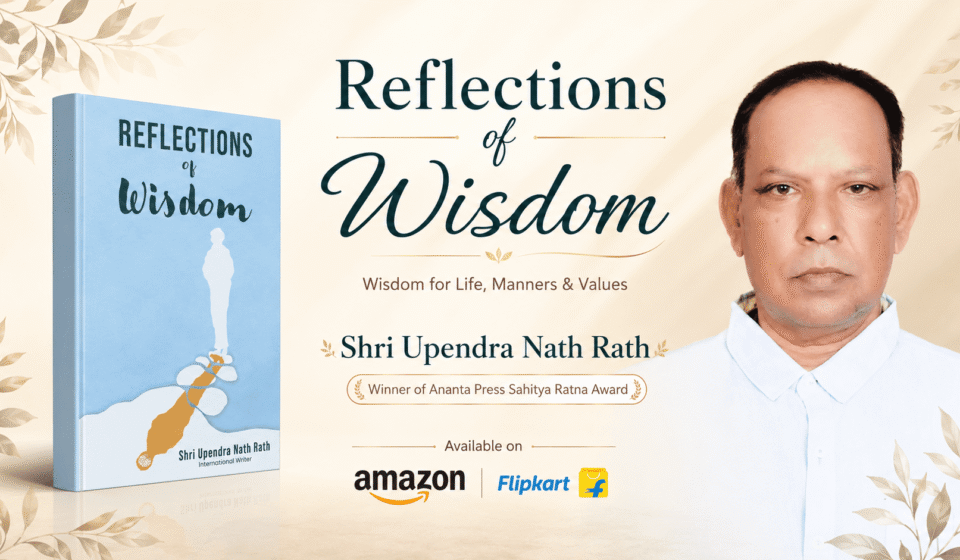

Reflections of Wisdom by Shri Upendra Nath Rath is a nonfiction work built around subjects that modern society often treats as secondary even though they shape almost every human interaction: manners, lifestyle, everyday conduct, healthy habits, and social behavior. Its value lies in bringing these subjects back to the center. The book invites readers to consider a basic but powerful idea: a good society is not created only by laws, institutions, or technology; it is also created by the quality of behavior practiced by ordinary people every day.
Manners are sometimes misunderstood as a collection of formal rules—how to sit, greet, dress, or speak in particular settings. But the deeper meaning of manners is respect. They reveal whether we acknowledge the dignity, time, feelings, and boundaries of others. In this sense, a book that reflects on manners is not dealing with something superficial. It is dealing with the social expression of character. Reflections of Wisdom becomes especially interesting when viewed through this lens because its other themes—healthy living, ways of living, and social behavior—are closely connected with the same question: what kind of person do our habits make us?
The book’s stated concerns also offer an important corrective to the highly individualistic language of much contemporary self-help. Personal development is often presented as a private project: become more productive, more confident, more successful, more efficient. These goals can be useful, but they can also become narrow if they ignore community. Reflections of Wisdom appears to widen the frame. It asks readers to think not only about how to live well for themselves but also about how to behave well among others.
That distinction matters. A person’s lifestyle affects family members. Communication style affects colleagues. Cleanliness affects shared environments. Emotional discipline affects relationships. Respect for time affects teams. Courtesy affects public spaces. Compassion affects vulnerable people. Environmental habits affect future generations. Seen this way, social behavior is not an optional addition to personal growth; it is one of the places where personal growth is tested.
Shri Upendra Nath Rath’s biography gives this theme unusual authenticity. He served for thirty-six years as an English teacher in Kendriya Vidyalaya, worked extensively in Scouts and Guides, conducted basic and advanced training programs, organized plantation initiatives, participated in cleanliness and anti-polythene campaigns, supported disadvantaged students, and contributed to community welfare. These activities show a long-standing concern with discipline, education, environment, and service. They also reveal a practical understanding of how values are formed in groups.
Scouting is particularly relevant to the spirit of this book. Scout traditions generally emphasize preparedness, service, cooperation, self-reliance, respect, and responsibility. An experienced Scout leader spends years observing how habits become character through practice. The author’s involvement in hundreds of training programs means that his interest in manners and social conduct is not detached from real life. It comes from environments where people must learn to work together, follow responsibilities, care for common resources, and serve others.
His teaching career adds another layer. Teachers witness human development at close range. They see how confidence grows, how discipline weakens or strengthens, how peer behavior influences students, how respect affects learning, and how small habits can shape academic and personal outcomes. A teacher who spends decades with young people is likely to develop a sensitivity to the difference between information and formation. Education is not only the transfer of facts. It also involves the development of judgment, responsibility, communication, and citizenship. Reflections of Wisdom seems well aligned with that broader philosophy of education.
The author’s academic qualifications in English, History, Political Science, Education, and Human Resource Development also suit a book about human conduct. English literature opens questions about character and human motive; history shows the consequences of collective behavior; political science examines civic structures and public life; education studies learning and development; and human resource management concerns people within organizations. These fields are different, yet all intersect around human relationships. The book’s focus can therefore be seen as the meeting point of many strands of the author’s lifelong interests.
One of the book’s most relevant themes is healthy lifestyle. Health today is widely discussed, but the conversation often becomes fragmented. Diet, exercise, sleep, mental health, digital habits, work pressure, environment, and social connection are treated as separate categories. In lived experience, however, they overlap. A person’s way of living creates patterns that can either support or weaken well-being. A reflective book can help readers examine those patterns without reducing health to a single technique.
The same is true of social health. Loneliness, incivility, mistrust, impatience, and constant conflict can affect well-being even when physical needs are met. Good manners, by contrast, create small forms of safety. A respectful greeting, an attentive conversation, a willingness to help, the ability to disagree without humiliation, or the habit of keeping shared spaces clean may appear minor, but societies are built from millions of such actions. Reflections of Wisdom gains significance because it takes everyday conduct seriously.
The author’s record of social service illustrates this seriousness. His activities have included plantation drives, cleanliness campaigns, cloth distribution, support to poor and destitute people, assistance to fire victims, and free teaching support for students in need. These acts move the idea of “good behavior” beyond etiquette. They suggest that the highest form of social behavior is participation in the welfare of others. Courtesy is important, but compassion is deeper. Discipline is important, but service gives discipline a social purpose.
Another striking element in the author’s life is his involvement in promoting peace and receiving international appreciation for that effort. Peace is often discussed at the level of nations, but it also begins at the level of behavior. Aggression, intolerance, humiliation, prejudice, and indifference all have everyday forms. Conversely, patience, fairness, dialogue, empathy, and mutual respect create the social conditions in which peace becomes possible. A book on manners and social conduct can therefore be read not merely as a personal guide but as a small contribution to a culture of peaceful coexistence.
This is one reason the book can be useful across generations. Young readers may encounter its ideas as guidance for forming habits. Middle-aged readers may use them to reassess routines hardened by responsibility and pressure. Senior readers may connect the reflections with experience and legacy. Teachers can discuss them with students; parents can use them to open family conversations; community leaders can apply them to collective life. The subject is universal enough to travel across age, profession, and background.
The book is also timely because social media has transformed public behavior. People communicate faster but not always better. Reactions are immediate, disagreements become performances, and attention is frequently divided. In such an environment, manners are not old-fashioned; they are urgently modern. Digital life requires new forms of patience, restraint, listening, and responsibility. Even when a book is not written specifically as a guide to online conduct, principles of thoughtful social behavior remain directly applicable.
Reflections of Wisdom stands out because it does not need sensationalism to justify its existence. Its subjects are foundational. A society may have advanced technology and still suffer from poor civic behavior. A person may have advanced qualifications and still lack courtesy. A household may have material comfort and still lack healthy routines. A professional may have status and still lack empathy. The book’s central territory is the gap between knowing and living—the difference between values we praise and values we practice.
A potential strength for readers is the reflective form implied by the title. Reflection allows space for self-correction without defensiveness. Instead of asking, “What is wrong with society?” a reader can ask, “What can I improve in my own behavior?” Instead of blaming younger or older generations, one can examine one’s own example. Instead of treating health as a future project, one can consider today’s routines. The book’s usefulness lies in turning broad social concerns into personal questions.
Shri Upendra Nath Rath’s rural upbringing and affection for nature also enrich this vision of the good life. Rural environments often make interdependence visible: people depend on land, seasons, animals, neighbors, and local cooperation. Whether or not one lives in a village, this awareness can challenge the illusion that human beings are completely independent. Healthy living is ecological as well as personal. Social behavior includes how we treat the environment as well as how we treat one another.
Ultimately, Reflections of Wisdom can be appreciated as a book about character in action. It suggests that wisdom is not merely the ability to speak intelligently; it is the ability to live responsibly. Manners are not decoration; they are respect made visible. Health is not simply the absence of illness; it is the cultivation of balanced habits. Social behavior is not performance; it is the daily practice of coexistence.
For readers interested in values-based nonfiction, education, personal growth, civic responsibility, and a more thoughtful way of living, the book offers a meaningful framework. Its uniqueness comes from the combination of personal well-being and social ethics. By bringing these together, Shri Upendra Nath Rath reminds readers that the quality of a life can be measured not only by what a person achieves, but also by how that person lives, relates, serves, and contributes.
Amazon / Purchase Link: https://share.google/vXOiJuSkHlGvVx2ny