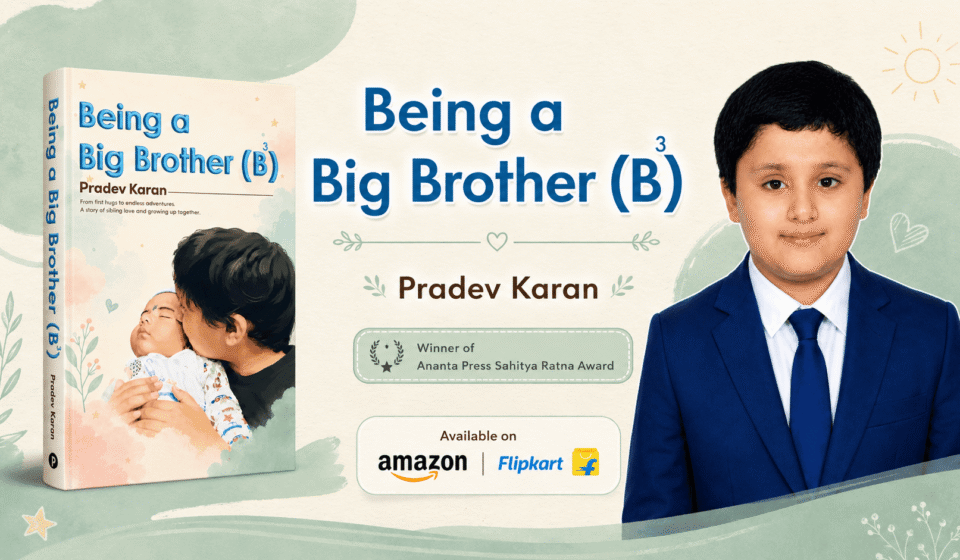

Being a Big Brother by Pradev Karan can be read as a touching account of sibling life, but its significance reaches much further. Beneath its memories, jokes, family adventures, and disagreements is a thoughtful exploration of emotional intelligence. The book shows how children learn to recognise feelings, manage reactions, understand another person’s needs, and accept responsibility within the intimate setting of a family. What makes this exploration compelling is that it is not delivered through theories or adult instructions. It is communicated through the honest observations of an eleven-year-old who is still learning these lessons himself.
Family is the first social world most children know. It is where they encounter love and security, but also sharing, waiting, compromise, conflict, disappointment, apology, and change. Becoming an elder brother intensifies all of these experiences. A younger sibling can bring excitement and tenderness while also changing familiar routines and expectations. Pradev’s book embraces that complexity. It does not reduce siblinghood to a cheerful slogan. Instead, it recognises that close relationships are meaningful precisely because they ask people to grow.
One of the book’s strongest qualities is its ability to place values inside recognisable situations. Kindness is not treated as an abstract virtue; it appears in acts of attention and care. Responsibility is not described merely as completing a task; it becomes part of understanding that another person may depend on you. Empathy grows through noticing a sibling’s emotions. Resilience appears when family members move beyond disagreement and continue to love one another. The book therefore has a natural educational value, but it avoids the stiffness that sometimes accompanies books written primarily to teach a lesson.
This balance is possible because Pradev writes from experience. A child narrator changes the relationship between the book and its audience. When an adult tells children how to behave, even good advice may sound like another rule. When a child shares how he felt, what happened, and what he learned, readers are more likely to feel companionship. The message becomes, “I have experienced this too,” rather than, “You must do this.” That difference gives Being a Big Brother its warmth and credibility.
The book is also valuable for parents because it encourages them to observe childhood from a different angle. Adults naturally focus on practical matters when a new baby enters the family: health, sleep, schedules, school, work, and household responsibilities. An older child, however, experiences the change emotionally. He may wonder what his new role means, whether attention will be divided, and how he should respond to a smaller person whose needs often come first. A book written by a young elder sibling helps parents remember that adjustment is not a single conversation but a gradual process. Children may understand family change through many small experiences rather than one clear explanation.
Another important theme is communication. The book’s emphasis on conversations, misunderstandings, disagreements, and shared memories suggests that healthy family relationships are not built by avoiding conflict. They are built by responding to conflict with honesty and care. This is an especially constructive message for children. Many young readers may assume that good families never argue, or that feeling angry means they are unkind. Pradev’s perspective offers a more realistic model: people who love one another can still disagree, and difficult moments can become opportunities for understanding.
The book’s humour is essential to this emotional balance. Childhood is not a continuous series of lessons. It is energetic, unpredictable, and frequently funny. By including playful episodes and family adventures, Pradev preserves the liveliness of his age. Humour prevents the book from becoming overly serious and reflects the way families often remember their most chaotic moments with affection. It also helps children engage with themes such as patience and responsibility without feeling burdened by them.
The sibling relationship at the centre of the book gives these themes a strong emotional anchor. Preetha is not simply a subject around whom lessons are organised; she is the inspiration for the entire work. The bond between brother and sister gives the book personal stakes. Pradev is reflecting on someone whose presence has changed him, challenged him, and expanded his understanding of love. This makes the book more than a collection of childhood anecdotes. It is a tribute to a relationship that is still developing.
Being a Big Brother also highlights an often-overlooked form of leadership. Children are usually introduced to leadership through positions such as class monitor, team captain, or competition winner. Pradev’s book suggests that leadership can begin at home. An elder sibling may lead by setting an example, offering reassurance, admitting mistakes, or showing patience. This is not leadership based on authority. It is leadership based on care. Such a message is particularly valuable because it allows children to see that they can contribute positively to others before they hold any formal role.
The author’s community engagement adds depth to this aspect of the book. His involvement with Positive Alliance Trust exposes him to ideas of human rights, education, child protection, and community wellbeing. Although Being a Big Brother remains personal and family-centred, the values of empathy and social responsibility are consistent with that wider environment. The ability to care for society often begins with the ability to care within close relationships. In this sense, the book’s domestic stories can be seen as the starting point of a broader ethical awareness.
The language and structure implied by the book’s description appear well suited to its audience. Simple storytelling is not the same as simplistic storytelling. Clear language allows emotional meaning to remain visible. Children can enter the narrative without struggling through complicated vocabulary, while adults can appreciate the honesty beneath the surface. This accessibility gives the book potential as a shared reading experience. A parent and child may read the same story and notice different things, then talk about them together.
The book could be especially useful in classrooms or reading groups focused on social-emotional learning. Teachers might invite students to write about a family memory, describe a time they learned to share, or reflect on how disagreements were resolved. Counsellors could use the book to help children discuss changes at home. Libraries could feature it in programmes celebrating young authors, family stories, or children’s nonfiction. Its practical usefulness grows from its relatability rather than from any formal workbook structure.
What makes Being a Big Brother unique is ultimately the combination of youth, honesty, and emotional purpose. Many books about sibling relationships are written for children, but far fewer are written by a child who is living the role he describes. That distinction matters. It allows readers to hear the hesitation, excitement, pride, and discovery of childhood without an adult narrator standing between them and the experience. The book’s truth is not that every sibling relationship looks the same, but that every child’s feelings deserve attention.
Pradev Karan has created a work that celebrates family without pretending family life is effortless. He presents growth as something that happens through love, mistakes, conversations, and repeated attempts to understand one another. The result is a warm and meaningful book for children, parents, educators, and anyone interested in the emotional lives of young people. Being a Big Brother reminds us that emotional intelligence is not learned only through formal instruction. It is learned at home, in real time, through the people we love most.
Purchase the book on Amazon: https://amzn.in/d/0bT3hytF