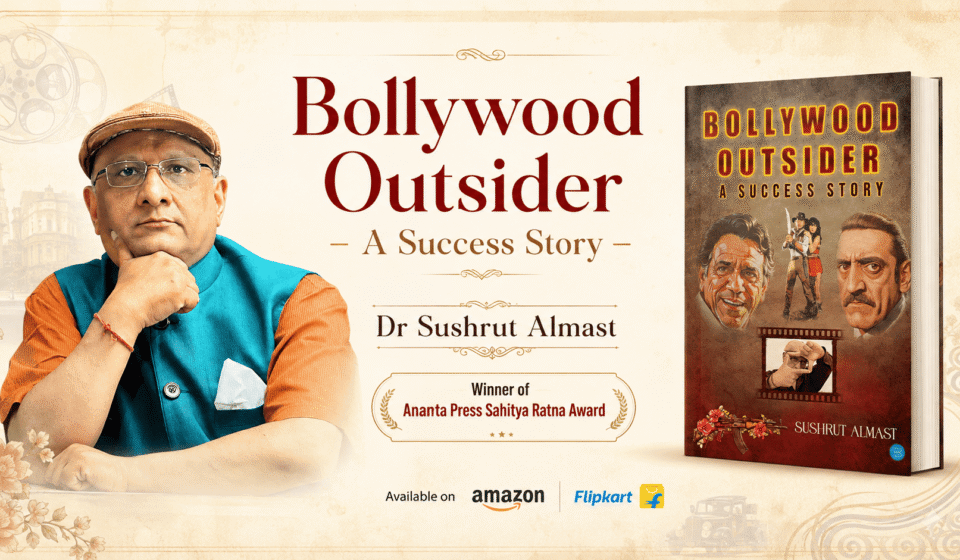

Bollywood Outsider – A Success Story can be read not only as an inspirational autobiography but also as a compact case study in creative entrepreneurship. At its centre is a difficult proposition: a medical professional with no established film-industry network chooses to produce a Bollywood film and then carries that project through years of uncertainty. The account of Vyakul, conceived in 1991 and renamed Nirnayak – The Decider in 1993, provides a practical framework for examining risk, reinvention, persistence, and delayed market acceptance. For readers interested in how projects survive beyond their original plans, this is the book’s most distinctive contribution.
Every independent production begins with a gap between vision and resources. An idea may be clear, but the people, finance, scheduling, distribution, and industry support required to realise it are rarely guaranteed. Dr Sushrut Almast’s story is especially instructive because he did not approach the industry from a protected position. He lacked the connections that often help a project secure attention or recover from setbacks. His outsider status meant that ordinary production challenges were intensified by the need to establish credibility. In entrepreneurial terms, he was entering a high-risk market with limited social capital. The book’s success narrative is therefore not merely about artistic confidence; it is about building momentum when the surrounding ecosystem offers little certainty.
The transition from Vyakul to Nirnayak – The Decider is a revealing moment. Renaming a film can be understood as a creative choice, but it can also represent strategic repositioning. A title communicates genre, mood, promise, and identity. The word “Nirnayak,” meaning decisive or determining, gives the project a stronger sense of action and consequence. It also retrospectively suits the producer’s journey, which depended upon repeated decisions made in the absence of guarantees. The rebranding demonstrates that commitment to a vision does not require rigidity in execution. A creator may preserve the core purpose of a project while changing the form through which it reaches the public.
The film’s years of delay make this lesson even clearer. A shelved production is not simply an artistic disappointment; it can become a financial, logistical, and emotional burden. Cast availability changes, market conditions shift, public taste evolves, and the creator’s own circumstances may become more complicated. Continuing to pursue release from 1991 through 1997–98 required more than enthusiasm. It required endurance, problem-solving, and a willingness to keep reassessing the project. This is where the book offers meaningful value to entrepreneurs and independent producers. It shows that perseverance is not passive waiting. It is the active management of obstacles over time.
The eventual theatrical release is presented as a box-office success, which gives the long struggle a satisfying outcome. Yet the most useful part of the narrative is not the victory alone. It is the relationship between uncertainty and decision-making. The book’s title identifies the author as an outsider, while the film’s title identifies the central importance of choosing. Together, those titles create a powerful idea: an outsider’s primary asset may be the ability to make committed decisions without relying on institutional reassurance. The decision to begin, rename, continue, release, and later preserve the film’s public life becomes the true architecture of the success story.
The presence of Om Puri and Amrish Puri further enriches the production case study. The supplied synopsis describes their appearance as a unique “Clash of Titans.” Bringing performers of such stature into a project led by an outsider suggests ambition and the capacity to secure meaningful collaboration. For aspiring producers, this is a reminder that credibility can be built through the seriousness of the project, the clarity of communication, and the persistence of the person leading it. A lack of inherited access does not eliminate the possibility of working with exceptional talent, though it may make the path far more demanding.
The film’s later digital popularity adds a second business lesson: intellectual and creative assets can gain new value when distribution technology changes. According to the supplied information, Nirnayak – The Decider has crossed sixteen million views on YouTube and holds a 7/10 IMDb rating. A film produced for theatrical circulation in the 1990s later found a substantial online audience. This demonstrates the importance of preserving and reintroducing work. A project’s initial commercial window may not be its final opportunity. Digital platforms can extend the lifespan of films, books, music, and other creative products, allowing them to reach viewers who were unavailable or too young during the original release.
In this respect, Bollywood Outsider – A Success Story is a book about asset longevity as much as personal resilience. The creator’s effort continues to generate recognition because the work remained available for rediscovery. For contemporary filmmakers, this is highly relevant. Production planning should not end at release; it should include preservation, platform strategy, audience renewal, and the possibility of future formats. The story illustrates that distribution is not a single event but an evolving relationship between content and technology.
Dr Almast’s professional background gives the book an unusual analytical dimension. His medical qualifications indicate years of structured study and disciplined practice, while his certifications and interests in finance suggest comfort with systems and risk. His work in Vedic astrology, leadership writing, media, and social organisations reflects curiosity across fields. This range helps explain the book’s entrepreneurial spirit. The author does not appear to divide life into sealed compartments. Instead, he brings knowledge from one domain into another. The diagnostic patience associated with medicine, the calculated judgement associated with finance, and the interpretive imagination associated with cinema all become parts of one professional identity.
The book may also encourage readers to reconsider the popular image of the entrepreneur. Entrepreneurship is often represented through technology companies, retail ventures, or rapid-growth businesses. Yet an independent film producer performs many of the same functions: identifying an opportunity, assembling a team, obtaining resources, managing uncertainty, communicating a vision, and delivering a product to an audience. Dr Almast’s filmmaking journey belongs within that broader definition. The book shows creative production as an enterprise in which emotional commitment and commercial discipline must coexist.
Importantly, the narrative does not imply that grit eliminates structural barriers. The industry remains difficult, and the supplied description openly acknowledges the low success rate of outsiders. That honesty protects the book from becoming a simplistic formula. Readers are not told that effort guarantees a hit. They are shown that without sustained effort, reinvention, and strategic persistence, a difficult project is unlikely even to reach the point at which success becomes possible. This distinction is essential. The book motivates by demonstrating agency, not by denying risk.
For film students, producers, founders, and project leaders, Bollywood Outsider – A Success Story offers several practical principles. First, professional identity can be expanded; expertise in one field does not forbid serious work in another. Second, a project may need to be reframed without being abandoned. Third, delays must be managed as operational realities rather than interpreted only as personal rejection. Fourth, collaboration with respected talent is possible when a project is pursued with credibility. Fifth, distribution channels change, so the long-term value of creative work may exceed its first release cycle.
The book’s final impact lies in the way it converts a personal achievement into a transferable model of thought. Readers may never produce a Bollywood film, but many will attempt something for which they lack conventional access. They may launch a company, publish a manuscript, change professions, build a social initiative, or introduce an unfamiliar idea into a resistant organisation. Dr Almast’s story offers them a durable question: what can still be done when the obvious route is closed? Bollywood Outsider – A Success Story answers through action. Reconsider the strategy, preserve the vision, make the next decision, and keep the project alive long enough to meet its audience.