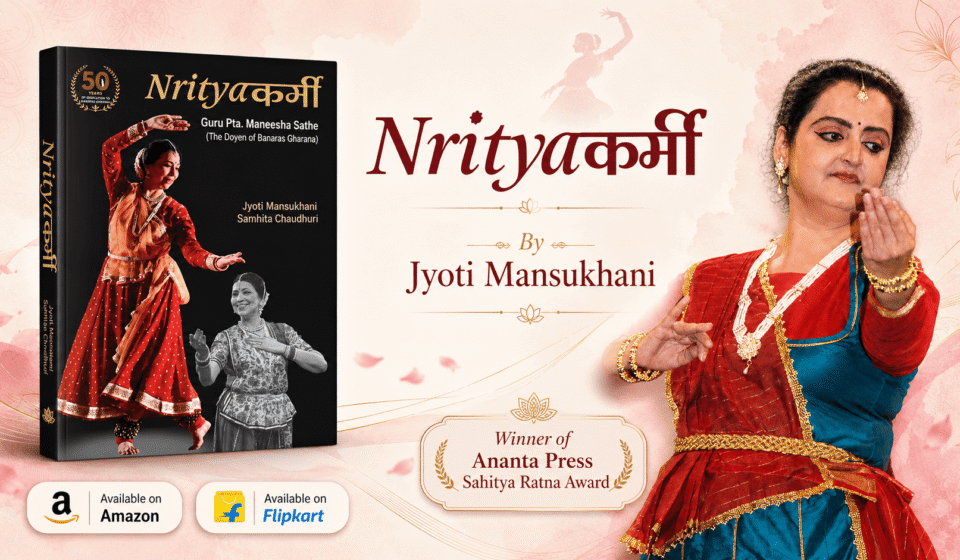

Nrityaकर्मी is a biography, but its most compelling feature may be that it refuses to treat a life as a solitary achievement. Jyoti Mansukhani, with co-author Samhita Chaudhury, has shaped the story of Guru Pta. Maneesha Sathe ji through a chorus of memories. The result is a narrative in which the central figure remains luminous, yet the many relationships around her are also given their rightful place. This approach is especially appropriate for a book about Indian classical dance, where knowledge is transmitted through human contact, observation, repetition, trust and the enduring Guru-Shishya relationship.
A conventional biography often places the subject at the centre and everyone else at the margins. Nrityaकर्मी appears to reverse that limitation by showing how an artistic life becomes visible through the people it has touched. The book’s three sections move from personal journey to professional relationships and then to students. This sequence is more than an editorial arrangement; it becomes an argument about legacy. An artiste first receives knowledge, then develops an individual voice, then works with a wider creative community, and finally transmits experience to future generations. Maneesha ji’s life is therefore presented not as a closed story of personal success, but as a continuing chain of artistic giving.
The first section establishes the foundation. It follows more than six decades, beginning with childhood and early training and continuing through the stages of performer, teacher, Guru and legend. The movement between these identities is crucial. Performance brings visibility, but teaching tests whether an artiste can translate instinct and experience into guidance. Becoming a Guru involves still more: the ability to nurture different personalities, preserve tradition without turning it rigid, and help students find authenticity rather than imitation. By charting this evolution, the book invites readers to consider the difference between mastering an art and becoming responsible for its future.
The photographs included throughout this section make the journey intimate. Images of parents and Gurus remind us that even the most accomplished artiste was once a child receiving encouragement and instruction. Solo performance photographs capture the public dimension of her art, while images with students reveal the shift from individual expression to shared inheritance. Family photographs add another layer, suggesting the personal world that exists alongside the demanding schedule of training, travel and performance. Together, these images transform the biography into a visual history of relationships.
The performance videos deepen this sense of transmission. A dance tradition is not completely contained in words. Its knowledge is carried in timing, posture, weight, eye movement, breath, expression and the precise relation between stillness and rhythm. By linking the written narrative to actual performances, the book enables readers to encounter the body as an archive. A student may notice technical details; a general reader may simply feel the intensity and grace. Both forms of viewing are valuable, because they demonstrate why the memories gathered in the book matter.
The second section is where Nrityaकर्मी becomes especially rich. Thirty-two write-ups from senior Gurus, artistes, musicians, technicians and associates offer distinct perspectives on Maneesha ji. The variety of contributors is important. A fellow dancer may observe her interpretation and stage presence. A musician may understand her command of rhythm and responsiveness to accompaniment. A technician may remember her professionalism and attention to presentation. A senior Guru may place her work within a larger historical lineage. Each perspective reveals a different dimension, and no single account is expected to carry the entire truth.
The inclusion of respected contributors such as Taalyogi Pt. Suresh Talwalkar ji, Pt. Rajendra Gangani ji, Pt. Jai Kishan Maharaj ji, Shama Bhate ji, Dr. Sucheta Chapekar ji and Pt. Nandkishore Kapote ji gives this section considerable depth. Yet prestige alone is not what makes the material valuable. The promise of “lovely anecdotes” suggests that readers will encounter living memories rather than ceremonial statements. A carefully remembered rehearsal, conversation or incident can illuminate character more effectively than a general compliment. The unique tagline attached to each piece also appears to guide readers towards its emotional or thematic centre.
This multi-voiced method protects the biography from becoming one-dimensional. Great artistes are often described through a small set of repeated words: disciplined, talented, dedicated, inspiring. Although such words may be accurate, they can become abstract. Personal recollections give them form. Discipline becomes visible in a rehearsal practice. Generosity becomes visible in an act of encouragement. Artistic courage becomes visible in a creative choice. Humility becomes visible in behaviour towards colleagues. Through these details, admiration becomes evidence-based and emotionally persuasive.
The third section, built around reflections from senior students representing different decades, gives the Guru-Shishya tradition its fullest expression. A student’s relationship with a Guru is complex. It can include reverence, fear, affection, frustration, gratitude, dependence and eventually maturity. Serious training demands correction and repetition, but it also creates a space in which a student learns how to listen, observe and persevere. Honest student accounts can therefore reveal not only what was taught but how learning changed the learner.
By choosing students from every decade, the editors avoid presenting legacy as a single frozen period. Teaching methods may adapt, students may come from changing social contexts and performance opportunities may evolve, yet certain core values can remain constant. The book seems to ask: What has Maneesha ji consistently given to her students across time? Perhaps it is technical grounding, perhaps rigour, perhaps confidence, perhaps an ethical understanding of art. The range of voices allows readers to discover patterns without erasing individual experience.
The phrase “strong pillars of Maneesha Nrityalaya” is particularly evocative. An institution is not sustained by a name alone. It lives because students internalise its values, support one another, perform, teach and remain connected. Their testimonies show that a school of dance is also a community. In that sense, Nrityaकर्मी documents not only the life of a Guru but the formation of a cultural family.
This emphasis on relationships makes the book relevant beyond Kathak. Readers from music, theatre, visual arts, education or even professional mentorship can recognise the broader questions it raises. What does a teacher leave behind? How is excellence communicated? How does discipline coexist with sensitivity? What creates loyalty across decades? How do institutions preserve values while allowing individual growth? The book’s subject is specific, but its emotional and educational concerns are universal.
Jyoti Mansukhani’s connection to the world of Kathak strengthens the authenticity of the project. She is not an external observer approaching the subject only through research. She has trained in Kathak, taught students, organised cultural programmes and worked for more than twenty years to encourage young dancers through Prerana Foundation. Her previous documentation project on Kathak maestros and her creation of platforms such as Ekal Nritya Utsav reveal a sustained interest in recognising Gurus and creating opportunities for the next generation.
Her personal relationship with Maneesha ji also gives the biography a special emotional foundation. Jyoti has described a bond built on love, care and mutual respect – a relationship that does not need a conventional label. She has watched Maneesha ji perform, attended workshops, listened to her talks and observed her work closely. The desire to document this life emerged from long attention rather than sudden opportunity. That distinction matters. A tribute created through years of observation is likely to notice small yet meaningful aspects of personality that formal research might miss.
The author’s own resilience adds another dimension to her understanding of discipline. Despite serious long-term health challenges, she continued teaching, choreographing, organising and contributing through dance. It would be inappropriate to equate two different life journeys, yet her experience may have sharpened her sensitivity to perseverance and commitment. She recognises that artistic continuity often depends on invisible effort, personal sacrifice and the refusal to allow adversity to silence purpose.
Nrityaकर्मी is unique because it treats biography as a shared act of remembrance. It gathers the voices of those who taught, collaborated with, accompanied, observed and learned from Maneesha ji. It respects the fact that no artistic life exists in isolation. The book’s photographs and videos further strengthen this communal archive, allowing future readers to see faces, moments and performances rather than relying only on summary.
As a reading experience, the book promises emotional variety. The first section likely inspires through the scale of the journey. The second offers admiration, humour, insight and professional memory. The third brings intimacy and gratitude. Together, they form a portrait that is both public and personal. Readers meet the legend, but they also meet the teacher, colleague, mentor and sensitive human being.
For anyone interested in the Guru-Shishya tradition, Nrityaकर्मी should be an important and rewarding book. It demonstrates that teaching is not a secondary chapter after performance; it is one of the greatest forms through which an artiste continues to live. Maneesha ji’s legacy emerges not only from what she has danced, but from the confidence, discipline and artistic consciousness carried forward by others. This is why the book stands out: it does not simply tell us that a legacy exists. It lets the legacy speak in many voices.