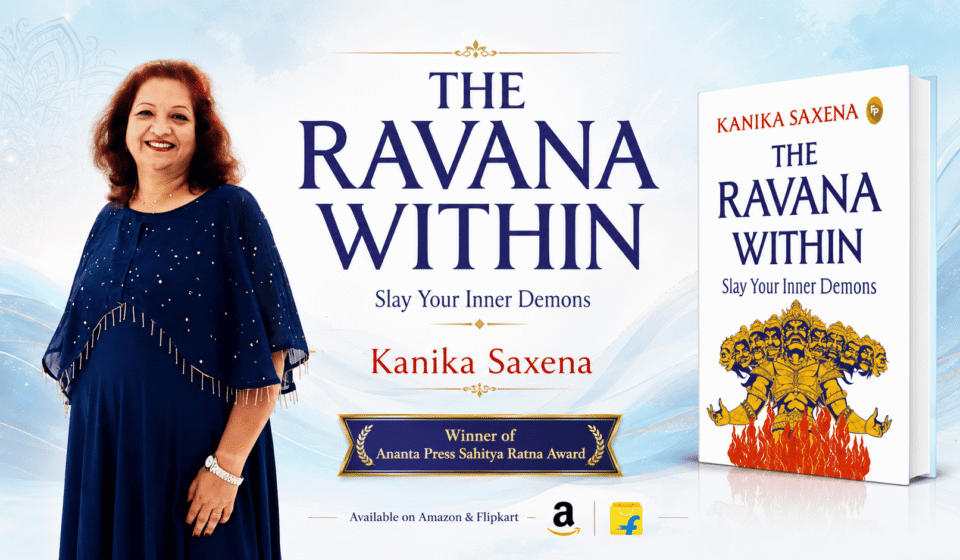

Indian epics remain relevant because their characters are never limited to a single era. They represent patterns of ambition, loyalty, doubt, duty, temptation, courage, and failure that continue to appear in modern life. The Ravana Within: Slay Your Inner Demons draws power from this timeless quality. Kanika Saxena does not present Ravana merely as the defeated king of Lanka or as a distant embodiment of evil. She interprets him as a symbolic map of the human shadow: the ego that refuses correction, the anger that seeks destruction, the greed that cannot recognise sufficiency, the jealousy that resents another person’s light, the procrastination that postpones growth, the self-doubt that reduces possibility, and the attachment that turns desire into bondage.
This reinterpretation is one of the book’s most original and engaging features. Ravana is a complex figure, remembered not only for wrongdoing but also for immense learning, devotion, power, and accomplishment. His tragedy lies in the fact that ability was not matched by self-governance. That makes him an ideal figure for a contemporary self-help book. Many people believe that knowledge alone will protect them from poor choices. Yet highly educated people can be ruled by ego. Successful people can be consumed by jealousy. Disciplined professionals can remain emotionally impulsive. Spiritually informed individuals can still be attached to status. Ravana’s story warns that external greatness cannot compensate for an undisciplined inner life.
The book’s title is therefore more than a dramatic phrase. “The Ravana Within” asks readers to abandon the comfortable habit of locating evil entirely outside themselves. Human beings naturally create moral distance: the arrogant person is someone else, the angry person is someone else, the greedy person is someone else. Saxena’s premise disrupts this distance. It suggests that destructive tendencies exist on a spectrum and that even respectable, well-intentioned people may express them in subtle ways. This does not equate ordinary flaws with epic wrongdoing; rather, it recognises that large consequences often begin as small, repeatedly unexamined impulses.
The ten-headed imagery traditionally associated with Ravana also lends itself naturally to psychological interpretation. A single person can contain multiple voices and contradictory drives. One voice seeks peace while another wants revenge. One wants to grow while another fears change. One values humility while another demands recognition. One understands what is right while another invents excuses. A book built around this image can help readers understand that inner conflict is not evidence of failure; it is part of being human. The important question is which voice receives authority.
The Ravana Within appears to approach this question through practical insight and self-reflection rather than through abstract philosophy alone. That balance is important. Mythological symbolism can be powerful, but without a connection to ordinary life it may remain inspirational rather than transformational. Relatable examples allow the reader to see the epic pattern in a meeting, a marriage, a friendship, a financial decision, a delayed project, or a moment of comparison. The battlefield becomes recognisable. The demon is not a supernatural creature; it is the thought that says, “I cannot admit I was wrong,” “I must prove that I am superior,” “I will begin tomorrow,” or “I cannot be happy until I possess what someone else has.”
This cultural and psychological bridge makes the book suitable for a wide audience. Readers who are deeply familiar with the Ramayana may appreciate the fresh application of its symbolism. Younger readers may discover that an epic character can illuminate modern emotional challenges. Readers who usually avoid self-help because it feels overly Western or corporate may find the Indian framework more intuitive. At the same time, the central ideas are universal enough to reach people beyond a specific cultural background. Ego, anger, greed, jealousy, delay, insecurity, and attachment are human experiences.
The book’s moral vision also deserves attention. It defines victory not as dominance over another person but as mastery over destructive impulses. This is a major correction to contemporary ideas of success. Much of public culture celebrates winning, visibility, influence, and superiority. People are encouraged to build a personal brand, defeat competition, acquire more, respond immediately, and display confidence even when they lack inner stability. The Ravana Within suggests that the more meaningful achievement may be invisible: pausing before an angry reply, apologising without defensiveness, celebrating another person’s success, completing an avoided task, releasing a harmful attachment, or acting despite self-doubt.
Such victories may not attract applause, but they change the quality of a life. An individual who conquers the need to win every argument becomes easier to love and work with. A person who manages jealousy can learn from others rather than resent them. Someone who reduces procrastination creates evidence of personal reliability. A reader who questions greed can discover contentment without abandoning ambition. These are not dramatic miracles; they are shifts in character. The book’s epic metaphor gives dignity to these quiet acts of self-mastery.
Another meaningful aspect is that the book does not appear to ask readers to hate or violently suppress parts of themselves. “Slaying” an inner demon can be understood as ending its control, not denying its existence. Anger, for instance, can signal that a boundary has been crossed. Ambition can energise effort. Attachment can begin in love. Self-doubt can encourage preparation. Problems arise when these experiences become disproportionate, unconscious, or dominant. A mature self-help framework does not divide the personality into acceptable and unacceptable parts; it helps the reader understand, regulate, and redirect emotional energy.
Kanika Saxena’s life journey adds another layer to the book’s integration of tradition and modernity. Trained as an instrumentation engineer, she worked in teaching, industry, consultancy, and marketing before stepping away from a flourishing career to raise her children. Years later, she restarted professionally with limited computer skills and uncertainty about where she belonged. Through persistence, she entered content writing, became a team leader, moved into freelancing and technology writing, earned life-coaching certification, launched a YouTube channel, and built a body of self-help writing. Her path crosses several identities that modern Indian women often negotiate: professional, mother, learner, homemaker, creator, and public voice. This experience can deepen her understanding of inner conflict, reinvention, and responsibility.
The fact that The Ravana Within followed several self-published self-help books and was brought out through a traditional publishing route also suggests an evolution in the author’s craft and ambition. The book’s central metaphor is strong enough to support not only motivation but sustained reflection. It invites readers to revisit an epic figure with new eyes and, more importantly, to revisit themselves.
The Ravana Within is likely to appeal to readers who enjoy books that combine cultural wisdom with direct personal application. It offers a way to read mythology not as a finished story about someone else’s defeat, but as an ongoing warning about the misuse of human potential. Ravana’s downfall becomes relevant whenever talent is weakened by ego, knowledge by arrogance, desire by greed, or power by lack of restraint. The book’s enduring question is therefore not, “Who is the villain?” but “Which tendency within me is making choices today?”
That question gives the book its force. It turns an ancient narrative into a living practice of self-awareness. In doing so, The Ravana Within reminds us that epics survive not because their battles are spectacular, but because their battles continue inside us.
Buy the book on Amazon: https://amzn.in/d/0cVDtzND