
A Gentle Journey from Emotional Pain to Inner Peace
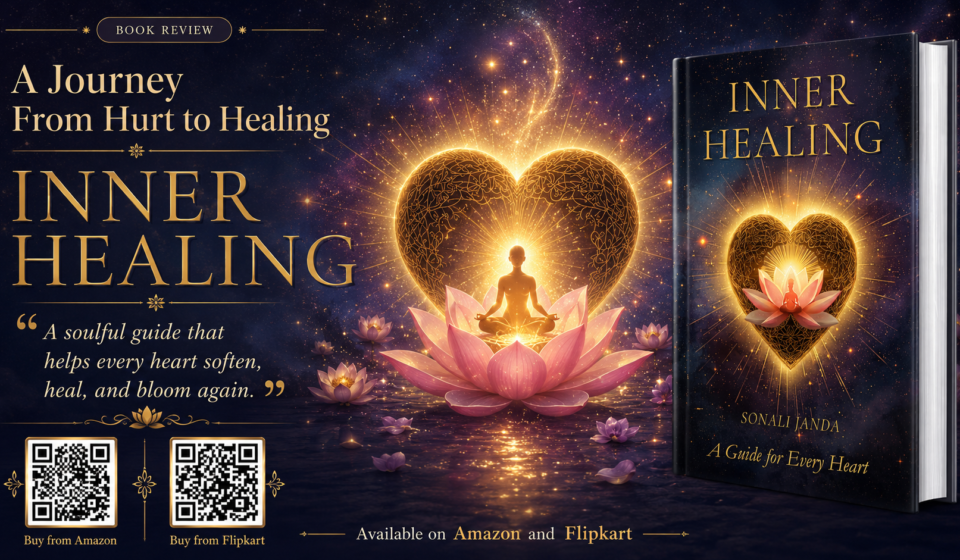
Many people appear strong, cheerful and completely in control of their lives, yet silently carry emotions they have never fully understood. Unspoken grief, childhood rejection, broken trust, guilt, fear and unmet expectations often remain hidden beneath everyday routines. They may not always be visible, but they influence how a person thinks, reacts, communicates and forms relationships. In Inner Healing — A Guide for Every Heart, author Sonali Janda creates a compassionate space for readers to recognise these hidden wounds and begin understanding their emotional world.
Published by Ananta Press, the book explores emotional awareness, acceptance, forgiveness, inner-child healing, self-love, personal boundaries, life purpose and emotional balance. Instead of presenting healing as a quick solution, Janda describes it as a gradual process of listening to oneself, recognising recurring patterns and responding to pain with greater awareness.
The emotional foundation of the book becomes clear from its deeply personal dedication to the author’s late eldest brother, Subedar S. Baldev Singh. She remembers him as her protector, guide and one of the strongest supporters of her dreams. His courage, affection and belief in her became an important source of inspiration behind the completion of this book. This personal beginning establishes the sincerity of the work. The author is not writing about pain only as an observer; she writes as someone who has experienced grief, change, responsibility and spiritual transformation.
Understanding Rather Than Suppressing Emotions
One of the strongest ideas in Inner Healing is that emotions are not enemies. Anger, sadness, fear and disappointment are not signs of weakness; they are signals carrying information about what is happening within us.
From childhood, many people are repeatedly told to stop crying, remain strong or forget painful experiences. Though such advice may be well-intentioned, it can teach individuals to hide their feelings instead of processing them. According to the book, suppressed emotions do not disappear. They often return in the form of overthinking, anxiety, anger, exhaustion, emotional numbness or conflict in relationships.
Janda encourages readers to pause and ask a simple question: “What am I feeling right now?” This may appear like a small exercise, but it represents the book’s central philosophy. Healing begins when people stop running away from their feelings and start observing them without judgement.
The language throughout the book is simple and reassuring. The author does not overwhelm readers with complex psychological vocabulary. Instead, she uses familiar situations, reflective questions and everyday analogies. The comparison of suppressed emotions to pressure building inside a pressure cooker is especially effective. It demonstrates how emotional tension can continue accumulating until it appears through anger, withdrawal, restlessness or burnout.
Finding the Root Beneath the Reaction
The book goes beyond identifying emotions and asks readers to investigate where those emotions come from. A present-day reaction may actually be connected to an older experience of rejection, comparison, abandonment or emotional neglect.
A person may become extremely upset when ignored because being overlooked awakens an earlier wound. Someone may fear failure because they were constantly compared with others as a child. Another person may demand frequent reassurance because affection once felt uncertain or conditional.
The author explains that our strongest reactions are not always responses to the current event alone. Sometimes we are unconsciously reliving the past. This observation becomes one of the most valuable parts of the book because it helps readers move away from self-criticism. Instead of asking, “Why am I so emotional?” they can ask, “When did I first experience this feeling?”
The chapters on emotional patterns and the inner child are particularly relatable. Through fictional examples involving people such as Neha, Rohit, Simran and Ankit, the author shows how childhood experiences can influence adult behaviour. These examples make abstract emotional ideas easier to recognise in real life.
The inner-child section does not merely describe wounds; it also offers a process for reconnecting with one’s younger self. Readers are encouraged to visualise their childhood version, listen to what that child needs and offer the safety, understanding and encouragement that may have once been missing. Journaling, meditation, emotional expression and compassionate self-talk are presented as ways to begin this process.
Acceptance and Forgiveness as Forms of Freedom
Acceptance and forgiveness are two major pillars of the book. However, the author carefully explains that acceptance does not mean approving of everything that has happened. It means acknowledging reality instead of wasting emotional energy fighting what cannot be changed.
This distinction is important. People often believe that accepting a painful situation means becoming passive. Janda presents acceptance differently: as the point from which a person can think clearly, make decisions and move forward. Resistance repeatedly asks why something happened; acceptance asks what can be learned and what should happen next.
The discussion of forgiveness is equally balanced. Forgiving someone does not mean returning to an unsafe relationship, removing boundaries or pretending that wrongdoing was acceptable. The book separates forgiveness from reconciliation. Forgiveness is described as an inner decision to stop allowing resentment to control one’s present life. Reconciliation, on the other hand, requires accountability, changed behaviour, trust and emotional safety.
This is one of the book’s most responsible messages. It prevents forgiveness from being presented as an obligation to tolerate repeated disrespect. A reader may release anger while still maintaining distance. In this sense, forgiveness becomes an act of self-liberation rather than permission for another person to hurt them again.
The section on self-forgiveness is also meaningful. People frequently carry guilt about decisions made with the limited understanding they had at the time. The author asks readers to learn from mistakes without allowing those mistakes to become their permanent identity.
Letting Go, Self-Love and Healthy Boundaries
The image of emotional baggage appears throughout the book in a practical and memorable way. Every unresolved argument, regret, betrayal or painful memory adds weight to the emotional load a person carries. Eventually, even ordinary life begins to feel exhausting.
Janda makes a helpful distinction between giving up and letting go. Giving up can arise from helplessness, while letting go may be an act of self-respect. Letting go means recognising that continuing to hold a painful memory, person or expectation is causing more harm than release would.
The chapter on self-love avoids reducing the idea to appearance, luxury or temporary comfort. Here, self-love is shown through daily decisions: saying no when necessary, protecting one’s time, resting without guilt, leaving unhealthy conversations and refusing to continuously seek approval.
The boundary-setting scripts included in the book are practical because they demonstrate that boundaries do not always require long explanations. Simple statements such as “I am not comfortable with this” or “I need some time to think” can help people communicate their limits without unnecessary confrontation.
The author also acknowledges that others may initially resist new boundaries. A person who was always available, agreeable or willing to compromise may be accused of changing. The book reminds readers that this reaction does not automatically mean the boundary is wrong. Sometimes people are uncomfortable because they no longer have unrestricted access to someone’s time and energy.
Rebuilding the Relationship with Yourself
Among the book’s most powerful messages is the idea that the first relationship requiring healing is often the relationship we have with ourselves.
People may spend years searching for reassurance, affection and validation from others while remaining disconnected from their own emotions. The author shares how closing her boutique after fifteen years did not automatically provide the peace she expected. External circumstances changed, but confusion and emptiness remained. This became a turning point in her understanding that the deeper work had to happen within.
Her personal journey includes Reiki, meditation, Rajyog, life skills, NLP and the study of spiritual texts. These influences shape the book’s approach, which combines emotional reflection with spiritual awareness. The author’s focus is not solely on analysing pain but on helping readers reconnect with their inner voice.
The book recommends simple self-connection practices: sitting quietly without a phone, writing honestly, identifying emotional needs, spending time alone and celebrating small progress. Solitude is presented not as loneliness but as an opportunity to hear thoughts that are usually hidden by constant noise and distraction.
Healing, Purpose and Balanced Energy
As the book progresses, its focus expands from emotional recovery to purposeful living. Healing is not presented merely as freedom from pain; it is also a preparation for a more meaningful life.
The chapter on purpose offers three useful questions: What activity makes you lose track of time? What life experience could help another person? What would you choose if fear did not exist? The author reminds readers that purpose does not always require fame, status or a large audience. Supporting a family, teaching a child, creating comforting art or listening to someone who feels alone can also be meaningful forms of purpose.
The exploration of feminine and masculine energy adds a spiritual dimension. Janda clarifies that these energies are not restricted by gender. Feminine energy represents qualities such as intuition, compassion, creativity and emotional connection, while masculine energy represents direction, discipline, action and protection. The author argues that a balanced life requires both: the ability to feel and the courage to act.
The final chapters bring the book’s lessons together through affirmations, reflection exercises and a self-assessment covering emotional awareness, confidence, stress management, boundaries, forgiveness, resilience and inner peace. Healing is described as a spiral rather than a straight line. The return of an old feeling does not necessarily mean failure; it may be an invitation to respond with deeper awareness than before.
Final Verdict
Inner Healing — A Guide for Every Heart is an accessible and emotionally supportive book for readers who want to understand their feelings, release past burdens and develop a healthier relationship with themselves. Its greatest strength lies in its warmth. The author writes like a compassionate companion rather than a distant instructor.
The book is especially suitable for readers beginning their journey of emotional self-awareness. Its journaling prompts, meditations, affirmations, relatable stories and practical boundary-setting suggestions make it interactive rather than purely theoretical. Readers can pause after each chapter and apply its questions to their own lives.
Because the work draws strongly from personal experience and spiritual healing traditions, it should be approached as a reflective self-help guide rather than a replacement for professional mental-health support. Readers facing severe trauma or persistent psychological distress may need qualified clinical care alongside personal reflection.
Ultimately, the book offers a hopeful reminder: healing does not require erasing the past or becoming an entirely different person. It begins with listening, accepting and returning to the self that pain may have temporarily hidden. Through awareness, forgiveness, boundaries and purpose, Sonali Janda encourages readers to stop abandoning themselves and begin becoming a safe home for their own hearts.