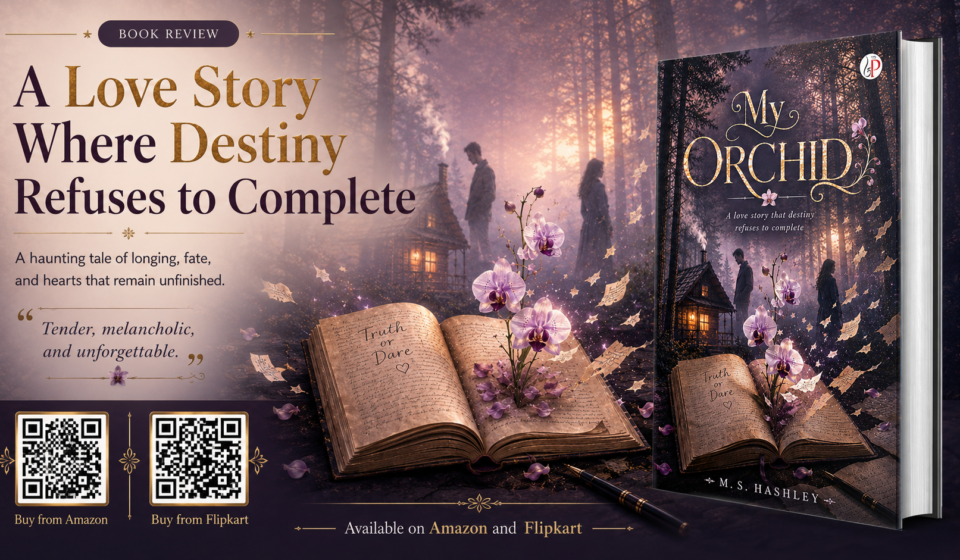
When Love Becomes Memory: Exploring Healing, Friendship and Sacrifice in My Orchid

Spoiler warning: This review discusses important events from the complete novel.
M.S. Hashley’s My Orchid: A Love Story That Destiny Refuses to Complete begins as the story of a young man recovering from a breakup, but gradually transforms into a broader exploration of love in its many forms. Romantic love is certainly important to the novel, yet the narrative is equally concerned with friendship, parenthood, family loyalty, emotional neglect, creative ambition and the memories people carry after relationships end.
The novel follows Hardhik, an aspiring writer whose understanding of love is initially shaped by ego, expectation and emotional immaturity. When his relationship with Sana ends, he believes that she has failed him by refusing to prioritise his dreams. His frustration is understandable: Sana dismisses his desire to become an author and expects him to participate in her family business. However, Hardhik is also unwilling to communicate without keeping score. He wants Sana to make the first move because he has grown tired of being the person who compromises.
Rohan, known as Ro, asks Hardhik to consider whether he truly loves Sana or merely loves the idea of having her in his life. The question appears simple, but it becomes central to everything that follows.
Ro is Hardhik’s maternal uncle, guardian and best friend. Hardhik’s mother died during childbirth, and his father later moved abroad for work. Ro therefore becomes the person who raises him, protects him and provides the emotional security that his circumstances might otherwise have denied him.
Their relationship gives the novel its deepest emotional foundation. Although the title refers to Hardhik’s romantic partner, the narrative repeatedly demonstrates that Ro is also one of the great loves of Hardhik’s life. This is not romantic love, but a familial attachment so powerful that Hardhik cannot imagine choosing a future that requires him to abandon Ro.
The generational parallel between Hardhik and Ro gives the novel its structure. Hardhik is beginning to discover love, while Ro has spent years living with the consequences of losing it. Ro once loved Lavanya, a visually impaired woman whose intelligence and independence immediately challenged his prejudices. Their relationship began through a competition, grew through collaborative work and eventually developed into an intimate partnership.
Lavanya’s disability is not presented as the only defining feature of her character. She is inventive, ambitious and capable of building an enterprise despite social and financial obstacles. She uses assistive technology, travels independently and creates a successful professional life. Ro admires her not because he pities her, but because her determination reveals the strength of her character.
At the same time, Ro changes his habits for her. He stops smoking because it affects her breathing and avoids alcohol after learning about her painful experiences with her father. Importantly, Lavanya does not force him to make these changes. Ro’s love gives him a reason to transform himself.
Through Ro, the novel distinguishes sacrifice from self-destruction. His decision to change harmful habits is positive because it makes him healthier and more considerate. His later decision to leave Lavanya, however, is more complicated. Believing she would be happier with Pratap, Ro removes himself from her life without asking what she wants.
He even accepts false rumours that he stole from the company because he would rather damage his own reputation than allow people to accuse Lavanya of exploiting him. The sacrifice appears noble, but it is also based on an assumption. Ro tries to decide Lavanya’s future on her behalf. In attempting to protect her, he denies her the freedom to choose him.
This tension between selfless love and unnecessary martyrdom runs throughout My Orchid.
Hardhik’s connection with Orchid develops through a mysterious diary discovered in a cabin in the woods. This device gives the romance an old-fashioned charm. Orchid leaves puzzles, literary clues and deeply personal questions. Hardhik responds in writing, and the two gradually reveal experiences they have hidden from everyone else.
The diary is more than a playful romantic instrument. It represents a form of communication that demands attention. Unlike a digital message, a handwritten answer cannot be interrupted by notifications or deleted immediately out of embarrassment. The physical page preserves hesitation, awkwardness and emotional truth.
Both Hardhik and Orchid are writers, and both turn towards stories after losing close friends. Their creative lives emerge from emotional fractures. Hardhik begins writing after an unresolved conflict with a best friend leaves him isolated. Orchid writes Drifting Away after her friendship with Maria collapses. Their books contain the feelings they cannot express directly to the people who hurt them.
The novel therefore presents authorship as an act of survival. People write because pages are often more patient than human beings. A page does not interrupt, misunderstand or walk away. It allows the writer to transform confusion into language.
Orchid is especially affected by emotional neglect. Her parents are successful, but she feels that they have rarely paid attention to the things that matter to her. She wants them to read her unpublished novel because their validation is more important than public recognition. When they fail to do so, she loses confidence in her work.
Hardhik becomes the first person she trusts with the manuscript. By reading it carefully and recognizing the person behind it, he offers her what she has always desired: not admiration without understanding, but attention.
This need to be understood explains Orchid’s attraction to the name Hardhik gives her. The letters hidden within his sequence of gifts spell “My Orchid.” The gesture proves that he has listened, planned and communicated through details. To someone whose desires have often been ignored, this attentiveness becomes a form of love.
Their relationship does not begin without resistance. Orchid is terrified of romantic attachment because her friendship breakup has already damaged her mental health. She assumes that if losing a friend caused so much pain, losing a partner would be unbearable. Her fear reveals a realistic consequence of emotional trauma: people sometimes reject happiness not because they do not want it, but because they cannot trust it to remain.
Hardhik persuades her to consider the cost of allowing the past to dictate the future. His sudden proposal is impulsive, but it also reflects the youthful intensity of their connection. Orchid accepts because marriage appears more permanent and secure than the uncertain category of a relationship.
The revelation that Orchid is Lavanya’s daughter brings the novel’s two emotional timelines together. Hardhik’s new love becomes inseparable from Ro’s old heartbreak. He immediately assumes that he must choose between them. His decision to choose Ro reveals the depth of their familial bond, but Ro refuses to accept the sacrifice and leaves.
At this point, the story raises one of its most significant questions: should romantic love require us to replace the people who already form our emotional foundation?
Orchid’s answer is no. She never asks Hardhik to reduce his love for Ro. On the contrary, she encourages him to call Ro, bring him home and involve him in their future. Her maturity lies in recognising that love is not always a competition for first place. Different relationships meet different needs, and a healthy partner does not demand the destruction of an existing bond.
This is why Orchid’s final sacrifice is both consistent with her character and deeply painful. When a truck is about to strike Ro, she pushes him aside and receives the fatal impact herself. In her final moments, she explains that Hardhik seemed only half alive without Ro. She believes that Ro completes a part of him that she cannot replace.
Her death is undeniably melodramatic, but it completes the novel’s pattern of sacrifice. Ro gives up Lavanya because he believes Pratap can give her a better life. Hardhik is prepared to give up Orchid because he cannot abandon Ro. Ro walks away so that Hardhik can choose Orchid. Finally, Orchid sacrifices herself to preserve Hardhik’s bond with Ro.
However, the novel does not present every sacrifice as equally wise. Ro’s sacrifice creates decades of unnecessary grief because it is based on silence. Orchid’s sacrifice occurs in an immediate life-or-death situation. One is a choice made without communication; the other is an instinctive attempt to save someone.
Even so, Orchid’s death leaves guilt behind. Ro believes he has now hurt Lavanya twice: first by leaving her and later by surviving at the cost of her daughter. Hardhik loses the woman he was preparing to marry. Lavanya loses a child connected to the man she once loved. Their lives become entangled through grief as completely as they were once connected through love.
Orchid reveals her real name, Hrishika, only moments before her death. The timing gives the revelation enormous symbolic power. Throughout the novel, “Orchid” is the identity through which she chooses to be known by Hardhik. Hrishika is her social identity, but Orchid is her emotional self—the writer, dreamer and wounded young woman who communicates through secret pages.
By finally sharing her name, she offers Hardhik the last hidden part of herself. The revelation also shows that she wanted their relationship to continue beyond mystery and symbolism. She was ready to be fully known.
The aftermath avoids presenting grief as something that disappears quickly. Hardhik and Ro mourn together and become each other’s sources of strength. Ro adopts a child, suggesting that he has begun to accept Orchid’s advice about allowing memories to become treasures rather than punishments. He also meets Lavanya again, bringing some emotional closure to a love story that remained unresolved for years.
Hardhik publishes his book under his own name and dedicates the first copy to Orchid. His achievement is bittersweet because she is not physically present to witness it. Yet her influence remains visible in the author he becomes.
The novel’s language is direct, conversational and emotionally expressive. Humour, teasing and casual exchanges make the relationships accessible. At times, the narrative repeats emotional ideas or depends heavily on coincidence. Some transitions could be smoother, and a more rigorous edit would sharpen the pacing and dialogue. The final accident may feel sudden to readers who prefer quieter or more realistic conclusions.
Nevertheless, the story succeeds in making its central relationships emotionally meaningful. Ro is not simply a supporting character, Lavanya is not merely a past lover, and Orchid is not only a tragic heroine. Each person changes the meaning of love for someone else.
My Orchid argues that the value of a relationship cannot be measured only by its duration. Some relationships end before promises are fulfilled, yet they permanently alter the lives of those involved. Hardhik does not receive the married life he imagined, but Orchid helps him become more honest, attentive and courageous. Ro does not marry Lavanya, but his love contributes to the life she builds. Lavanya does not forget Ro, but she continues moving forward.
The book’s most enduring message appears in its treatment of memory. Memories can become prisons when people use them to punish themselves. They can also become treasures when they are carried with gratitude. Healing does not require forgetting the person who left. It requires learning how to live without turning their absence into the end of one’s own life.
For readers drawn to emotional romance, friendship-breakup narratives and stories about unfinished love, My Orchid offers a highly sentimental and thought-provoking experience. It asks whether love is possession, sacrifice, transformation or remembrance—and ultimately suggests that it may be all four.
Destiny refuses to complete Hardhik and Orchid’s love story, but the novel refuses to call their relationship a failure. Their forever is not measured in years. It survives through a book, a dedication, a family brought back together and the memories of a young woman who taught others how to love without asking them to erase the people they already loved.